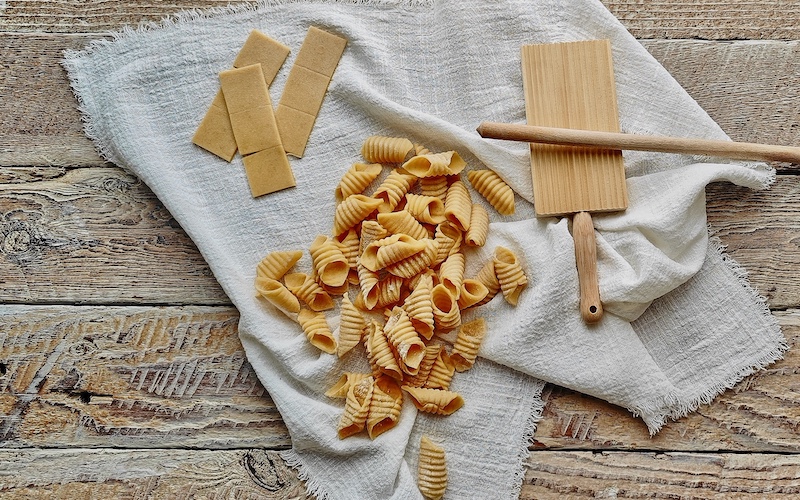
Fresh pasta is easy to make at home without a machine or any special equipment. Add a few simple implements such as a gnocchi board and piece of wooden dowel and the variety of fresh pasta shapes you can make increases – and if you have a pasta machine, they’re almost endless.

Fresh pasta from more affluent northern Italy, such as garganelli, usually contains egg.

While fresh pastas from the south – such as Sardinian cicciones and Puglian orecchiette – are usually made without egg.

Gnocchi is a special type of fresh pasta as is the passatelli of Romagna and Marche and even Swiss spätzli.

A pasta machine and the correct attachments make it simpler to create long pasta shapes like tagliatelle – though with a little practice and a sharp knife it’s easy to cut these by hand.

Some pasta shapes, like spiralli, require a machine with an extruder attachment.

To make fresh pasta you’ll need:

  • plain (all-purpose) flour
  • coarse semolina, for dusting (often labelled just ‘semolina’)
  • a large tray

For some pasta shapes you’ll also need:

  • eggs (for northern-style pasta)
  • gnocchi board
  • thin wooden dowel
  • blunt knife, such as a butter knife
  • sharp cook’s knife (for making long pasta by hand)

Follow these simple tips for making fresh pasta. 

  1. A wooden surface is best for making pasta as it absorbs any excess moisture which minimises the need to dust with extra flour to prevent sticking.
  2. Most northern Italians prefer finely milled Tipo 00 flour for making egg pasta as it gives the most tender result, though regular all-purpose flour can be substituted if necessary.
  3. For egg-free southern Italian pasta, a harder wheat flour is used for a chewier texture. Durum wheat flour (semola rimacinata di grano duro) is popular, sometimes blended with Tipo 00, and baker’s flour (which is also made from a harder wheat variety) can be substituted.
  4. If a pasta recipe includes water it’s impossible to say exactly how much will be needed, as it depends on a number of factors such as the humidity – so hold a little back and then add a little at a time to achieve the right consistency.
  5. An electric mixer fitted with a dough hook is the easy way to knead fresh pasta dough.
  6. Pasta dough is easiest to work with if it’s been rested for half an hour or more so the gluten in the flour relaxes. It can be made a day ahead and refrigerated overnight before being shaped.
  7. If using flour to roll out pasta dough, use as little as possible to avoid changing the ratio in the recipe.
  8. While working with one piece of pasta dough, keep the remainder covered with a clean, dry tea towel so it doesn’t dry out.
  9. If using a pasta machine, start on the widest setting and pass the dough through each consecutively narrower setting to ensure it becomes supple and doesn’t tear.
  10. To dust the tray or board where shaped pasta is resting, ideally use coarse semolina (called semola in Italian and often just ‘semolina’ in English), as most of it can easily be dusted off before cooking. 
  11. Shaped fresh pasta can be left covered with a clean, dry tea towel on a semolina-dusted tray at room temperature for several hours before cooking.
  12. Fresh pasta dough freezes well when vacuum-packed.

Scroll down for detailed recipes, a step-by-step video, and comprehensive FAQ.

Share page on:

How To Make Fresh Egg Pasta

Fresh Pasta FAQ

Is fresh pasta better than dried pasta?

Dried pasta (typical of southern Italy) and fresh pasta (more common in northern Italy) are both good products – they’re just made differently and traditionally served with different sauces. Fresh pasta is typically made with soft wheat flour (often Tipo 00) and, in northern Italy, eggs — giving it a tender, silky texture. Dried pasta is made from hard durum wheat, giving it the firmer bite needed to hold al dente texture.


Why isn't fresh pasta cooked al dente?

Al dente – meaning literally ‘to the tooth’, in other words with some ‘bite’ or resistance – relies on the firm structure of hard durum wheat, which fresh pasta doesn’t contain. Made with flour from softer wheat varieties, fresh pasta is said to be cooked ‘until tender’ as it won’t achieve the firm resistance of al dente dried pasta.

Do I need a pasta machine to make fresh pasta?

No – you can make many fresh pasta shapes with just your hands. Others can be formed using just a gnocchi board, thin wooden dowel, knitting needle or a blunt knife. A pasta machine just makes long shapes like tagliatelle quicker to cut – and a few shapes, like spiralli, need a machine with an extruder attachment.

What flour is best for making fresh pasta?

It depends on the style. Northern-style egg pasta is best made with Tipo 00, finely milled soft wheat flour, for a tender result – though all-purpose flour works as a substitute if needed. Southern-style egg-free pasta calls for a harder wheat flour for a chewier bite — durum semolina flour (semola rimacinata di grano duro) is traditional, sometimes blended with Tipo 00, with baker’s flour as a workable substitute.

Do I need eggs to make fresh pasta? Can I make egg-free fresh pasta?

It depends which region the pasta is from. Northern Italian fresh pasta, such as garganelli and tagliatelle, contains egg, while southern-style pasta such as Sardinian cicciones and Puglian orecchiette are egg-free.

Why does my pasta dough keep tearing?

Two common causes: not resting the dough long enough for the gluten to relax before rolling or moving through a pasta machine’s settings too quickly rather than narrowing gradually.

Can I make fresh pasta ahead of time?

Yes. Shaped pasta can rest, covered, on a semolina-dusted tray at room temperature for several hours before cooking, or the dough itself can be made a day ahead and refrigerated overnight before shaping. Fresh pasta dough also freezes well vacuum-packed.

Share page on:

What Other Travellers Say

Janet (Tamworth, NSW, Aus.)
Just back from the most amazing trip to Emilia-Romagna with Roberta. Not only the home of Prosciutto di Parma, Parmigiano-Reggiano & Balsamic Vinegar, but scenery to die for and more quaint and exciting restaurants and cafés than you ever imagined. And Roberta is just the person to help you discover and enjoy them! Her knowledge of the history of the region and its wonderful cuisine know no bounds and all added to the excitement of the trip. It was faultless - well organized and lots of fun!
Deb (Belconnen, ACT, Aus.)
Wow, what a tour – I learned so much! Awesome fun traveling through Emilia-Romagna experiencing first hand some of the produce I've worked with over the last couple of years cooking with Roberta's recipe kits – the family are reaping the benefits now. If you're thinking of joining Roberta in future years get ready for an amazing experience.
Mark (Elizabeth Bay, NSW, Aus.)
My wife and I recently joined Roberta's Emilia-Romagna tour. We enjoyed all the temptations offered and learned a lot about that part of Italy, especially its food and wine culture. What was most impressive was Roberta's local knowledge of people and places. The planning and effort she put into making the whole experience seem effortless was remarkable.
Karen (Bowral, NSW, Aus.)
Our tour with Roberta through Emilia-Romagna was the highlight of the year. Good company, gorgeous palazzi and great food. What more could one ask for? Roberta's enthusiasm and knowledge made this a once in a lifetime experience through an extraordinary, diverse and very special region.
Shelley (Auckland, NZ)
Roberta’s passion for Italy shone throughout an unforgettable food and wine tour. She introduced us to family-owned artisanal producers, where we experienced everything from attic-aged balsamic to small-batch wines, Parma ham and Parmigiano-Reggiano. The local guides were equally passionate, and the excellent transport and accommodation made the trip effortless. This tour captured the region’s traditions, flavours and people, and thanks to Roberta’s deep knowledge we left with wonderful memories. A truly authentic culinary adventure — highly recommended.
Subscribe To My Newsletter & Get A Free Online Italian Cooking Class (RRP $39)