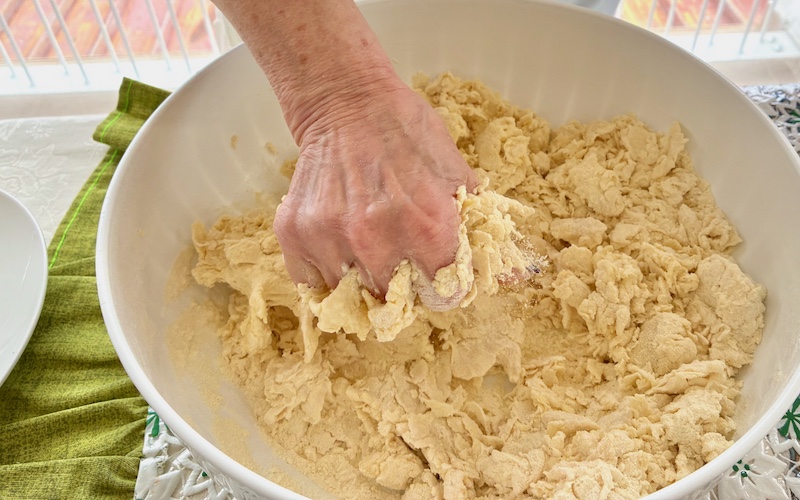
When we talk about fresh pasta we’re often in northern Italy, where flour from soft wheat (farina di grano tenero) is combined with egg and the dough is usually rolled into thin sheets through a pasta machine then cut into long strips or rolled into delicate shapes like garganelli (see video below). Fresh southern Italian pasta is made without eggs, using just water and flour. The flour is made from a variety of wheat with a harder grain (durum wheat) and called semolina flour. Pasta dough made from this flour creates chewy little shapes that are made by hand – no machine needed. Some recipes for southern Italian pasta dough use just this hard wheat flour and water. My version is inspired by the dough made by Mamma Marinella at Hotel Zi’Ntonio in the Amalfi Coast hinterland during the cooking classes on my southern Italian food & wine tour. She uses a blend of half soft wheat flour (tipo 00) and half fine semolina flour (semola rimacinata di grano duro) – it’s important to use semolina flour and not the coarser semolina, the key is the word ‘rimacinata’ (re-milled) on the packet. Rimacinata semolina flour is as fine as regular flour but has a more yellow colour. Not all cooks add olive oil to their dough, but Mamma does so I do too. This simple egg-free southern Italian pasta dough is used for making all sorts of shapes, including cavatelli, foglie d’ulivo, orecchiette and strozzapretti.
Makes about 300g (Serves 4 as a starter)
Share page on:
Northern Italy has long grown soft wheat varieties that grind into a very fine, white flour. Combined with the relative prosperity of the north, this meant eggs became a standard ingredient in fresh pasta — producing the silky, golden pasta all’uovo of tagliatelle, garganelli and tortellini. Southern Italy has a hotter, drier climate ideal for growing durum wheat, a harder variety with higher protein content. Fresh southern Italian pasta is traditionally made with just durum wheat flour (semolina flour) and water — no eggs — producing a firmer, chewier dough that’s typically shaped by hand (no pasta machine needed) and has a lovely golden colour from the semolina flour.
Durum wheat (Triticum durum, or grano duro in Italian — literally ‘hard wheat’) is a different species from the common wheat used in most bread and pastry flours (Triticum aestivum, or grano tenero — literally ‘soft wheat’). Durum wheat contains more protein and produces a type of gluten that gives pasta its characteristic firmness and al dente bite. The high-protein structure means the dough holds together without eggs. Durum wheat thrives in the hot, dry conditions of southern Italy — particularly Puglia, Basilicata, Campania and Sicily — which is where most of Italy’s durum wheat is grown. Milled durum wheat is called semolina.
The Italian word semola and the English word semolina are simply translations of each other — both refer to milled durum wheat. The difference lies in how finely it’s milled. Standard semolina is a coarse grind, granular in texture and similar to very fine polenta. Semola rimacinata (rimacinata meaning “re-milled” or “twice-milled”) is milled a second time to a much finer consistency — as fine as regular wheat flour but with a warm yellow colour. This is the flour to use for southern Italian pasta dough. Look for the words “semola rimacinata di grano duro” on the packet.
The ‘tipo’ (type) classification — 00, 0, 1, 2, integrale — is Italy’s system for grading flour by how much bran remains after milling, from 00 (most refined, almost no bran) through to integrale (wholemeal). Importantly, this classification applies to both species of wheat: as well as a tipo 00 soft wheat flour you can (in theory at least) have a tipo 00 durum wheat flour — they share the same refinement grade but are entirely different products from different species of wheat. In practice, when Italians refer to ‘tipo 00’ in a pasta or baking context, they mean flour from soft wheat (Triticum aestivum), also known as common wheat or bread wheat. This is the tipo 00 used in this recipe. It is extremely fine, low in bran, and the flour of choice for northern-style fresh egg pasta, pizza dough and delicate pastry. Semola rimacinata is the durum wheat equivalent — the finest grind of hard wheat — but the two are not interchangeable.

Not without losing what makes this pasta distinctively southern Italian. The protein structure of durum wheat is fundamentally different from that of common wheat, and it’s what gives the finished pasta its firm bite and ability to hold its shape during cooking. Plain flour would produce a softer, less structured dough. If semola rimacinata is difficult to find locally, look for it in Italian delicatessens or specialty food stores, or order it online — it has become much more widely available outside Italy in recent years.
Many traditional southern Italian pasta doughs use 100% semola rimacinata and water, with no oil. This version — inspired by Mamma Marinella’s dough at Hotel Zi’Ntonio in Scala in the Amalfi hinterland of Campania — blends equal parts semola rimacinata and tipo 00, and adds a small amount of olive oil. The tipo 00 makes the dough a little more yielding and easier to work by hand, while the semola rimacinata provides the structure and characteristic chew. The olive oil adds richness and keeps the dough supple.
Both come from durum wheat – the difference is in how finely the grain is milled. Semola (also sold as semolina or coarse semolina) is granular and gritty — similar in texture to a fine polenta or cornmeal. Semola rimacinata is milled to the texture of regular flour and may be labelled semolina flour or fine semolina. Semola rimacinata is used in the pasta dough, while the coarser semola is used to dust the tray when resting the shaped pasta — its gritty texture prevents the pieces sticking together and shakes off cleanly before cooking.