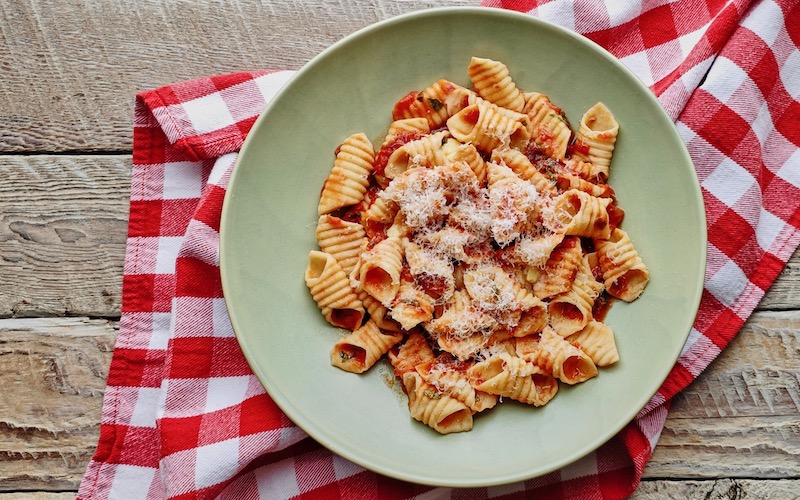
Garganelli are pasta quills – similar to penne rigate but instead of an extruded flour and water dough, they’re squares of fresh egg pasta rolled around a wooden rod (see video below). Traditionally garganelli were rolled across a set of fine reeds in a wooden frame – called a pettine, meaning comb (see FAQ below) – though today a gnocchi board is more common.
The name comes from ‘garganel’, the local dialect word for ‘chicken gullet’, which the tubular, ridged shape resembles. In some parts of Emilia-Romagna garganelli are variously called maccheroni al pettine (after the comb), zuflòt or scifulóti (both meaning whistle and also bullfinch).
I had garganelli with a delicious duck ragù at Hosteria Giusti in Modena in Emilia and learnt to make this simple pasta from a local Nonna in Romagna. The ridged hollow shape holds sauce well and you can dress garganelli with whatever you like, from a classic ragù Bolognese to a simple tomato sauce; after all Parma is the home of Mutti.
Learn more about how to make fresh pasta here – including tips on technique, equipment and ingredients – and see my page on how to cook pasta for perfect results every time.
To make enough garganelli to serve 4 as a starter, you’ll need:
Here’s how to make garganelli:
Here’s how to cook garganelli:
Share page on:
A pettine (meaning ‘comb’) is the traditional tool from Emilia-Romagna over which squares of fresh egg pasta were rolled to give garganelli their grooves.
Originally cooks used a repurposed weaver’s comb – rows of very fine, closely spaced reed or bamboo slats, held at each end between wooden strips tightly bound with hemp twine.
Today antique examples can still be found in specialty shops and artisanal craftsmen make them from restored textile combs. Most often though, a ridged gnocchi board is used to give a similar effect.
The thin piece of wood around which the pasta was rolled is called a bastoncino. A thin-handled wooden spoon is a good substitute.

In much of Emilia-Romagna the names garganelli and maccheroni al pettine are used interchangeably.
Around Mirandola (in the province of Modena), however, maccheroni al pettine are a distinct local shape, rolled straight rather than on the diagonal to make perfect cylinders without the pointed ends typical of garganelli.