Top Turkish Street Foods in Istanbul

Istanbul streets are alive with the sights, smells and sounds of street food at every turn – from iconic red carts piled high with simit to vendors stretching dondurma high into the air.

Istanbul Street Food - HERO

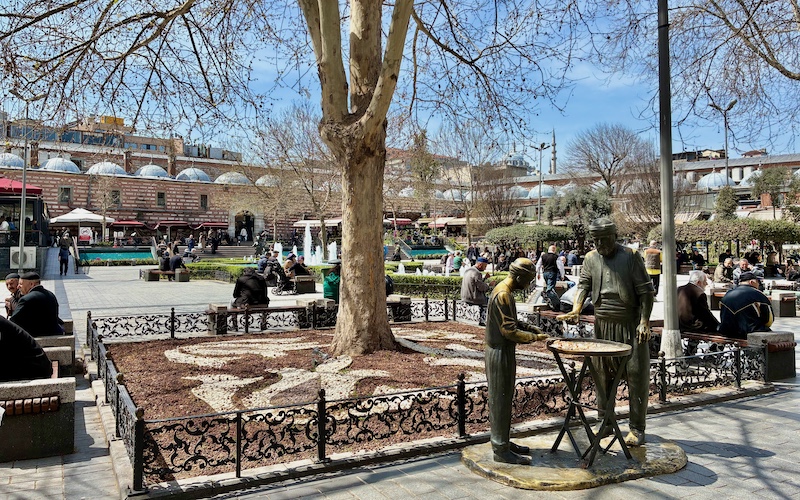
Istanbul’s street food culture runs deeper than in most cities. As the former capital of the Ottoman Empire it drew people from across a vast empire, each bringing the flavours of home with them. The result is a street food scene as diverse as the city itself, and as much a part of daily life today as it was centuries ago. Turkish street food is some of the best ‘cheap eats’ in the world, and an essential part of experiencing Istanbul like a local. Grab something from a cart, perch on a wall – or a bench in Gülhane Park – and watch the world go by, just as whole families do all over Istanbul.

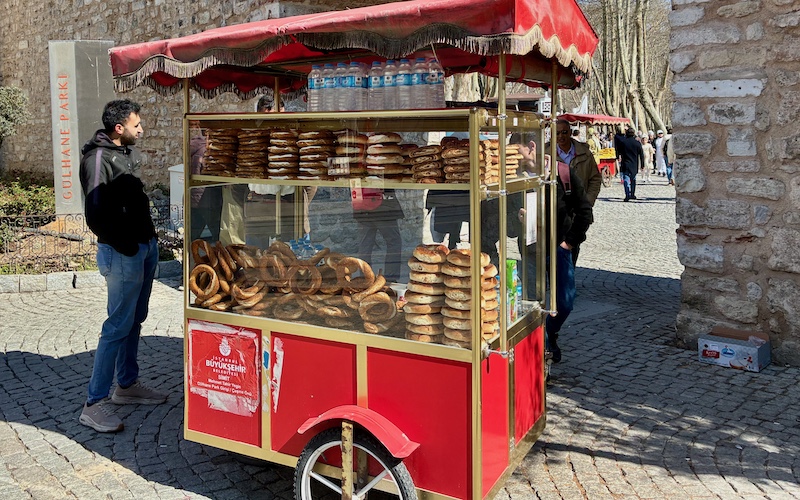
Istanbul Street Food - Simit Cart

Simit
These sesame seed-coated bread rings are perhaps Türkiye’s most iconic street food with their crisp caramelised crust and tender, chewy interior. They’ve been sold across Istanbul since at least the 16th century, today from signature red carts wheeled into place — at ferry terminals, park entrances and busy intersections — before dawn. I stop at the one outside Gülhane Park most days and grab a simit to enjoy on my early morning stroll.

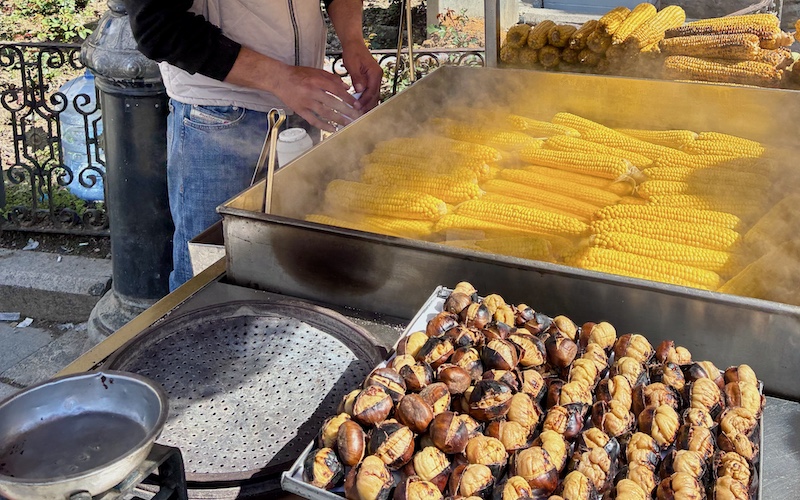
Istanbul Street Food - Roast Corn and Roast Chestnuts

Roast Corn & Chestnuts
Charred, salty köz misir – corn on the cob grilled over charcoal braziers – is one of Istanbul’s most satisfying street foods in warmer weather. As temperatures drop, the same street carts offer charcoal-roasted chestnuts (kestane), sold in paper bags perfect for warming your hands. The same carts, two seasonal stars – and in spring and autumn you may be lucky enough to find both. The aroma is reason enough to stop.

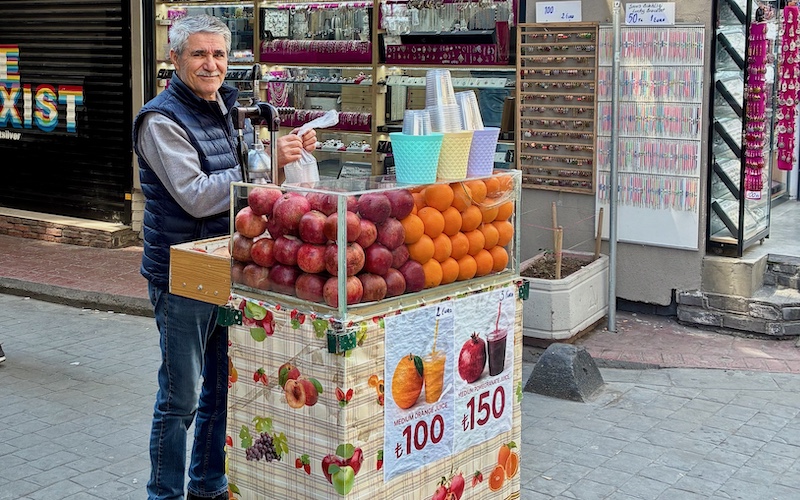
Istanbul Street Food - Fresh Juice

Fresh Fruit Juice
Turks love fruit juice, though the ones you’ll buy in tetrapaks often contain more than juice. Pomegranates and oranges both grow prolifically in Türkiye’s hot Mediterranean and Aegean regions. Their vivid ruby and bright golden juice is pressed to order at glass-fronted street carts and served separately or mixed – it’s as eye-catching as it is refreshing and a very healthy street food snack.

Istanbul Street Food - Midye Dolma (Sarmarine)

Midye Dolma (Stuffed Mussels)
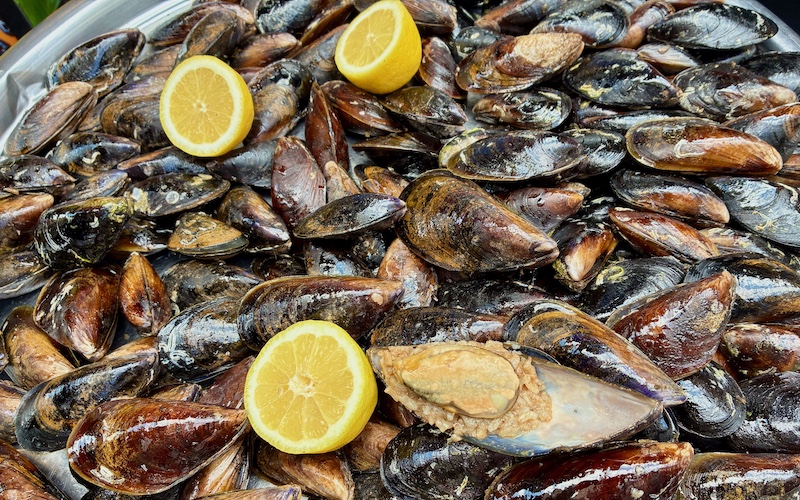
One of Türkiye’s most distinctive street food snacks, these plump, rice-stuffed steamed mussels are eaten straight from the shell with just a squeeze of lemon. Sometimes sold from trays carried by vendors other times from carts with large steamers keeping them warm – my favourite midye dolma are at Sarmarine in Karaköy, just across the Galata Bridge, where the mussels are super fresh and the service super friendly.

Istanbul Street Food - Gözleme (cheese and herb) - Turkish Airlines Lounge Istanbul

Gözleme
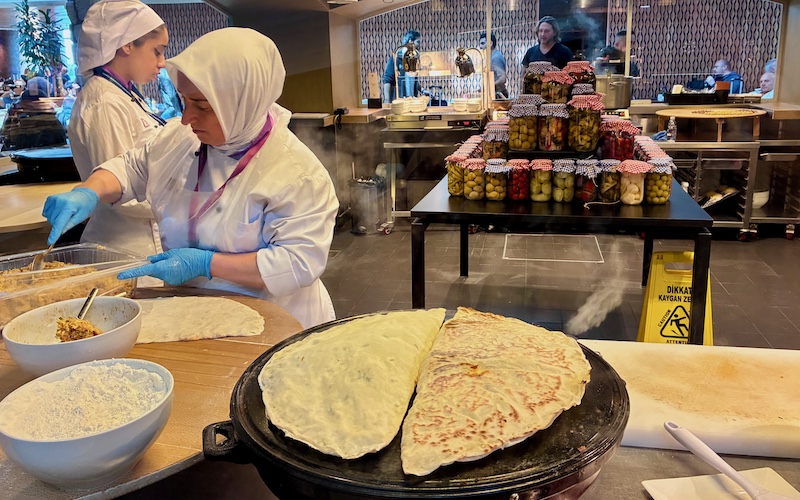
Thin unleavened dough, filled, sealed, and cooked on a convex saj griddle until lightly blistered and golden, gözleme are one of Türkiye’s best known street foods internationally, sold from food trucks all over the world. Classic gözleme fillings include cheese, herbs, spinach and seasoned beef or lamb. The beyaz peynir (white cheese) gözleme hot off the grill at the Turkish Airlines business lounge is by far the best I’ve eaten anywhere.

Istanbul Street Food - Balik Ekmek

Balik Ekmek (Fish Sandwich)
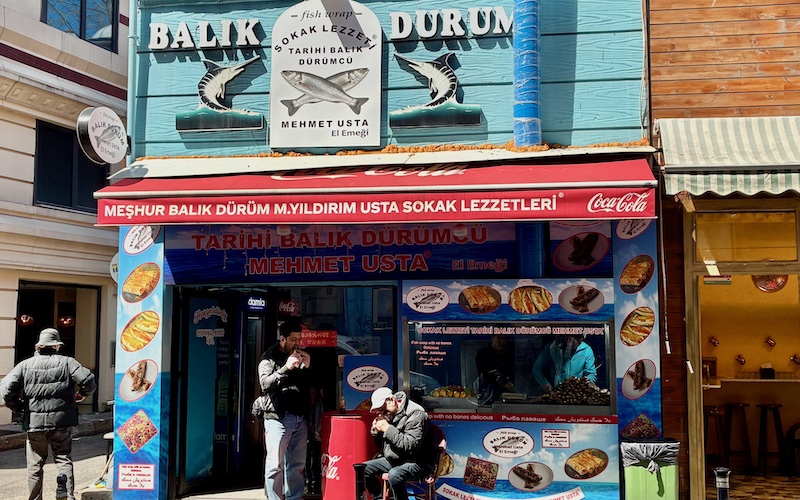
Fishermen once grilled fish on their boats moored near Galata Bridge and sold it in a roll with lemon, lettuce, onion and peppers. These balik ekmek (literally ‘fish bread’) became an Istanbul institution. Skip the touristy restaurants around the bridge – with the same photos and menus – and cross to Karaköy where locals grab a balik ekmek or balik dürüm (wrap) from hole-in-the-wall stands like Rota Dürüm Balık or Balık Dürüm Mehmet Usta.

Istanbul Street Food - Sweets - Osmanlizadeler

Turkish Sweets: Baklava & Lokum
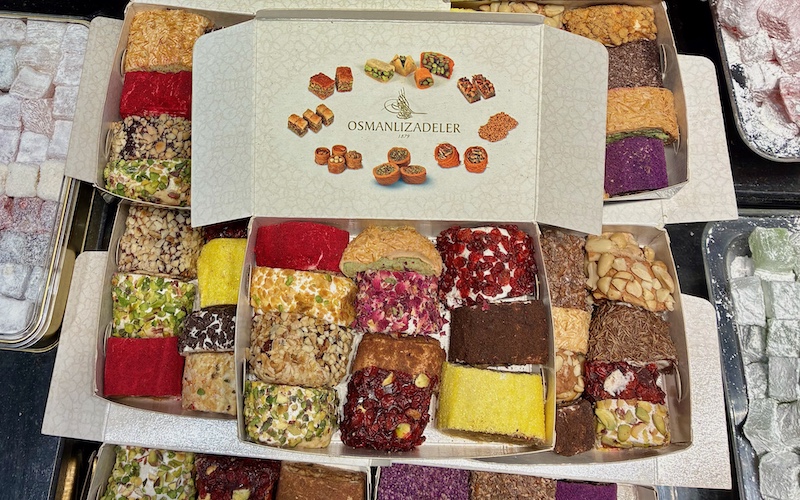
Turks love sweets, and shops selling baklava and lokum (Turkish delight) are everywhere in Istanbul. My favourite is Osmanlizadeler Hoca Paşa, on the corner of Gülhane Park – the family has been serving coffee and sweets to Istanbullular since 1879. Get a Turkish coffee and rose-flavoured lokum at one of the small wooden tables, or take some to enjoy in the park — a box of lokum also makes the ideal gift if you’re invited to a Turkish home.

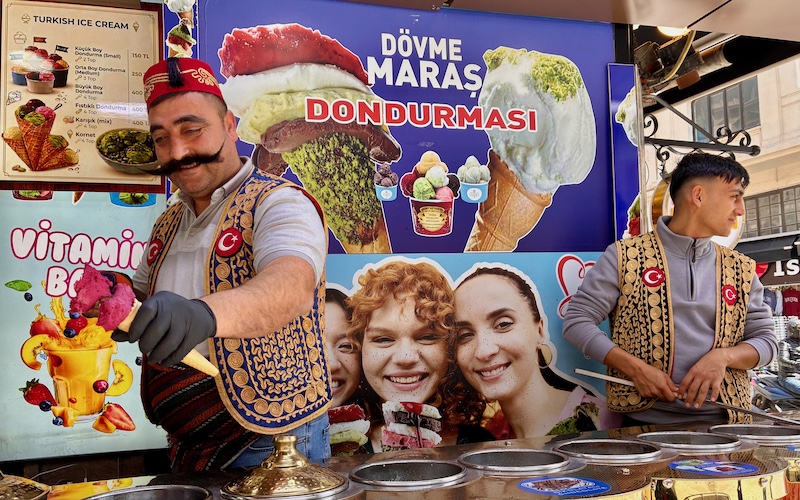
Istanbul Street Food - Dondurma

Dondurma (Turkish Ice Cream)
Slow-melting, stretchy dondurma (Turkish for ‘frozen’) is unlike any other ice cream thanks to salep (an orchid extract) and mastic (a bark resin). Theatrical street vendors stretch it high into the air before presenting the cone. Showmanship is fine with quality and service, but beware dondurma stands in busy tourist spots that are all show and no substance, like the one at the front of Tarihi Gönen Pilavcisi facing the back of the Spice Bazaar.

Published 22 Aug 2026

Balık Ekmek (Turkish Fish Sandwich)

Istanbul Street Food FAQ

What makes simit distinctive? Why are simit special?

Rings of bread dough dipped in diluted grape molasses (pekmez) then heavily-coated in sesame seeds before baking, simit have a crisp dark crust and chewy texture. Simit are best eaten as fresh as possible and have been a Turkish breakfast staple since at least the 16th century, when Ottoman explorer Evliya Celebi recorded that Istanbul had around 300 simit vendors (simitci) selling bread baked five times a day to ensure freshness. It’s also said that simit was the Ottoman Sultans preferred Ramadan gift to their soldiers. The only time simit have not been commercially available in Türkiye was during World War II when a flour shortage made it necessary to ban their production. The signature red simit cart at Turkish Airlines business lounge has a huge block of Türkiye’s iconic Trabzon butter alongside it, made with milk from cows grazing the rich mountain pastures of the Black Sea hinterland.

What is the difference between balik ekmek and balik dürüm?

Balik ekmek is grilled fish – usually oily mackerel – and salad served in a bread roll. This traditional Istanbul street food snack has largely been replaced in recent years by the same ingredients served in a flatbread wrap: balik dürüm. The wrap is easier to eat on the go and the flatbread holds the fish and accompaniments together more neatly, making it the Karaköy locals preference today. Note that balık in Turkish is spelled with the undotted I, representing a very short ‘i’ sound.

What is the origin of gözleme?

Gözleme – Türkiye’s popular stuffed flatbreads – originated with Anatolian nomads cooking flatbread on portable griddles over the coals of open fires. The name gözleme likely derives from közleme, meaning ‘to cook on the embers.

What is lokum?

Lokum – known in English as Turkish delight – is a confection made from starch and sugar, flavoured with rosewater, citrus, mastic or fruit, and often studded with nuts. It has been made in Türkiye since at least the 18th century and remains one of the country’s most beloved sweets. Istanbul sweet shops sell it in dozens of flavours and colours.


Is it safe to eat street food in Istanbul?

Istanbul street food vendors are certified by the Istanbul municipality, so their street food is generally safe to eat – look for the certification number on the cart. The most reliable food safety rule anywhere is that food cooked hot and served immediately carries far less risk than food that’s been sitting out. The best safety signal of all is a queue of locals which shows a fast turnover, good word of mouth and regular repeat business.

What Other Travellers Say

Janet (Tamworth, NSW, Aus.)
Just back from the most amazing trip to Emilia-Romagna with Roberta. Not only the home of Prosciutto di Parma, Parmigiano-Reggiano & Balsamic Vinegar, but scenery to die for and more quaint and exciting restaurants and cafés than you ever imagined. And Roberta is just the person to help you discover and enjoy them! Her knowledge of the history of the region and its wonderful cuisine know no bounds and all added to the excitement of the trip. It was faultless - well organized and lots of fun!
Deb (Belconnen, ACT, Aus.)
Wow, what a tour – I learned so much! Awesome fun traveling through Emilia-Romagna experiencing first hand some of the produce I've worked with over the last couple of years cooking with Roberta's recipe kits – the family are reaping the benefits now. If you're thinking of joining Roberta in future years get ready for an amazing experience.
Mark (Elizabeth Bay, NSW, Aus.)
My wife and I recently joined Roberta's Emilia-Romagna tour. We enjoyed all the temptations offered and learned a lot about that part of Italy, especially its food and wine culture. What was most impressive was Roberta's local knowledge of people and places. The planning and effort she put into making the whole experience seem effortless was remarkable.
Karen (Bowral, NSW, Aus.)
Our tour with Roberta through Emilia-Romagna was the highlight of the year. Good company, gorgeous palazzi and great food. What more could one ask for? Roberta's enthusiasm and knowledge made this a once in a lifetime experience through an extraordinary, diverse and very special region.
Shelley (Auckland, NZ)
Roberta’s passion for Italy shone throughout an unforgettable food and wine tour. She introduced us to family-owned artisanal producers, where we experienced everything from attic-aged balsamic to small-batch wines, Parma ham and Parmigiano-Reggiano. The local guides were equally passionate, and the excellent transport and accommodation made the trip effortless. This tour captured the region’s traditions, flavours and people, and thanks to Roberta’s deep knowledge we left with wonderful memories. A truly authentic culinary adventure — highly recommended.
Subscribe To My Newsletter & Get A Free Online Italian Cooking Class (RRP $39)