Bologna Quadrilatero Market Guide

I love so many of Italy’s brilliant food markets, but Bologna’s immense Quadrilatero has a special place in my heart.

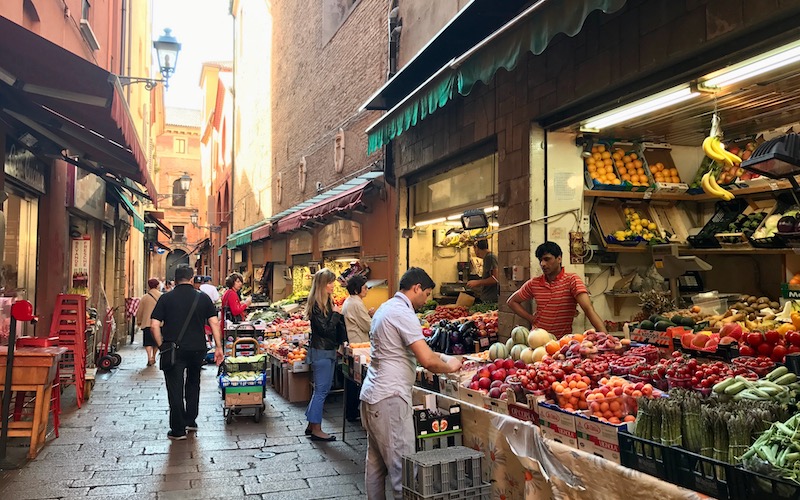
Produce stalls in Quadrilatero Market Bologna - Walking Tour of Italian Food Markets - Bologna Food Tour

There’s a breathtaking variety of goods – fresh and prepared – from across Emilia-Romagna, dubbed ‘Italy’s food valley’ for the fertile soil of the Po Valley and its diverse produce. Many of the Quadrilatero shops have been in the same family for generations and preserve their antique storefronts and fittings. Step from the huge open space of Piazza Maggiore, through the thick stone archway beneath the Renaissance Palazzo dei Banchi, into Via Pescherie Vecchie, and you’re immediately transported to another time.

While Bologna’s Quadrilatero is often referred to as ‘Italy’s oldest market’, it’s safer to say it’s one of Italy’s two oldest continuously operating market districts – the other being the Rialto Market in Venice, established by Ducal decree in 1097. To really understand how the unique Quadrilatero market differs from other historic Italian markets, like Modena’s charming Mercato Albinelli, you need to know a little of Bologna’s fascinating history.

If you’d rather just read my guide to the best shops in the Quadrilatero market, please scroll down.

The forum (marketplace) for the Roman settlement of Bologna – Bononia, established in 189 BC – was just west of today’s Quadrilatero, beneath what is now Piazza Maggiore and the surrounding buildings. The Quadrilatero district became the city’s central market between the 11th and 13th centuries thanks to a couple of key developments.

  • First, in 1088 AD, the University of Bologna was founded by a student guild as a self-governing body (universitas). It was the first secular community of higher learning in Europe and brought a massive influx of students, professors and associated craftsmen.
  • Just 28 years later came the death of Contessa Matilda di Canossa, who had ruled Bologna on behalf of the Holy Roman Empire. The city’s wealthy merchant and trade guilds seized the opportunity and negotiated with Henry V of Germany, the Holy Roman Emperor, to secure Bologna’s freedom. In May 1116 AD, Bologna became a self-governing city-state and its guilds became the rulers – with the heads of each of the most powerful guilds forming the city council.

These medieval guilds established a comprehensive framework to control commerce within Bologna. The streets adjacent to Piazza Maggiore already constituted an informal open-air market of local farmers, traveling traders and unregulated butchers. Now, each guild was assigned an area there, within which its members must operate their businesses. This prevented cross-contamination – for example by keeping butchers and fishmongers separate – and made it easy for patrolling guild inspectors to ensure their quality standards, and pricing limits for everyday items (like meat and bread), were being adhered to. So Bologna’s Quadrilatero market district was born – a rectangular area (quadrilatero) bordered by Via dell’Archiginnasio (running along the eastern side of Piazza Maggiore) and Vie Rizzoli, Castiglione and Farini.

While the fishmongers clustered at the junction of Via delle Pescherie Vecchie (Old Fish Market Street) and Via Drapperie are the last remaining links to the street’s original namesake trades, walking through the Quadrilatero market today is a stroll through Bologna’s medieval history.

  • Via Calzolerie housed the cobblers, kept busy by the constant influx of students and traders who needed footwear made and repaired.
  • Via Caprarie, what remains of Strata de Beccaris (Butchers’ Street), was dedicated to butchers of goat (capra) and sheep – the most popular meats among everyday people of the Middle Ages – and where the powerful Butchers’ Guild had its residenza (headquarters).
  • Via Drapperie was home to cloth merchants and drapers, controlled by one of the most powerful and well-connected guilds.
  • Via Clavature was the home of locksmiths and key-makers (chiavaturari), specialized blacksmiths whose iron gates and locks ensured the security of the city’s banks, warehouses and fortified noble houses. They also made the gears, chains and padlocks to control the wooden sluice gates of the 60-kilometre network of man-made canals that powered the city’s textile mills and connected it to the Po River.
  • From Via degli Orefici (Goldsmiths’ Street), members of the guild of jewellers supplied the nobility and wealthy university professors with ornate wax seals, custom-minted coins and ceremonial rings.

At the end of the 19th century, several blocks were demolished to widen Via Rizzoli, relegating a number of traditional guild lanes to history. These include the armorers and sword-makers’ Via Spaderie and Via Pelliccerie which housed furriers and tanners. Today these smaller, vanished guilds are remembered in the name of narrow Via degli Artieri (Artisans’ Street).

Now let’s step inside the Quadrilatero market and visit some of my favourite stalls and stores – I’ll show you how to shop in Bologna’s famous market like a local, not a tourist.

Bologna - Quadrilatero Guide - La Baita Vecchia Malga

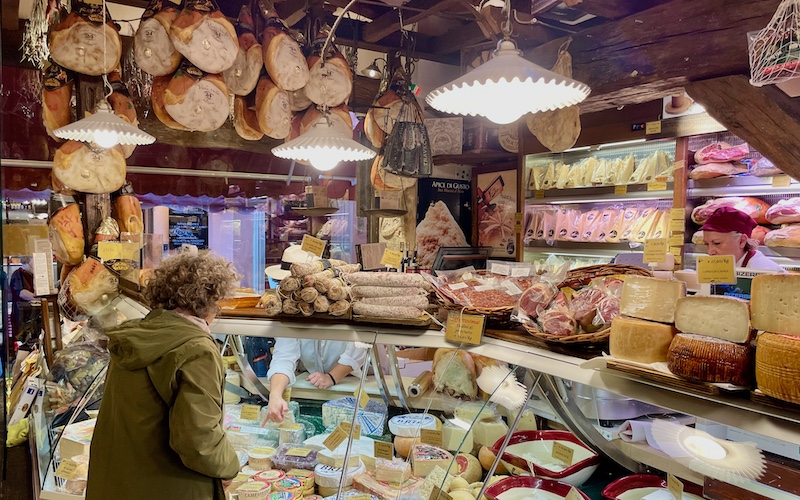
La Baita Vecchia Malga Via Pescherie Vecchie 3a
Just after you pass through the stone archway from Piazza Maggiore into Via Pescherie, you’ll see my favourite salumeria on the right. Inside is an Aladdin’s cave of prosciutti, salumi, cheese and foraged local mushrooms and condiments. Upstairs – or outside – you can enjoy an aperitivo and salumi boards themed around the produce of Emilia, Romagna and other Italian regions. The local mortadella is a must!

Bologna - Quadrilatero Guide - fresh produce stalls

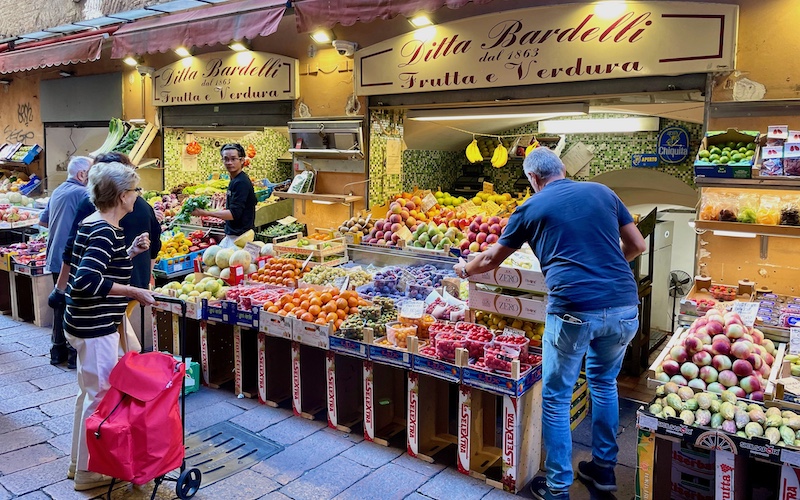
Fresh Produce along Via Pescherie Vecchia
Just past La Baita is the main fresh produce section, with stall after stall of colourful fruits and vegetables. Depending on the season there will be the ripest tomatoes in many shapes and colours, artichokes, puntarella, radishes, lettuces, mushrooms, fresh chestnuts still in their spiky skins, borlotti beans, melons, grapes, stone fruit, fiche di India (prickly pears), asparagus and more. Arrive early when the locals do for the best buys.

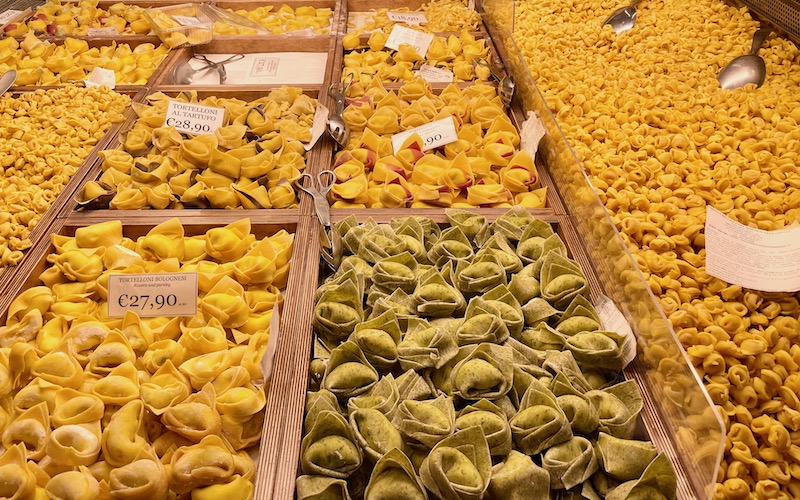
Bologna - Quadrilatero - Ceccarelli Amedeo - Trays of fresh yellow and green pasta in a shop - Food Lovers' Guide

Ceccarelli Amedeo Via Pescherie Vecchie 8
Opposite the fresh produce, is the pastificio (fresh pasta shop) I always come back to. It has a mesmerising display of fresh pasta, especially the tortellini and tortelloni in an array of colours, with fillings from radicchio and walnut or potato and speck to porcini, truffles, pumpkin, and ricotta with herbs. There are tagliatelle and lasagne too, along with passatelli, curly gramigna and spaghetti pressed through a bronze torchio.

Best shops in the Quadrilatero - Pescheria Brunelli

Fishmongers Via Drapperie opposite Via Pescherie Vecchia
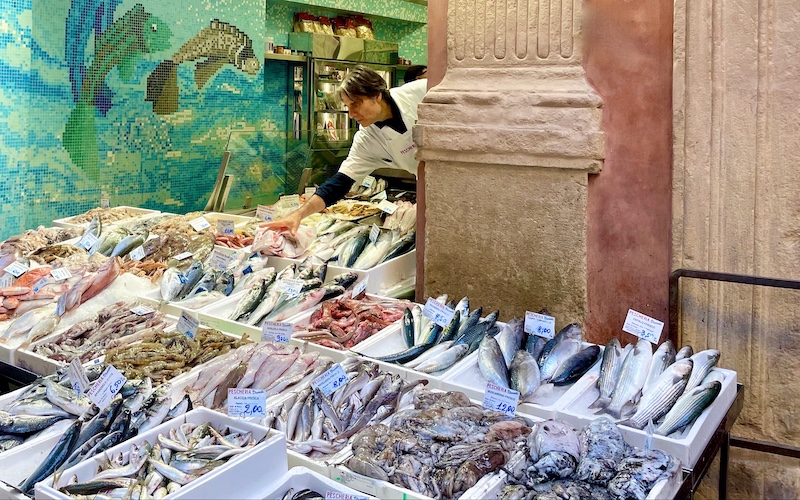
The Quadrilatero’s fishmongers are clustered together at the end of Via Pescherie Vecchia on Via Drapperie. Their boxes are brimming with small blue mackerels, flat-bottomed red gurnards (called gallinella di mare or ‘little hens of the sea’), sardines and sea bass, alongside canocchia (mantis shrimp), inky cuttlefish, mussels and clams. Pescheria Brunelli has one of the best displays, and reputations, and I love their colourful mosaic wall.

Best shops in the Quadrilatero - Drogheria Gilberto

Drogheria Gilberto Via Drapperie 5a
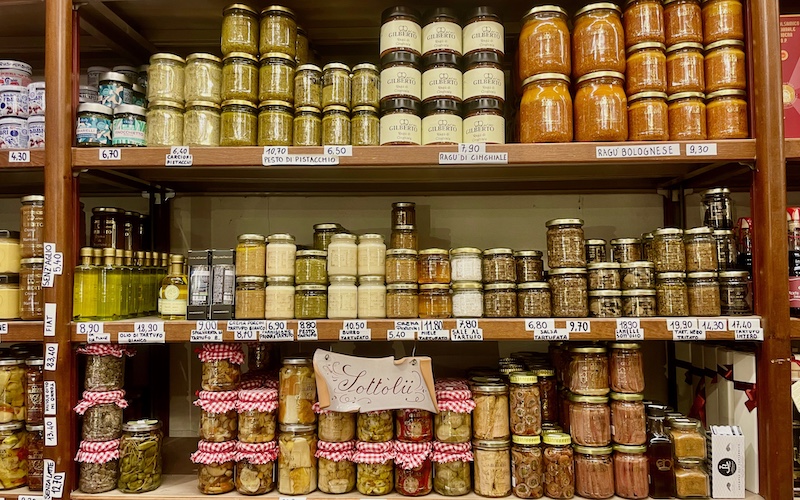
This huge two-storey shop, opposite the fishmongers, is the best general provedore in the Quadrilatero. I love their shelves of balsamic vinegars, pestos, preserved vegetables (sottoli), anchovies and – of course – huge jars of ragù Bolognese; plus the great selection of wine in their basement cellar. Just around the corner, on Via Drapperie, their smaller shop is full of beautiful wooden-handled brushes and other specialty cleaning products.

Bologna market - Quadrilatero - Frida's Florist

Frida’s Bologna Via Drapperie 1b
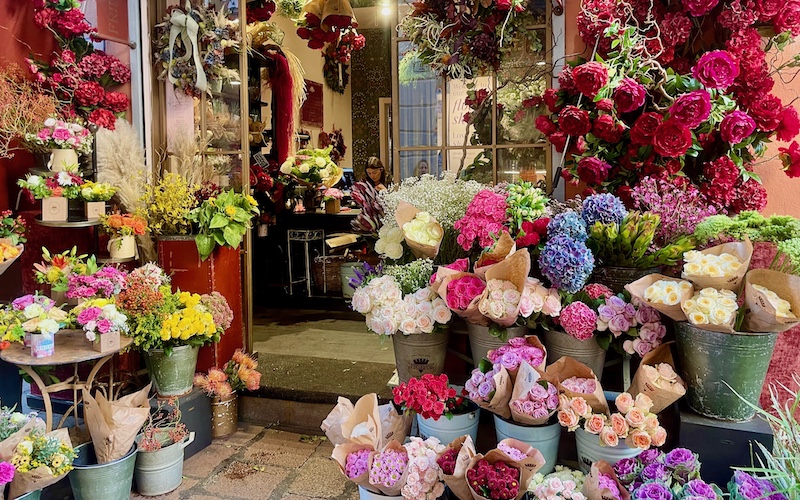
Just past Gilberto you’ll see Frida’s zinc buckets brimming with dramatic clusters of bright roses, hydrangeas, sunflowers and ornamental brassicas. Named for the colourful, flower-clad Mexican artist Frida Kahlo, Frida’s was opened by Alessandra Santi in 2008 and has since expanded to multiple ‘floral boutiques’ across Italy, from Milan to Rome. Now let’s turn around and walk back along Via Drapperie towards Via Farini.

Bologna market - Quadrilatero - Antica Aguzzeria del Cavallo

Antica Aguzzeria del Cavallo Via Drapperie 12
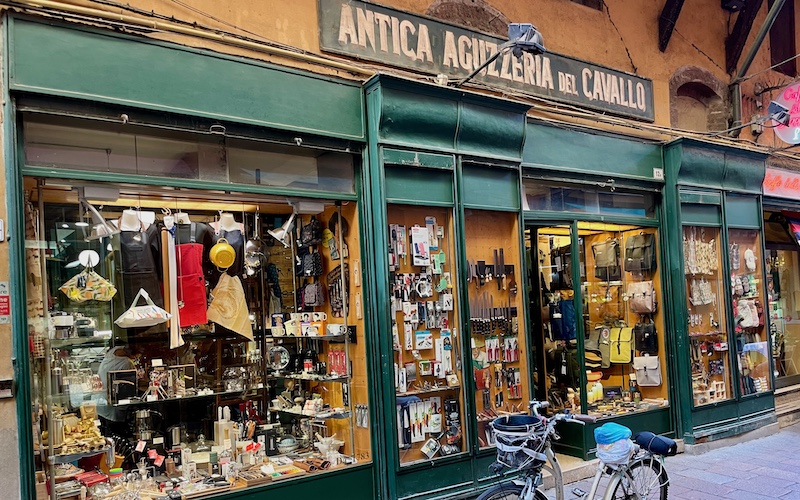
Just past Via Pescherie Vecchia you’ll see the ancient shopfront of this store with its intriguing name (see FAQ below for details). Opened in 1783, and run by the same family for six generations, this is the oldest ‘bottega storica’ (historic shop) in the Quadrilatero. Its core business is still sharpening and selling specialised blades – though I love its extensive display of other kitchenware too, especially the brass pasta cutters and wooden stamps.

Bologna - Quadrilatero market - Alimentari Melega

Alimentari Melega Cnr Via Drapperie & Via Clavature
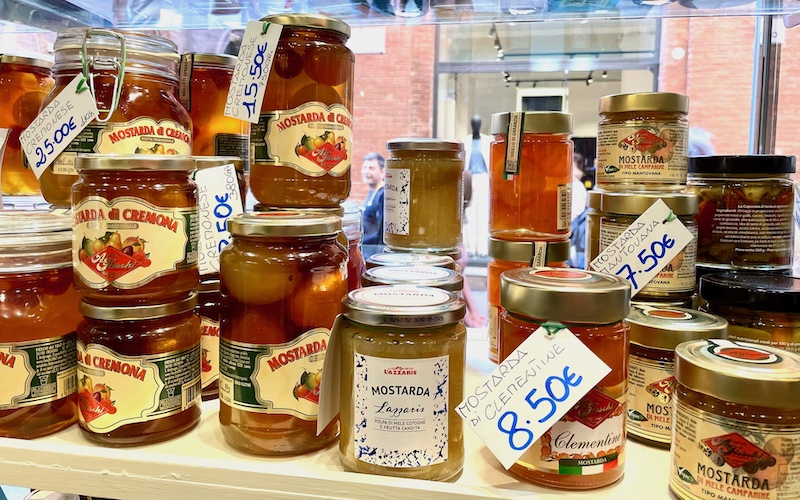
Another bottega storica, this small alimentari is a treasure trove of Italian delicacies. Operated by the Melega family since the early ’60s, this old-fashioned general store is a one-stop shop for locals. There’s a deli counter with local salumi and cheese, an ever-changing display of seasonal produce, and an impressive range of artisanal mostarda di frutta – a few jars of which always make their way into my luggage for souvenirs.

Bologna - Quadrilatero market - Roccati Cioccolato

Roccati Cioccolato Via Clavature 17a
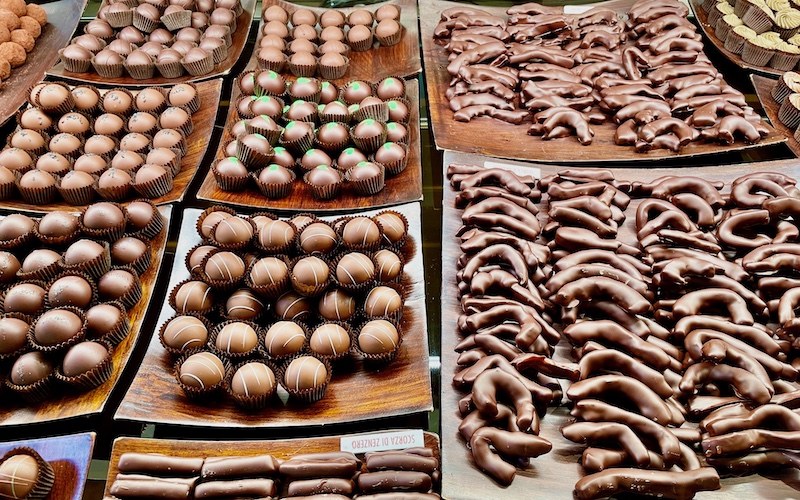
Turn left and a few doors down on the right you’ll come to Roccati. Opened in 1996 by Mario Roccati, whose ancestors were pastry chefs to the Royal House of Savoy, this beautiful chocolate shop has the most arresting displays. Roccati hails from Piemonte, famous for its hazelnuts, so gianduja (choc-hazelnut paste) features in his signature truffles, chocolate ‘books’, and giant wheels of chocolate from which staff cut off chunks.

Wondering what else there is to see and do around the Quadrilatero market?

Some of Bologna’s most famous sites are nearby – so after this tour of the best shops in the Quadrilatero, make time for a little sightseeing.

Bologna - Quadrilatero - Santuario di Santa Maria della Vita

Santuario di Santa Maria della Vita Via Clavature 8-10
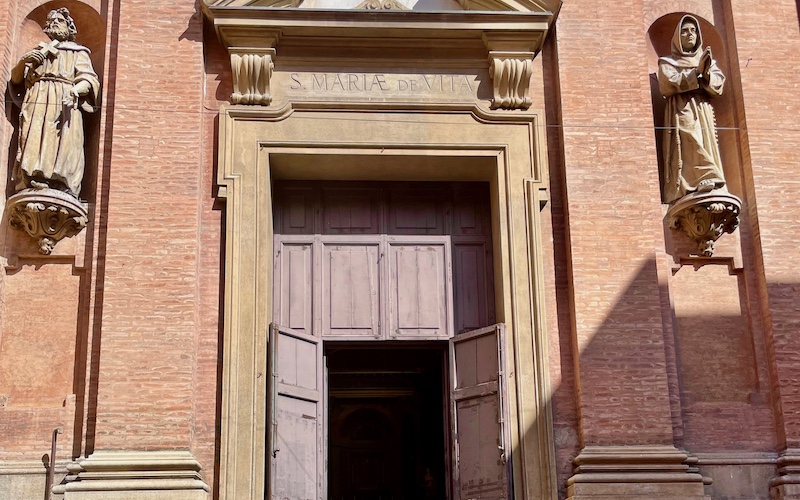
From Roccati, turn around and walk back up Via Clavature to this unassuming church on the right. Inside you’ll find one of the most remarkable artworks of the Early Renaissance, Niccolò dell’Arca’s Lamentation Over The Dead Christ.

Osteria del Sole Vicolo Ranocchi 1d
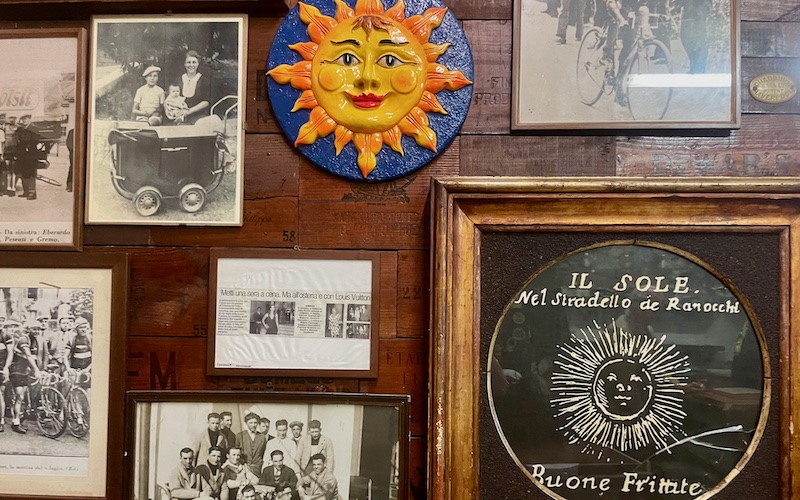
In Vicolo Ranocchi (Frog Alley), opposite La Baita, you’ll find Bologna’s oldest bar. Pop in for a glass of sparkling pignoletto before lunching at La Baita. See FAQ below for more on this street’s curious name and my guide to the best bars in Bologna for more of Osteria del Sole’s history.

Bologna - Quadrilatero - Archiginnasio

Palazzo dell’Archiginnasio Piazza Galvani 1
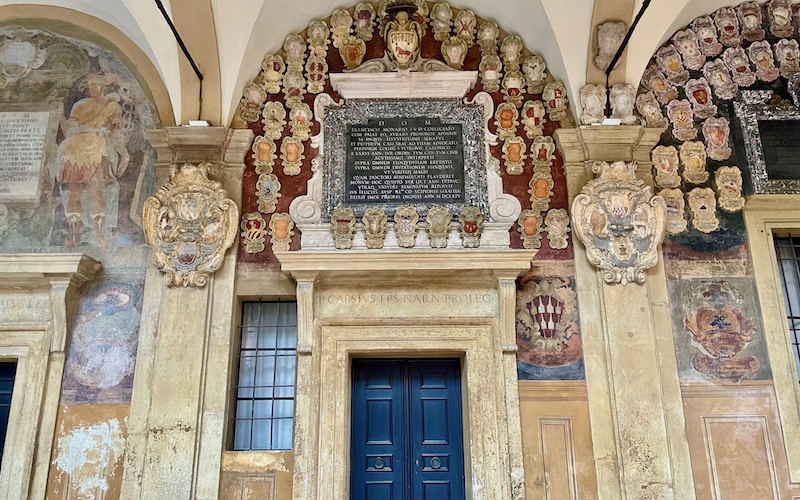
After lunch, walk back through the portico at the end of Via Pescherie Vecchie onto Piazza Maggiore. Turn left and follow the road along the back of the Basilica to the entrance of the 16th century Archiginnasio, the first unified seat of Bologna’s famous university.

Bologna - Quadrilatero - Asinelli Tower

Asinelli and Garisenda Towers Cnr Via Rizzoli & Via Castiglione
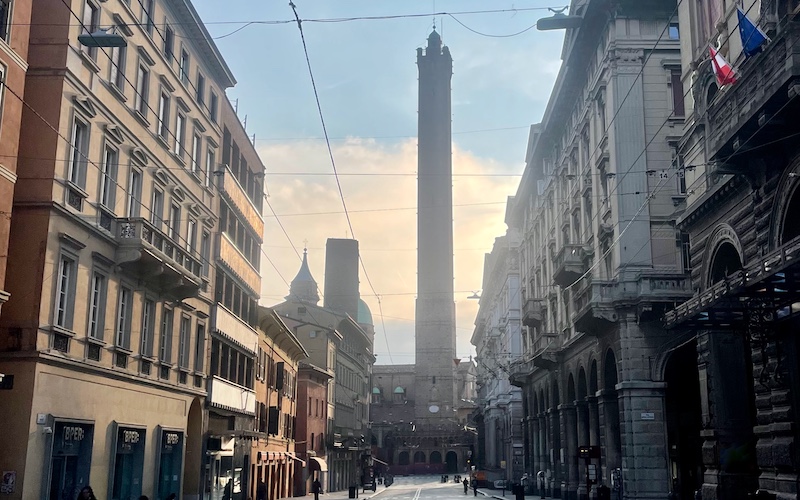
Bologna’s most recognised landmarks, its two leaning towers, sit on the opposite side of the Quadrilatero – on the corner of Via Rizzoli and Via Castiglione. Learn more about them in the FAQ below.

Discover more of ‘La Dotta, La Grassa e La Rossa’ in my Bologna Guide for Food Lovers.

Published 27 Sep 2026

Emilia-Romagna Food Tour Highlights

Quadrilatero Market FAQ

What does Via Caprarie mean and why was it the butchers' street in the Quadrilatero?

Via Caprarie takes its name from capra (goat) – it was the section of the medieval Butchers’ Street (Strata de Beccaris) dedicated to the slaughter and sale of goat and sheep, the most affordable meats for ordinary Bolognesi. Cattle were too valuable as working animals and dairy producers to be commonly slaughtered for meat. The powerful Butchers’ Guild (Arte dei Beccai) had its Guild Hall headquarters (residenza) here, and the local noble family who built their tower houses nearby even took their surname from it: the Scannabecchi, from scannare (to slaughter) and becchi (buck/male goats).

Why is Vicolo Ranocchi called Frog Alley?

Vicolo Ranocchi (literally Frog Alley), a narrow laneway in the Quadrilatero, takes its name from the frogs once sold there as an inexpensive source of protein for Bologna’s students and working people. The Po Delta’s wetlands once teemed with frogs, and in the medieval economy of the market district they were as commonplace as fish. Osteria del Sole, Bologna’s oldest bar, has occupied this laneway since 1465.


Where is the entrance to the Quadrilatero market from Piazza Maggiore?

The Quadrilatero is directly behind the Palazzo dei Banchi, the Renaissance building that forms the eastern side of Piazza Maggiore. There are two large arched openings cut directly through its façade – one leads into Via Pescherie Vecchie, the other into Via Clavature. The building was designed by Jacopo Barozzi da Vignola in the mid-1500s to screen the chaotic market behind it from the elegance of Piazza Maggiore. The name, literally ‘Palace of the Benches’ refers to the tables of the early bankers, moneylenders and gold merchants who operated from beneath its porticoes.

What is the Mercato di Mezzo in the Quadrilatero market?

The Mercato di Mezzo (Middle Market) was originally the main thoroughfare between Piazza Maggiore and the Two Towers (see below), lined with wooden stalls selling grain, cured meats and poultry. By the early 1800s it had become an overcrowded maze of tiny dark shops carved into medieval tenements. After Italian unification in 1861, the tenements were replaced by an iron-and-glass covered market building, and in 2014 this was renovated into the three-storey food hall it is today.

What are Bologna's Two Towers?

The Asinelli and Garisenda towers, built between 1109 and 1119 by rival aristocratic families as private fortresses and status symbols, stand at the eastern edge of the Quadrilatero. The Asinelli tower, at 97.2 metres, is the tallest medieval leaning tower in the world; following extensive restoration in 2026, visitors can climb its 498 wooden steps for panoramic views of Bologna. The Garisenda tower was dramatically reduced to 48 metres in the 14th century after severe subsidence caused a dangerous tilt.

How did the Antica Aguzzeria del Cavallo shop get its name?

The rather nonsensical name of the oldest bottega storica (historic shop) in the Quadrilatero literally means ‘ancient horse sharpening shop’. It’s a reference to the massive millstone once used to sharpen swords and other blades which was turned by horses (or donkeys) in the courtyard behind the shop.

What Other Travellers Say

Janet (Tamworth, NSW, Aus.)
Just back from the most amazing trip to Emilia-Romagna with Roberta. Not only the home of Prosciutto di Parma, Parmigiano-Reggiano & Balsamic Vinegar, but scenery to die for and more quaint and exciting restaurants and cafés than you ever imagined. And Roberta is just the person to help you discover and enjoy them! Her knowledge of the history of the region and its wonderful cuisine know no bounds and all added to the excitement of the trip. It was faultless - well organized and lots of fun!
Deb (Belconnen, ACT, Aus.)
Wow, what a tour – I learned so much! Awesome fun traveling through Emilia-Romagna experiencing first hand some of the produce I've worked with over the last couple of years cooking with Roberta's recipe kits – the family are reaping the benefits now. If you're thinking of joining Roberta in future years get ready for an amazing experience.
Mark (Elizabeth Bay, NSW, Aus.)
My wife and I recently joined Roberta's Emilia-Romagna tour. We enjoyed all the temptations offered and learned a lot about that part of Italy, especially its food and wine culture. What was most impressive was Roberta's local knowledge of people and places. The planning and effort she put into making the whole experience seem effortless was remarkable.
Karen (Bowral, NSW, Aus.)
Our tour with Roberta through Emilia-Romagna was the highlight of the year. Good company, gorgeous palazzi and great food. What more could one ask for? Roberta's enthusiasm and knowledge made this a once in a lifetime experience through an extraordinary, diverse and very special region.
Shelley (Auckland, NZ)
Roberta’s passion for Italy shone throughout an unforgettable food and wine tour. She introduced us to family-owned artisanal producers, where we experienced everything from attic-aged balsamic to small-batch wines, Parma ham and Parmigiano-Reggiano. The local guides were equally passionate, and the excellent transport and accommodation made the trip effortless. This tour captured the region’s traditions, flavours and people, and thanks to Roberta’s deep knowledge we left with wonderful memories. A truly authentic culinary adventure — highly recommended.
Subscribe To My Newsletter & Get A Free Online Italian Cooking Class (RRP $39)