When I first visited southern Italy as a backpacker in the ‘80s, I stayed in small towns along the coast. Places with few tourists, just locals going about their daily lives. I still love to experience Italy this way.
Basilicata is one of the few Italian regions where it’s still relatively easy to dodge mass tourism and be a traveller among the locals. Small towns, like Venosa in the north and Montescaglioso in the south of this largely landlocked region, offer great glimpses into traditional southern Italian life. The food and culture have a lot in common with neighbouring Puglia, without the swarms of tourists – and the main appellation, Aglianico del Vulture, produces outstanding wines. This Basilicata food guide shares a few of my favourite places to stay, eat and drink in one of Italy’s least explored regions.
Where to Stay in Montescaglioso Il Borgo Ritrovato
This charming B&B, run by sisters Francesca and Lucia, is in a peaceful hill town just across the ravine from Matera. They prepare an excellent breakfast buffet of regional dishes with local produce including cialledda fredda (see video below). Montescaglioso is a great base for exploring Basilicata’s food and wine, ideal for strolling around soaking up Italian life away from the tourist trail, and enjoying the impressive view across the plain to Matera.
Where to Eat in Montescaglioso Il Trappeto
This bustling pizzeria in a restored oil mill is close to Il Borgo Ritrovato (above) and run by the same family. Tables sit around the mill stones and original basket presses are off to one side. A pizza of local salsiccia and mushrooms with peperone crusco may be the best I’ve ever eaten. And a simple dessert of ricotta mousse with salted caramel is etched in my memory. The hospitality and friendliness make this one of the locals’ favourites too.
Where to Dine in Melfi La Villa
I discovered this wonderful family-run restaurant thanks to Elena Fucci (below). Father and son Michele and Vito Sonnessa are in the kitchen, while brother Gabriele runs the floor and cellar. Upstairs is cosy and rustic, but I prefer a table in the well-stocked cellar, “the heart of the restaurant” as Gabriele calls it. The degustation menu showcases local ingredients and traditional dishes with a twist and Gabriele’s wine matches are excellent. Food photos.
Where to Drink in Melfi Vineria d’Autore
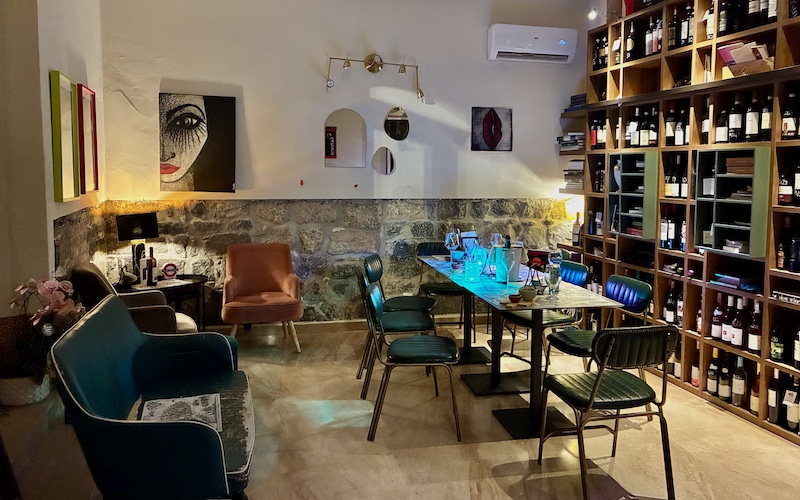
This wine bar on a sleepy piazza in the hill town of Melfi is perfect for a drink before dinner at La Villa. Roberto takes his wine seriously and has a great selection from Basilicata and wider Italy, including a good range by the glass. It’s a cool, casual space where locals gather for an aperitivo and to snack on the likes of crostini with lardo, honey and broad beans or panino filled with porchetta of local black pig with mâche and tomato compote.
What to Drink in Basilicata Elena Fucci (Barile)
One of Italy’s most exciting winemakers, Elena Fucci, has some of the highest vineyards in the Aglianico del Vulture appellation. In 2000, she took over the vineyards planted by her great-grandfather at 600m (1,970′) on the side of Monte Vulture. She combines intuitive knowledge with science, making excellent wine with head and heart. A guided tasting with Elena is the best way to understand Basilicata’s most important grape, aglianico.
What to See in Venosa The Holy Trinity Complex
Venosa, birthplace of the Roman poet Horace (of ‘carpe diem’ fame), is home to a fascinating religious complex. Built on the site of a pre-Christian temple, it bears the hand of the Romans, Lombards and Normans. The ancient church with wonderful Byzantine frescoes and mosaic floors – and ‘new’ unfinished church started in the 12th century and later used by the Knights of Malta – are open to the public and well worth a wander.
Updated 19 Oct 2026
Lucania – the ancient region that covered most of today’s Basilicata – takes its name from the Lucani, an Italic people from central Italy who settled here long before Rome conquered the region in the 3rd century BC.
The name Basilicata probably comes from ‘basilikos’, the Greek word referring to the Byzantine emperors who ruled the region for around 200 years until 1059.
Mussolini’s government officially renamed the region Lucania in 1932, but Italy’s 1947 constitution restored Basilicata. The old name lives on in the region’s people, who still call themselves Lucani, and in its distinctive Lucanian cuisine.
Lucanian cuisine is the traditional food of ancient Lucania, which covered almost all of today’s Basilicata, plus the Cilento in southern Campania, a slice of northern Calabria and the western edge of Puglia’s province of Taranto – although today Lucania is often used interchangeably with Basilicata.
It’s hearty cucina povera (‘cooking of the poor’) rooted in the area’s mountainous, rural past, built on beans and other legumes, durum wheat, vegetables and potatoes combined with a little pork or lamb.
Thrift shows in clever touches: toasted breadcrumbs are sprinkled over pasta in place of cheese, and fresh horseradish, nicknamed ‘poor man’s truffle’, is grated into dishes like rafanata, a baked horseradish frittata.
Look out, too, for protected local specialties such as sheep’s milk cheese Pecorino di Filiano DOP, Canestrato di Moliterno IGP shaped in baskets, fagiolo di Sarconi IGP beans and Peperone di Senise IGP.

Peperoni cruschi (or peperone crusco in the singular) are Basilicata’s crunchy dried peppers, nicknamed the ‘red gold of Basilicata’.
They’re sweet Senise peppers – protected as Peperone di Senise IGP – which are threaded into long garlands called serte and hung to dry. The dried peppers are then quickly fried in olive oil and salted. They’re eaten as a snack, like potato chips, and also often crumbled over pasta. The word ‘crusco’ refers to their crunch.
Lucanica is a pork sausage named after Lucania, the ancient name for Basilicata.
In the 1st century BC the Roman writer Varro recorded that Roman soldiers learnt to make it from the Lucanians; Cicero and Martial both mention it, and Apicius left a recipe for a spiced, smoked version.
Carried by Roman legions across the empire, it gave its name to sausages from northern Italy’s luganega to Portugal’s linguiça, Spain’s longaniza and Greece’s loukaniko.
Basilicata’s best-known version today, Lucanica di Picerno, is protected by an IGP appellation.
Aglianico del Vulture is Basilicata’s most famous red wine, made from 100% aglianico grapes grown on the slopes of Monte Vulture, an extinct volcano 1,326m (4,350′) high in the north of the region.
The thick-skinned, late-ripening grape thrives in the volcanic soils at 200–700m (660–2,300′), where cool nights preserve its acidity, giving powerful, tannic reds that age beautifully.
It became Basilicata’s first DOC in 1971, and in 2010 its Superiore and Riserva wines became the region’s only DOCG.
Venosa packs more than 2,000 years of history into one small town. The Romans founded the colony of Venusia here in 291 BC, extending the Appian Way to it in 190 BC, and the Roman poet Horace was born here in 65 BC.
The Normans made the Holy Trinity abbey the religious centre of their domain, and Robert Guiscard – who conquered much of southern Italy – lies there with his Hauteville brothers.
In late antiquity Venosa was also home to Italy’s second-largest Jewish community after Rome; its 4th–6th-century catacombs still bear inscriptions in Hebrew, Greek and Latin.