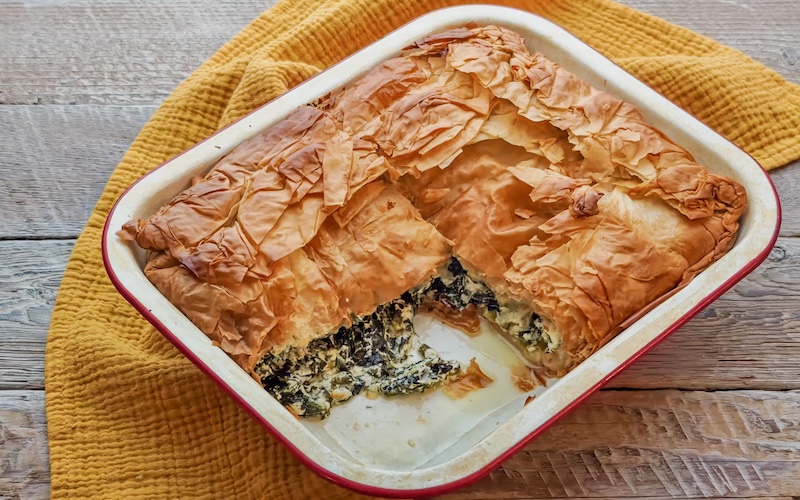
I developed my recipe for spanakopita years ago, in consultation with a Greek friend whose Mum made the best spanakopita I’d ever tasted. I use a 21cm (8½″) square baking dish to give four chunky serves, but use whatever size and shape you have and alternate the pastry sheets in a way to cover all of the sides as well as the base. For a more delicate presentation, and more fillo crunch, cut the fillo into long strips, place a tablespoon or so of filling at one end and fold over and over into little spinach and cheese triangles, or roll into fillo cigars. These smaller pastries will only take 15–20 minutes to bake and are great finger food for parties or as a starter. Spanakopita is likely a descendant of the traditional Greek hortopita, filled with wild greens foraged in the hills and fields – so feel free to swap out the spinach for any leafy greens including beetroot tops, nettles, chicory or dandelion. Chef Janni Kyritsis says he’s even made it with radicchio – see the video below of him making his famous wild weed pie. Janni taught me that the secrets to success with any of these Greek fillo pastry pies is to squeeze the greens well to remove excess moisture, be very generous with the olive oil, and bake until the pastry is really dark golden. I serve my spanakopita with tzatziki and a salad of mixed heirloom tomatoes and red onion for a bit of contrasting colour. And while a glass of ouzo would be appropriate, I prefer Lark Hill’s grüner veltliner, a delicious Austrian variety with the zing of riesling and some of the floral aroma of gewürztraminer. This biodynamic Canberra winery was the first to release grüner veltliner in Australia and theirs compares very favourably with the Austrian versions I’ve had. Yiasou!
Serves 4
Share page on:
In Greek the word pita means pie, and horto (horta in the plural) means wild greens or weeds – a vegetarian in Greek is a hortofagos (greens eater).
There are many types of Greek pies – spanakopita, tiropita (cheese), prasopita (leeks) and hortopita among them. Hortopita – often called ‘wild weed pie’ (see video above) – is the most rustic, and likely the ancestor of the spanakopita most people know today. Hortopita was a peasants’ dish made with whatever edible greens could be foraged from the hillsides and fields, including nettles, chicory, dandelion, wild sorrel, and amaranth.

While spanakopita literally means ‘spinach pie’ it’s essentially a refined, urban version of hortopita that became popular once cultivated spinach was widely available. The method is the same regardless of the greens used and it’s a great way to make the most of seasonal abundance in the garden – I often make it with the greens from a bunch of beetroot (beets), which have a lovely earthy flavour and would otherwise go in the bin. Bitter leaves like chicory, dandelion, or even radicchio, work particularly well as they balance the richness of the cheese and oil.
Yes, spanakopita can easily be made as finger food.
While a large tray-baked spanakopita is a popular family meal served in squares with a salad, small spinach and cheese triangles – or cigar-shaped rolls – made from the same ingredients are perfect finger food. They work well for cocktail parties, as part of a mezze or as a starter.
The Greek kitchen has a whole family of pies using filo pastry with different fillings – collectively called pita. Tiropita is a cheese-only pie, typically made with feta and egg. Prasopita is a leek and cheese pie often containing graviera cheese. Kreatopita is a meat pie, and hortopita uses wild greens. All are made with filo pastry either as a large tray baked pie or small individual triangles or cylinders.