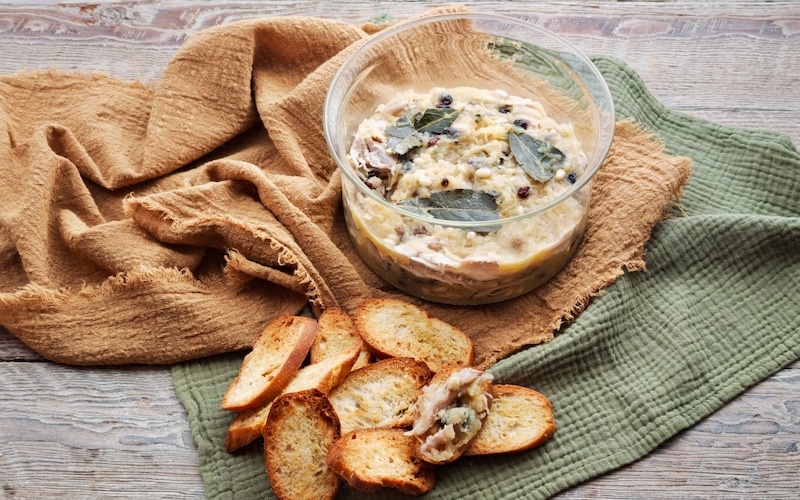
You may be familiar with the Venetian dish of sardines in saòr (sardelle in saòr), sardines marinated in a sweet and sour onion mixture (if not, see FAQ below). In the province of Padua, just outside Venice, they serve the prized local Padovan hens in a dish called gallina in saòr. It’s often referred to as ‘pulled chicken’ in English, which doesn’t do this delicious regional specialty justice. Gallina in saor is a perfect dish for entertaining as it’s best made a day ahead so the chicken has time to marinate in the sweet and sour onion mixture – just be certain to remove it from the fridge an hour or so before serving as it should be eaten at room temperature (ideal for ‘bring a plate’ parties). Leftovers keep well for a couple of days too. Gallina in saòr is typically an appetiser, served in a bowl with a pile of crisp crostini for texture. I first had it this way in my favourite restaurant in Padova, Bacaro Padovano. It can also be plated as a starter with a drizzle of olive oil, grind of pepper and colourful accompaniment like agro-dolce radicchio, which is how it is served at Agriturismo Ca’ de Memi where owner Michela Tasca included it in a cooking class for my Veneto food & wine tour. Michela uses a whole Padovan hen, as is traditional – I use chicken marylands as the darker meat of the thigh and drumstick stays juicier and has more flavour than the breast of commercially available chickens. Whatever chicken you use, freeze the cooking liquid to use as stock for other recipes like risotto (see video below). Gallina in saor needs a wine with good body to meet the slightly sweet and sour flavours. I love Greysands pinot bianco from Tasmania with it – the notes of melon and nectarine, great acid and touch of bitterness on the finish harmonise beautifully with this unusual Italian ‘pulled chicken’.

Serves 8 as an appetiser or starter

Ingredients
  • 650g chicken maryland (1lb 7oz)
  • 1 stalk celery, chopped
  • 1 small carrot, chopped
  • 750g brown onions, very thinly sliced (11oz)
  • Salt flakes and freshly ground white pepper, to taste
  • 2 tablespoons extra virgin olive oil, plus extra for drizzling (40ml)
  • 3 fresh bay leaves, torn
  • ½ teaspoon black peppercorns
  • 4 dried juniper berries
  • 2 teaspoons white sugar
  • 2 tablespoons white wine vinegar (40ml)
  • 20g currants, soaked in warm water for at least 30 minutes, drained (¾oz)
  • 15g pine nuts (½oz)
  • Crostini, for serving
Method
  1. Place chicken, celery, carrot, and a handful of the onion (about 60g/½ an onion) in a large saucepan.
  2. Add enough water to cover well and salt generously, using 10g salt/litre water (⅓oz salt/2 pints water).
  3. Bring to the boil, reduce heat, cover and simmer for 1 hour.
  4. Meanwhile, place oil in a frying pan with remaining onion, bay, peppercorns, juniper and a good pinch of salt.
  5. Stir to combine well, cover and cook over low heat, stirring occasionally, for about 30 minutes until very soft but not coloured.
  6. Stir in sugar then vinegar, increase heat to high and stir well to remove any bits stuck to the base of the pan, stir for a minute or so until virtually all of the liquid has evaporated.
  7. Remove from heat and stir in currants and pine nuts.
  8. Taste and add salt if needed. Set aside.
  9. Strain cooked chicken, reserving stock for another use. Set chicken aside until cool enough to handle and discard remaining solids.
  10. When cool, shred the meat, discarding skin and bones.
  11. Spread a third of the onion mixture over the base of a glass or ceramic dish, top with half the chicken, then another third of the onion, remaining chicken, and a final layer of onion, arranging some bay on top for garnish.
  12. Cover and refrigerate overnight.
  13. Remove from the fridge about 1 hour before serving to bring to room temperature.
  14. Serve with crostini.

Share page on:

How To Make Risotto

What Other Travellers Say

Janet (Tamworth, NSW, Aus.)
Just back from the most amazing trip to Emilia-Romagna with Roberta. Not only the home of Prosciutto di Parma, Parmigiano-Reggiano & Balsamic Vinegar, but scenery to die for and more quaint and exciting restaurants and cafés than you ever imagined. And Roberta is just the person to help you discover and enjoy them! Her knowledge of the history of the region and its wonderful cuisine know no bounds and all added to the excitement of the trip. It was faultless - well organized and lots of fun!
Deb (Belconnen, ACT, Aus.)
Wow, what a tour – I learned so much! Awesome fun traveling through Emilia-Romagna experiencing first hand some of the produce I've worked with over the last couple of years cooking with Roberta's recipe kits – the family are reaping the benefits now. If you're thinking of joining Roberta in future years get ready for an amazing experience.
Mark (Elizabeth Bay, NSW, Aus.)
My wife and I recently joined Roberta's Emilia-Romagna tour. We enjoyed all the temptations offered and learned a lot about that part of Italy, especially its food and wine culture. What was most impressive was Roberta's local knowledge of people and places. The planning and effort she put into making the whole experience seem effortless was remarkable.
Karen (Bowral, NSW, Aus.)
Our tour with Roberta through Emilia-Romagna was the highlight of the year. Good company, gorgeous palazzi and great food. What more could one ask for? Roberta's enthusiasm and knowledge made this a once in a lifetime experience through an extraordinary, diverse and very special region.
Shelley (Auckland, NZ)
Roberta’s passion for Italy shone throughout an unforgettable food and wine tour. She introduced us to family-owned artisanal producers, where we experienced everything from attic-aged balsamic to small-batch wines, Parma ham and Parmigiano-Reggiano. The local guides were equally passionate, and the excellent transport and accommodation made the trip effortless. This tour captured the region’s traditions, flavours and people, and thanks to Roberta’s deep knowledge we left with wonderful memories. A truly authentic culinary adventure — highly recommended.

Venetian ‘in Saor’ FAQ

What is Venetian saòr (saor)?

In Venice, and the surrounding region of Veneto, saòr is a traditional preservation technique. Seafood – typically small oily sardines – were stored in a sweet and sour marinade of slowly cooked onion, vinegar, and sugar to preserve them for long sea voyages. Over time, currants, raisins and pine nuts were added to the recipe, a reminder of the Venetian Republic’s trading ties with the Eastern Mediterranean. When used for preservation, to prevent spoilage the vinegar and sugar levels would have been much higher than they are in modern recipes.


What does ‘in saòr’ (in saor) mean?

Saòr is the Venetian dialect word for the Italian ‘sapore’ meaning ‘flavour’ or ‘savoury’ a reference to the tastiness of food prepared with this sweet and sour onion marinade.

Can anything other than sardines be prepared ‘in saòr’ (in saor)?

In the Venetian province of Padua, the Padovana hen is prepared in saòr. This colourful ancient breed has a distinctive feather crest and is prized for its tasty meat. Being a traditional breed the flesh is firm and well-suited to slow cooking and marinating, retaining its flavour and texture. If making gallina in saor with commercially-available chickens it’s best to use the darker thigh and drumstick meat which will remain juicy, as the breast meat of these birds tends to be tasteless and dry out easily.

Subscribe To My Newsletter & Get A Free Online Italian Cooking Class (RRP $39)