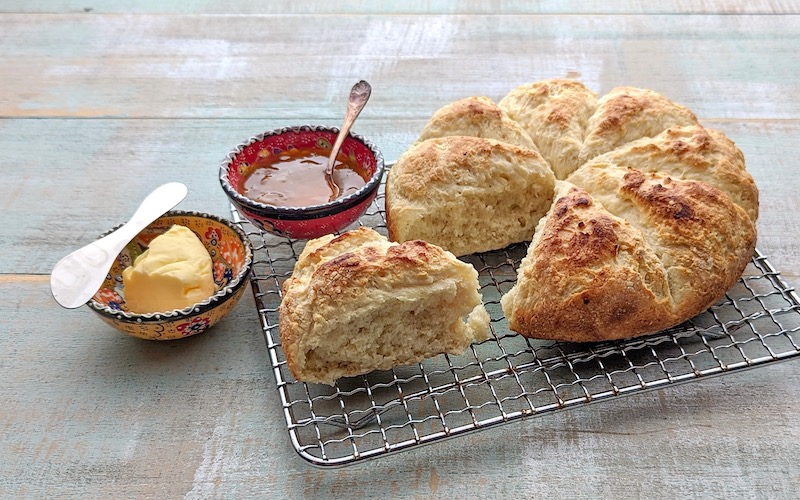
People dropping by unexpectedly? All you need is self-raising flour, milk and 30 minutes to whip up a batch of scones (see FAQ below if you only have plain flour). If you have buttermilk (thanks Pepe) they’ll be even lighter! The first time I tried to make scones, they turned out more like rock cakes, then I discovered the golden rule: handle the dough as little as possible. A light touch and a hot oven are the secrets to light fluffy scones, so I prefer this method of making one large round cut into segments, rather than shaping them into rounds then reforming the dough to use the offcuts. Buttermilk scones are one of the quickest and easiest sweet treats to make, and perfect with a cup of smoky Russian Caravan tea. Once you’ve mastered this basic recipe, you can make scones flavoured with just about anything, including cheese scones, date scones, herb scones, and pumpkin scones.
Makes 8 pieces
Ingredients
300g self-raising flour (10½oz), plus extra for dusting
50g cold salted butter, diced, plus extra for greasing (1¾oz)
220ml buttermilk, plus extra for brushing (just under 1 cup)
Jam, for serving
Butter or cream, for serving
Method
Preheat oven to 250°C (480°F).
Sift flour into a bowl.
Add butter and use your fingertips to rub it into the flour until there aren’t any more lumps.
Make a well in the centre, add buttermilk and use a pastry scraper or hard spatula to cut it into the flour to form a soft sticky dough.
Turn onto a lightly floured bench, dust your hands with flour, and pat into a 3cm-thick round (about 1¼″).
Place in a lightly greased and floured round cake tin (springform is easiest).
Use a pastry scraper or hard spatula dipped into flour to mark the round into eighths, pressing all the way through.
Brush top with buttermilk.
Place in oven, reduce temperature to 240°C (465°F) and bake for 15–20 minutes, until well-browned.
Transfer to a wire rack to cool a little.
Break the round into individual buttermilk scones and serve warm with jam and butter or cream.
Just back from the most amazing trip to Emilia-Romagna with Roberta. Not only the home of Prosciutto di Parma, Parmigiano-Reggiano & Balsamic Vinegar, but scenery to die for and more quaint and exciting restaurants and cafés than you ever imagined. And Roberta is just the person to help you discover and enjoy them! Her knowledge of the history of the region and its wonderful cuisine know no bounds and all added to the excitement of the trip. It was faultless - well organized and lots of fun!
Deb (Belconnen, ACT, Aus.)
Wow, what a tour – I learned so much! Awesome fun traveling through Emilia-Romagna experiencing first hand some of the produce I've worked with over the last couple of years cooking with Roberta's recipe kits – the family are reaping the benefits now. If you're thinking of joining Roberta in future years get ready for an amazing experience.
Mark (Elizabeth Bay, NSW, Aus.)
My wife and I recently joined Roberta's Emilia-Romagna tour. We enjoyed all the temptations offered and learned a lot about that part of Italy, especially its food and wine culture. What was most impressive was Roberta's local knowledge of people and places. The planning and effort she put into making the whole experience seem effortless was remarkable.
Karen (Bowral, NSW, Aus.)
Our tour with Roberta through Emilia-Romagna was the highlight of the year. Good company, gorgeous palazzi and great food. What more could one ask for? Roberta's enthusiasm and knowledge made this a once in a lifetime experience through an extraordinary, diverse and very special region.
Shelley (Auckland, NZ)
Roberta’s passion for Italy shone throughout an unforgettable food and wine tour. She introduced us to family-owned artisanal producers, where we experienced everything from attic-aged balsamic to small-batch wines, Parma ham and Parmigiano-Reggiano. The local guides were equally passionate, and the excellent transport and accommodation made the trip effortless. This tour captured the region’s traditions, flavours and people, and thanks to Roberta’s deep knowledge we left with wonderful memories. A truly authentic culinary adventure — highly recommended.
FAQ
How do you make self-raising flour?
No self-raising flour? No worries. Just add 1½ teaspoons of baking powder to each cup of plain flour. But be sure to check the baking powder is fresh or you’ll have rock cakes instead of scones.
Does baking powder go stale?
Yes, baking powder does lose its effect after 12 months or so. To test if it’s fresh, stir a little into hot water – if it fizzes it’s still fresh enough to use; if it doesn’t, it’s time to buy a fresh batch.
What’s the difference between baking powder and baking soda?
Baking soda is another name for bicarbonate of soda. Baking powder is a mixture of 1 part bicarbonate of soda and 2 parts cream of tartare.
Are cream of tartare and tartaric acid the same thing?
Not exactly, cream of tartar is tartaric acid mixed with potassium hydroxide to neutralize the acid, so cream of tartare doesn’t have the acidic tang of tartaric acid.
Subscribe To My Newsletter & Get A Free Online Italian Cooking Class (RRP $39)