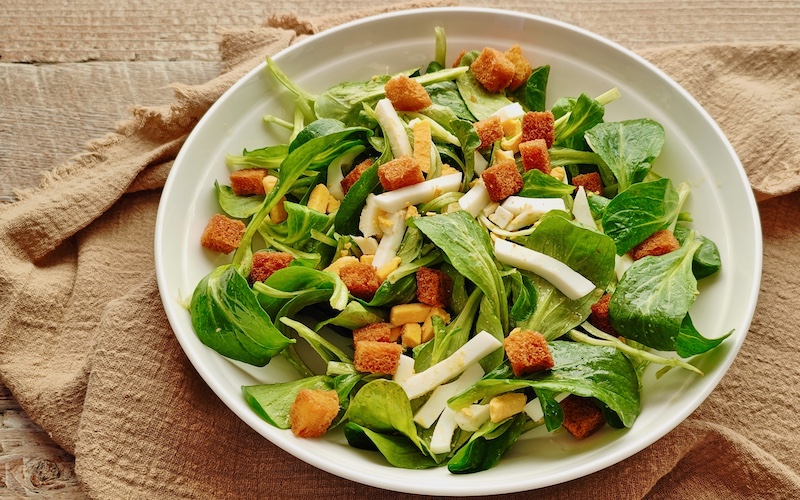
Swiss salads are often like a slaw or remoulade – such as Swiss kohlrabi & herb salad and Swiss cucumber salad – rather than based on leafy greens. The exception is nüsslisalat, which appears on almost every Swiss restaurant menu. You may know this small spoon-shaped leaf by its French name mâche (pronounced mahsh). It’s also called lamb’s lettuce because the leaves are shaped like lambs’ tongues, and cornsalad as it traditionally grew wild among the grain crops. The Swiss name, nüsslisalat, refers to its slightly nutty flavour. In Switzerland these small, spoon-shaped leaves are traditionally garnished with croûtons and finely chopped boiled egg and almost always served with a cream dressing. I prefer a classic vinaigrette, just enough to lightly coat the leaves – you may not need it all and any leftover can be stored in the jar in the fridge for at least a week. In Switzerland salad is typically a separate course, and nüsslisalat is a deliciously simple starter. It’s also a great accompaniment to grilled or roasted meat and Swiss dishes, from Chässchnitte to mushrooms in cream sauce.

Serves 2 as a starter

Ingredients
  • 100g mâché lettuce (3½oz)
  • 1 egg, hard boiled
  • 1 slice white bread
  • Vegetable or olive oil, for shallow-frying

Vinaigrette

  • 3 teaspoons agrodolce white wine vinegar (15ml)
  • Salt flakes and freshly ground white pepper, to taste
  • ½ teaspoon Dijon mustard
  • 2 tablespoons extra virgin olive oil (40ml)
Method
  1. Separate the mâche leaves, discarding any roots; wash and dry well.
  2. Make Vinaigrette: Place vinegar, salt, pepper and mustard in a screw-top jar and shake to dissolve salt. Add oil and shake to emulsify. Set aside.
  3. Chop egg finely, set aside.
  4. Discard crusts from the bread and cut into 1cm (½″) cubes.
  5. Heat oil in a small saucepan and fry bread until golden and crisp. Drain on paper towel and set aside.
  6. When ready to serve, toss leaves with half the Vinaigrette, adding more if needed to coat well.
  7. Arrange in a salad bowl, top with egg and croûtons and serve.

Share page on:

Nüsslisalat (Lamb's Lettuce Salad)

What Other Travellers Say

Janet (Tamworth, NSW, Aus.)
Just back from the most amazing trip to Emilia-Romagna with Roberta. Not only the home of Prosciutto di Parma, Parmigiano-Reggiano & Balsamic Vinegar, but scenery to die for and more quaint and exciting restaurants and cafés than you ever imagined. And Roberta is just the person to help you discover and enjoy them! Her knowledge of the history of the region and its wonderful cuisine know no bounds and all added to the excitement of the trip. It was faultless - well organized and lots of fun!
Deb (Belconnen, ACT, Aus.)
Wow, what a tour – I learned so much! Awesome fun traveling through Emilia-Romagna experiencing first hand some of the produce I've worked with over the last couple of years cooking with Roberta's recipe kits – the family are reaping the benefits now. If you're thinking of joining Roberta in future years get ready for an amazing experience.
Mark (Elizabeth Bay, NSW, Aus.)
My wife and I recently joined Roberta's Emilia-Romagna tour. We enjoyed all the temptations offered and learned a lot about that part of Italy, especially its food and wine culture. What was most impressive was Roberta's local knowledge of people and places. The planning and effort she put into making the whole experience seem effortless was remarkable.
Karen (Bowral, NSW, Aus.)
Our tour with Roberta through Emilia-Romagna was the highlight of the year. Good company, gorgeous palazzi and great food. What more could one ask for? Roberta's enthusiasm and knowledge made this a once in a lifetime experience through an extraordinary, diverse and very special region.
Shelley (Auckland, NZ)
Roberta’s passion for Italy shone throughout an unforgettable food and wine tour. She introduced us to family-owned artisanal producers, where we experienced everything from attic-aged balsamic to small-batch wines, Parma ham and Parmigiano-Reggiano. The local guides were equally passionate, and the excellent transport and accommodation made the trip effortless. This tour captured the region’s traditions, flavours and people, and thanks to Roberta’s deep knowledge we left with wonderful memories. A truly authentic culinary adventure — highly recommended.

Mâche (Lamb's Lettuce) FAQ

What is the correct French spelling and pronunciation for lamb's lettuce?

In French, lamb’s lettuce is called mâche, pronounced mahsh. It’s sometimes misspelled with an accent over the e (maché), but this is incorrect. Mâche is also sometimes called douceur in French, meaning sweet (or in this case tender), though that name can also refer to other delicate lettuces such as butter lettuce.


What are other names for mâche?

Mâche (Valerianella locusta in Latin) is also known as nüsslisalat, lamb’s lettuce, corn salad, field salad, feldsalat, fetticus (from the Dutch vetticost), douceur and rapunzel .

Why is mâche called lamb's lettuce?

Mâche is often called lamb’s lettuce (or lambs lettuce) because its small spoon-shaped leaves resemble the shape of a lamb’s tongue.

Why is lamb's lettuce called corn salad, field salad or feldsalat?

Lamb’s lettuce (mâche) traditionally grew wild among the grain crops and was foraged as a wild weed, therefore it’s known as corn salad (corn once referred to any grain, not just maize) as well as field salad (feldsalat in German).

Why is mäche called nüsslisalat in Swiss German?

The name nüsslisalat, literally ‘nut salad’, refers to the slightly nutty flavour of this delicate salad green.

Why is mâche (lamb's lettuce) called rapunzel?

Mâche is also known as rapunzel because in the Brothers Grimm fairytale of that name it was the salad green that Rapunzel’s father stole from the witch’s garden for his wife.

What does mâche taste like?

Mâche (nüsslisalat) has a delicate, slightly nutty flavour and soft, tender texture.

What does mâche look like and how is it sold?

Mâche (lamb’s lettuce or corn salad) consists of small, dark green, spoon-shaped leaves that grow in small rosettes or clumps. It is available in punnets from many greengrocers.

Subscribe To My Newsletter & Get A Free Online Italian Cooking Class (RRP $39)