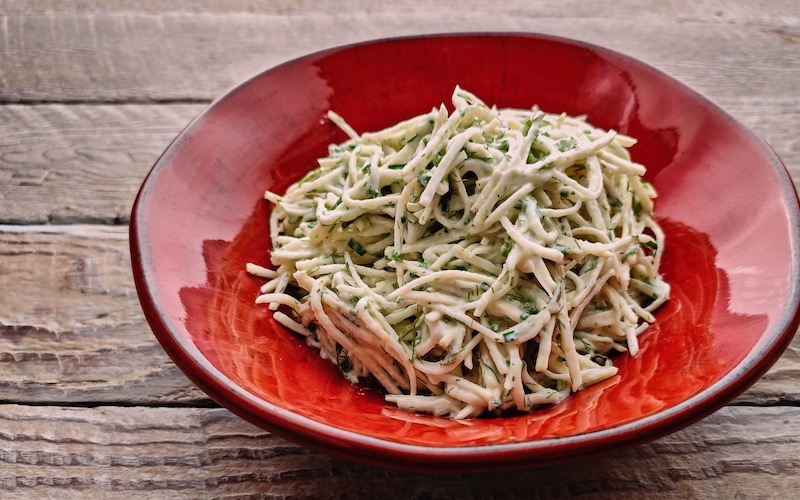
The Swiss love creamy salad dressings, often using yoghurt to supply both the creaminess and a little tang. Finely sliced root vegetables such as kohlrabi or celeriac are often served this way. As celeriac are much larger than kohlrabi, you’d need about half a small one for this salad. This kohlrabi salad makes a great side dish for any grilled meat or seafood as well as Swiss cheese tarts (Chäschueche) and vol-au-vents (Pastetli) and I have been known to have a bowl of it for lunch with some toasted sourdough bread and a glass of Torre Rosazza pinot grigio. Use a good prepared horseradish, a lot hardly have any heat so check the contents on the label. I love the American brand Beaver from Oregon; see the video below for another easy Swiss salad using it.
Serves 4 as a side dish
Horseradish Dressing
Share page on:
Kohlrabi is a member of the brassica family, related to cabbage and broccoli, with a mild, slightly sweet flavour somewhere between a radish and a water chestnut. The edible bulb is actually the swollen stem of the plant, not a root vegetable as many people assume. It’s widely eaten across Central Europe, particularly in Switzerland, Germany and Austria, where it’s a staple salad and side dish ingredient.

Kohlrabi is easy to prepare — peel the outer skin, then slice thinly on a mandolin and cut into fine matchsticks for salads, or cook it as you would celeriac or turnip. Both the purple and green varieties taste the same; choose smaller bulbs as they tend to be more tender and less woody.
Raw kohlrabi has a crisp texture and mild, slightly sweet, peppery flavour — more delicate than turnip, less sharp than radish. It pairs beautifully with creamy dressings, fresh herbs and horseradish, as in this Swiss kohlrabi salad.
Celeriac makes the best substitute for kohlrabi in most dishes, including salad. For this recipe, slice a quarter of a small celeriac the same way. Thinly sliced fennel also works well and adds a pleasant anise note alongside the horseradish dressing.