It takes a bit of practice to learn how to make caramel – the skill is in knowing just the right moment to take the pan off the heat.
Professionals make caramel without water, just heating pure sugar. This is quicker, but more likely to end in a burnt mess. For the home cook it’s better (at least initially) to add some water to the sugar so that it cooks more slowly, giving you more time to manage it.
Depending on the pan, the heat level and the amount of water, I’ve had it take anywhere from 8 to 20 minutes for the sugar to caramelise. So patience is another key component.
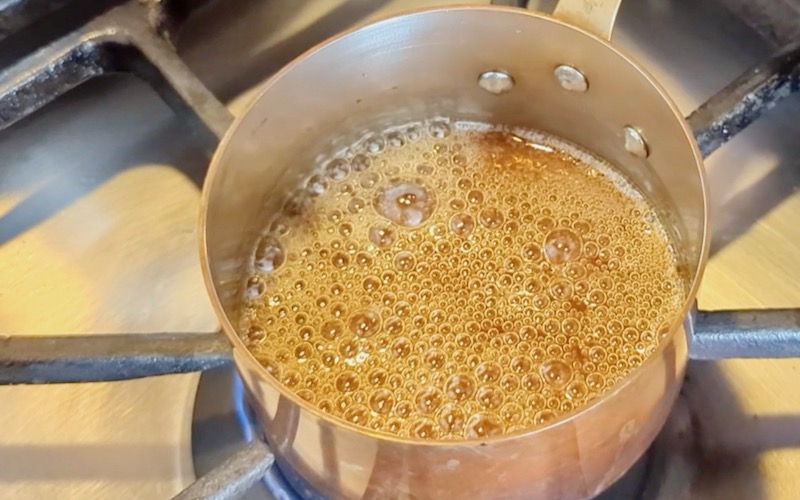
Most of the time it can be left to its own devices. Just keep glancing at it to see if it’s changed colour. Once the caramel starts to turn golden, it changes quite quickly. That’s when you need to stand by, swirling the pan regularly so it colours evenly. At this stage the bubbles will subside to a tiny froth and it’ll suddenly smell delicious. Then you whip your caramel off the stove and pour it into the waiting dish – whether that’s a ramekin for crème caramel or a cake tin for an upside-down pineapple cake.
To make ¼ cup of caramel, you’ll need:
¼ cup castor sugar
1 tablespoon water
Here’s how to make caramel (scroll down for a step-by-step video).
Combine sugar and water in a small heavy-based saucepan and place over a medium heat.
Cook without stirring until it’s dark golden, swirling the pan as it starts to caramelise so it colours evenly; the above quantity should take around 10 minutes to caramelise.
Once it’s dark golden, remove from heat quickly and transfer to the necessary dish.
Soak the pan immediately to make it easy to clean.
Now you know how to make caramel, use your new skill to whip up some praline, or desserts as diverse as French crème caramel, Caribbean flan and Vietnamese glutinous red rice with coconut caramel sauce.
This is usually caused by stray sugar crystals on the side of the pan (from stirring, or sugar splashed up early on) seeding crystallisation through the syrup. In my experience it doesn’t happen often as long as you avoid stirring once it’s on the heat. If you get a lot of buildup of sugar crystals on the side of the pan, you can brush them down with a wet pastry brush.
How do you know when caramel is ready without a thermometer?
Colour is the best guide — a deep golden-amber, similar to dark honey, means it’s ready. Any paler and it will taste too sweet. You can let it get a little darker for a more bitter-sweet flavour, but do not let it burn.
What Other Cooks Say
Melisa (Beacon Hill, NSW)
We made the pot-sticker dumplings and bang bang chicken from the Chinese class the other night. Once again both exceeded our expectations. My husband keeps saying it’s better than going out to restaurants as the recipes and quality are amazing.
Glennis (Caringbah South, NSW)
The whole Be Inspired experience has helped me love cooking again. I was sick of cooking the same old things - meal time is a lot brighter thanks to you Roberta.
Pam (Cammeray, NSW)
Your recipes are something I always feel confident offering guests and also reasonable in the time to prepare. We often try your recommended wines and suppliers and enjoy your travel tales too!
Darcy, Austin TX (USA)
I find your weekly check-in to my kitchen an inspiration with chatty, warm, inspiring dishes to experience. Recently I was looking for a recipe for Persian spice blend advieh and yours was the first to catch my attention, even before I knew it was written by you. What a fun surprise to see your happy, calming face with a new friend sharing the benefits of Persian cooking.
Katrina (Arncliffe, NSW)
I am absolutely loving Be Inspired! There are ingredients I have never worked with before so having the confidence to try something new is so much fun! The recipes are just amazing and the notes on what can be prep’d beforehand are a great help too. Thank you so much.
Deb (Belconnen, ACT)
Awesome fun traveling through Emilia-Romagna experiencing first hand some of the produce I've worked with over the last couple of years cooking with Roberta's classes – the family are reaping the benefits now.
Judith (Woronora, NSW)
Food, wine and travel! Three of my favourite things! Be Inspired with Roberta has been a wonderful experience and given me more confidence in the kitchen. I have learnt so much, cooked things I never would have attempted without Roberta’s excellent videos, and used ingredients I have never tried before.
Sandra (Garran, ACT)
I'm a competent cook whose learned so much from Roberta's online cooking classes. The recipes are yummy and Roberta’s video guidance offers so many little tips to improve flavour and organise the flow of preparation. I enjoy her warmth, sense of humour, and ability to giggle at herself when she occasionally messes up.
Subscribe To My Newsletter & Get A Free Online Italian Cooking Class (RRP $39)