Amalfi Coast For Food Lovers

Amalfi is my favourite place in southern Italy. Not just the pretty town itself, but the villages around it like Scala, Ravello and Tramonti high above the coast. 

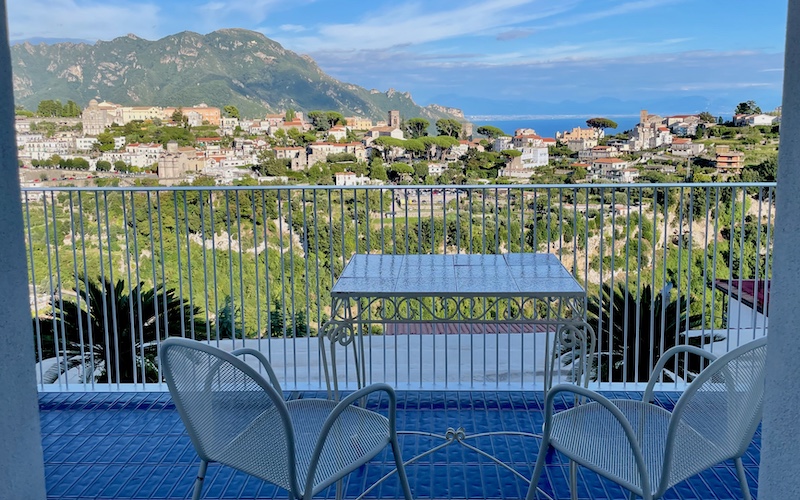
View of Ravello from Hotel Zi'Ntonio in Scala - Amalfi Coast Food Guide

The scenery is spectacular and the food and wine delicious. But what really makes the Amalfi Coast special is the people. When visiting the Costiera Amalfitana, I’m always most excited about the people I’ll meet there, and the way they love to share their passion for their land and culture. Over many visits I’ve developed friendships with locals who’ve shown me the real Amalfi Coast, away from the traffic jams and crowded beaches. High up in the clouds – where the grapes and other fresh produce grow – the air is cool, the views magnificent and the welcome warm. This Amalfi Coast food guide shares just a few of the reasons I love any excuse to visit this wonderful part of the southern Italian region of Campania.

Hotel Z'Ntonio (Scala) - Amalfi Coast Food Guide

Where to Stay on the Amalfi Coast Hotel Zi’Ntonio
Stefano and his team at this family-run albergo in Scala treat guests like extended family. Papà Ciccio grows much of their produce on the terraced organic farm opposite, while Mamma Marinella shares family recipes at hands-on cooking classes. The terrace – with views of Ravello and the coast – is the perfect spot for delicious breakfasts (try caponata Napoletana) and aperitivi. The comfortable rooms all have balconies with stunning views.

Spaghetti alle vongole being served at Ristorante da Ciccio - Amalfi Coast Food Guide

Where to Eat on the Amalfi Coast Ristorante da Ciccio
One of my favourite restaurants in Italy is run by the same family that owns Hotel Zi’Ntonio: brothers Marco (chef), Giuseppe (sommelier) and Antonio (manager). Papà Ciccio’s organic produce features on the menu alongside the local fishermen’s daily catch. Service is refined yet friendly, there’s a great wine list and theatrical gueridon. Plus the best spaghetti vongole al cartoccio ever and great gnocchi Sorrentina (see video below).

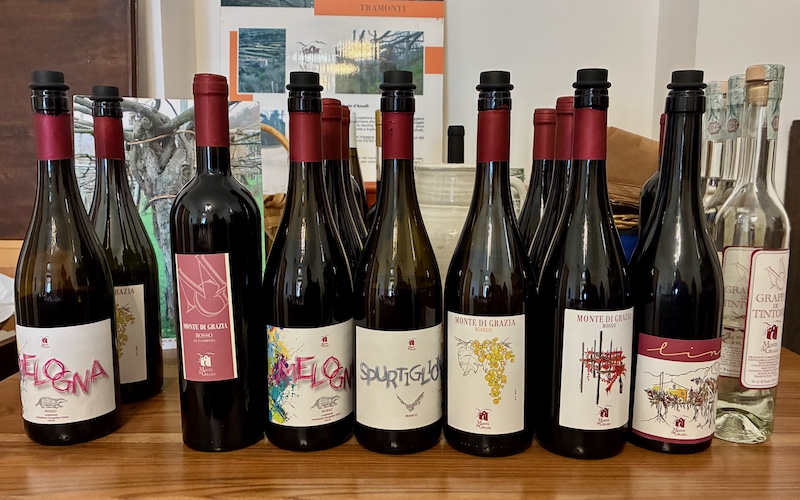
Monte di Grazia wines in Tramonti (Amalfi Coast)

What to Drink on the Amalfi Coast Tramonti Wines
Tramonti, in the cool hills above Amalfi, is one of only three villages in the Costa d’Amalfi appellation that can list the village as a sub-zone. At Monte di Grazia winery, Olivia and her parents, Alfonso and Anna, make delicious organic wines from pre-phylloxera vines over 150 years old – some of the stems are as thick as tree trunks. I love a glass of Tramonti wine under the canopy of lemon trees in the garden of nearby casual Agriturismo da Regina too.

Agricola Ruocco on the Path of The Lemons - Amalfi Coast Food Guide

Where to Walk on the Amalfi Coast Path of the Lemons
Amalfi lemons are famous and, whether or not you walk the full ‘Path of the Lemons’ from Minori to Maiori, it’s worth the climb to Agricola Ruocco, a rustic refreshment stand at the top of the ‘Sentiero dei Limoni’. Giovanni and Nadia serve lemonade, limoncello, lemon jam and marinated lemon salad, and may invite you to peek inside their beautiful garden of lemon and other fruit trees. As the path doesn’t pass through actual lemon groves, this is a treat.

View of town of Amalfi at dusk - Amalfi Coast Food Guide

What to Visit on the Amalfi Coast Amalfi
Amalfi, once the capital of a powerful maritime republic rivalling Pisa and Genoa, is now often overlooked in favour of larger Salerno and Sorrento. Which suits me! Most visitors are day trippers, so visit early to wander uninterrupted around the harbour and up the narrow main street built into a deep ravine. Enjoy a coffee at 200-year-old Pasticceria Andrea Pansa on the main piazza, then head back to the hills before the tourists arrive.

Sant'Andrea Cathedral Amalfi - Amalfi Coast Food Guide

Art & Culture on the Amalfi Coast Sant’Andrea
Before you leave Amalfi, visit its impressive 10th-century duomo, where the bones of Saint Andrew are said to lie in the ornate crypt. The adjoining ‘Cloister of Paradise’ reflects the church’s Arabic influence and houses an open-air museum with artefacts displayed around a beautiful central garden. The Basilica of the Crucifix next door, built in the 9th century, was the original cathedral and is now a museum containing gorgeous frescoes.

Updated 19 Oct 2026

Gnocchi alla Sorrentina

Amalfi Coast Food & Wine FAQ

Where is the best place to stay on the Amalfi Coast?

For food and wine lovers, the hill villages above the coast are the best base for exploring the Amalfi Coast. They’re cooler and quieter than the towns right on the water and surrounded by the terraced farms, lemon groves and vineyards that supply local kitchens.

While Positano is the most photographed village – with steep stairs and the busiest summer season – the town of Amalfi sits about halfway along the coast that carries its name, which stretches 50km (30 miles) from Positano to Vietri sul Mare. Amalfi is the area’s transport hub, with buses and ferries in both directions.

Ravello and Scala, around 350–400m (1,150–1,300′) above the sea, offer sweeping coastal views and evenings at a slower, local pace, just a short drive from Amalfi. Scala, opposite Ravello, is traditionally considered the oldest town on the Amalfi Coast. Today it has a population of just 1,500 people across 6 hamlets.

Why is Ravello famous?

Ravello is famous as the Amalfi Coast’s ‘City of Music’, thanks to the gardens of Villa Rufolo.

Built in the 13th century for the wealthy Rufolo merchant family, the villa was restored in the mid-1800s by a Scottish botanist who created its cascading terraced gardens. When composer Richard Wagner visited in 1880, he was so taken with them that he made them the model for Klingsor’s enchanted garden in Act II of his opera Parsifal.

Since 1953 the Ravello Festival has held summer concerts on a stage that juts out over the sea in the villa’s lower garden.

What wines are made on the Amalfi Coast?

Amalfi Coast wines are protected by the Costa d’Amalfi DOC, established in 1995 and covering the coast’s 13 municipalities.

Three sub-zones – Tramonti, Ravello and Furore – are permitted to list their names on the label. Each also takes in neighbouring villages, so wines from Scala, for example, fall within the Ravello sub-zone.

White wines are based on falanghina and biancolella, often blended with rare local varieties such as fenile, ginestra, pepella and ripoli.

Reds and rosés blend piedirosso, aglianico and sciascinoso, and Tramonti reds must include at least 20% tintore, a local red-fleshed grape whose name means ‘dyer’.

What are Amalfi lemons?

Amalfi lemons – or Sfusato Amalfitano – are a fragrant, spindle-shaped lemon grown on steep terraces in villages along the Amalfi Coast. The name Limone Costa d’Amalfi IGP has been protected since 2001. These drystone-walled terraces are a key reason UNESCO World Heritage listed the Amalfi Coast as a cultural landscape in 1997.

Sfusato lemons have medium-thick, pale yellow skin rich in essential oils which give them a fabulous aroma. The skin is the secret of genuine Amalfi Coast limoncello – Liquore di Limone della Costa d’Amalfi – which can only be made by steeping the peel of Sfusato lemons in neutral spirit for at least 36 hours within the Amalfi Coast’s 13 municipalities.

The juicy, semi-sweet flesh of Amalfi lemons has very few seeds and is sweet enough that locals slice it into salads. Mozzarella grilled between two lemon leaves is a popular Amalfitana dish.

What is the Path of the Lemons?

The Path of the Lemons – Sentiero dei Limoni in Italian – is a steep 4km (2½ miles) path that runs between the Amalfi Coast towns of Minori and Maiori.

It’s largely a narrow walkway between houses and the stone walls of lemon groves, with occasional vantage points that have impressive views of the coast.

As recently as the 1970s, orchard workers carried huge baskets of freshly picked lemons along this and other narrow paths on the steep slopes of the Amalfi Coast.

What was the Maritime Republic of Amalfi?

Amalfi was the capital of a powerful maritime republic from 839 AD, trading throughout the Mediterranean. Its merchants grew rich as middlemen – selling timber, grain and salt to the Arabs for gold that they then used to buy Byzantine silks to sell in Europe.

Governed by dukes from 958, it produced the Tavole Amalfitane – one of the earliest maritime codes in the Western world. Its 66 chapters set the rules of sea trade, from the cost of hiring a boat to what to do in a shipwreck, and ports across the Mediterranean followed them until 1570 – centuries after Amalfi itself had lost its power.

Amalfi’s independence ended in 1073, when it fell to the Normans, though it kept many of its rights and revolted more than once before Roger II of Sicily finally subdued it in 1131.

Pisa sacked it in 1135 and 1137, and in 1343 a tsunami destroyed its port and lower town.

In 1461 the dukedom passed to the Piccolomini family. Giovanna d’Aragona, wife of Alfonso I Piccolomini, is the title character of John Webster’s Jacobean drama The Duchess of Malfi.

Amalfi’s seafaring glory lives on in the Regatta of the Ancient Maritime Republics, held since 1955 and hosted by Amalfi every fourth year in rotation with Genoa, Pisa and Venice.


Why does the Amalfi Cathedral look Arabic?

The facade and bell tower of Amalfi’s impressive Sant’Andrea Cathedral (dedicated to Saint Andrew) were built in the Arab-Norman style seen in other churches along the Amalfi Coast.

Following the collapse of part of the church in the mid-19th century, it was rebuilt in a combination of highly ornate Italian Gothic and Arab-Norman styles.

The interior is a combination of Romanesque, Gothic, Renaissance and Baroque.

What Other Travellers Say

Diane (Cremorne Point, NSW, Aus.)
Relaxed, organised and well-paced – a wonderful bespoke small group tour, starting in Rome, then travelling down the Amalfi Coast to stay at a family estate where we were treated like old friends. This tour included some hidden gems too, notably on our way to Matera, a fascinating town built into the side of a mountain. We finished with Naples and Pompeii – with plenty of wine and more new tastes. Roberta is a specialist and very personable as she hosts and explains every detail of the food and wine experience.
Belinda (Balmain, NSW, Aus.)
I’ve been on three of Roberta’s food and wine tours so far and each one has been an amazing well-organised experience. From historic Rome and Pompeii to the spectacular Amalfi Coast, remarkable Venice and the charming villages of Switzerland, each tour offers something special. Then there’s the food in fabulous places where you can truly eat like a local. I highly recommend Roberta’s tours to anyone who wants to discover inspired travel through great food, wine and company. I’m already looking forward to the next one!
Michael (Cremorne, NSW, Aus.)
Starting in Rome then spending time on the Amalfi Coast and further south before heading back to Rome for the last couple of days made for a nice ‘round trip’. Roberta’s choice of eateries was excellent with some very enjoyable meals – and a nice mix of other activities, like vineyard visits, between meals. Everything was very well organised: transport, nice hotels in close proximity to most activities, and a relaxed pace with enough time to follow your nose if that took your fancy. A very worthwhile tour and I’m already looking forward to another!
Di (Manly, NSW, Aus.)
I absolutely recommend Roberta’s Southern Italy tour! We’ve always been independent travellers so were a little apprehensive – by day 2 we knew we’d made a great decision! Roberta knows people and places far from the tourist trail so we visited wineries where we were always invited for lunch as well as wine-tasting, a family lemon grove high on the Amalfi Coast and a 3rd generation cheesemaker. We stayed in a stunning cave hotel in Matera and a gorgeous family hotel in Scala – and book-ended the tour with the vibrancy of Rome. So many highlights, such a brilliant experience. We will do another tour with Roberta.
Neville (St Ives, NSW, Aus.)
We had an absolutely fantastic time in Southern Italy and Rome with Roberta. Incredible food and wine experiences combined with authentic cultural encounters, fascinating history and breathtaking scenery. From the charming streets of Trastevere and the stunning Amalfi Coast to Matera, Pompeii and the hidden gems of Basilicata, every day brought something memorable. Meeting local winemakers, farmers, chefs and families who welcomed us with genuine warmth made this trip exceptional. Roberta's passion for Italy, attention to detail, warmth, knowledge and care for every guest made the experience unforgettable. We will gladly travel with Roberta again.
Subscribe To My Newsletter & Get A Free Online Italian Cooking Class (RRP $39)