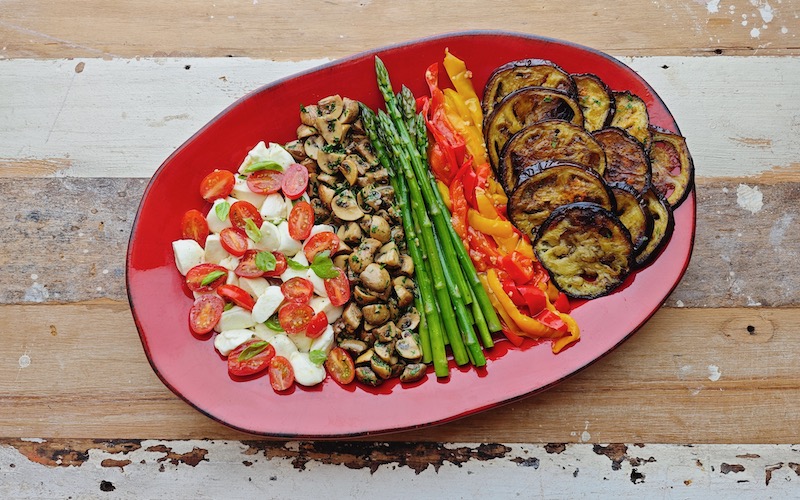
Remember food doesn’t have to be complicated to be delicious and impressive. Inspired by travels around the Mediterranean, when I entertain I keep things super simple with platters of food down the centre of a long table. To the colourful array of vegetarian antipasto below, I add cooked prawns with lots of lemon wedges; gravlax or smoked salmon with caperberries, dill and thinly sliced red onion; salumi such as pancetta, ‘nduja, salami and salsiccia; a large tin of good anchovy fillets in olive oil; plus a bowl of Losada olives and lots of crusty bread. Grilled zucchini with stracciatella and scarole di Natale (see video below) are great vegetarian antipasti too. The capsicum, eggplant and mushrooms for this vegetarian antipasto platter are all best cooked the night before and the asparagus can be as well. In the morning, everything, including the Insalata Caprese, can be assembled on the platter and covered in the fridge until just before guests arrive. With my vegetarian antipasto platter and accompaniments, I always serve Sbagliato, Aperol Spritz or one of my other favourite Prosecco cocktails!

Serves 4 or more

Ingredients
Method
  1. Arrange Insalata Caprese at one end of a platter and Melanzane Grigliate at the other end.
  2. Add strips of Funghi Trifolati, Steamed Asparagus and Peperoni in Padella or roasted capsicum down the centre.
  3. Drizzle with a little oil and sprinkle with salt and/or pepper if needed.
  4. Serve vegetarian antipasto platter with plenty of crusty bread.

Share page on:

Scarole di Natale

Antipasto FAQ

What is antipasto? What's the difference between antipasti and antipasto?

Antipasto means ‘before the meal’ in Italian and refers to an appetiser served before the first course. If that appetiser consists of more than one dish it becomes plural, therefore antipasti.

What vegetables are good in an antipasto platter?

Italians serve all sorts of vegetables as antipasto, including asparagus, zucchini (courgettes), eggplants (aubergines), mushrooms and peppers (capsicum). They may be raw, lightly steamed, pan-fried, baked, deep-fried or pickled. Start with these simple vegetables dishes as inspiration for your next antipasto platter.

What do you put in an antipasto platter?

Antipasto platters can contain a wide range of vegetables (see above) as well as salumi (cold cuts such as prosciutto, pancetta and salami). In some regions, such as Emilia-Romagna, a few chunks of cheese (especially Parmigiano-Reggiano) is also added. Dips and spreads aren’t typical antipasti, nor will you usually see fruit on an antipasto platter. Bread, grissini (bread sticks) and gnocchi fritti are the typical accompaniments.


What do vegetarians put on charcuterie boards? How do you make a vegan charcuterie board?

While the French word charcuterie is sometimes translated as ‘cold cuts’, it refers to cold prepared meat products such as ham, terrines and pâté. So the terms vegetarian charcuterie board (or vegan charcuterie board) are non-sensical as vegetarians and vegans don’t eat charcuterie. The good news is that there’s a wonderful array of vegetarian and vegan-friendly dishes that make great snacks and are perfect for a vegan grazing platter or vegetarian antipasto platter.

What Other Travellers Say

Diane (Cremorne Point, NSW, Aus)
Relaxed, organised and well-paced – a wonderful bespoke small group tour, starting in Rome, then travelling down the Amalfi Coast to stay at a family estate where we were treated like old friends. This tour included some hidden gems too, notably on our way to Matera, a fascinating town built into the side of a mountain. We finished with Naples and Pompeii – with plenty of wine and more new tastes. Roberta is a specialist and very personable as she hosts and explains every detail of the food and wine experience.
Belinda (Balmain, NSW, Aus)
I’ve been on three of Roberta’s food and wine tours so far and each one has been an amazing well-organised experience. From historic Rome and Pompeii to the spectacular Amalfi Coast, remarkable Venice and the charming villages of Switzerland, each tour offers something special. Then there’s the food in fabulous places where you can truly eat like a local. I highly recommend Roberta’s tours to anyone who wants to discover inspired travel through great food, wine and company. I’m already looking forward to the next one!
Michael (Cremorne, NSW, Aus)
Starting in Rome then spending time on the Amalfi Coast and further south before heading back to Rome for the last couple of days made for a nice ‘round trip’. Roberta’s choice of eateries was excellent with some very enjoyable meals – and a nice mix of other activities, like vineyard visits, between meals. Everything was very well organised: transport, nice hotels in close proximity to most activities, and a relaxed pace with enough time to follow your nose if that took your fancy. A very worthwhile tour and I’m already looking forward to another!
Di (Manly, NSW, Aus)
I absolutely recommend Roberta’s Southern Italy tour! We’ve always been independent travellers so were a little apprehensive – by day 2 we knew we’d made a great decision! Roberta knows people and places far from the tourist trail so we visited wineries where we were always invited for lunch as well as wine-tasting, a family lemon grove high on the Amalfi Coast and a 3rd generation cheesemaker. We stayed in a stunning cave hotel in Matera and a gorgeous family hotel in Scala – and book-ended the tour with the vibrancy of Rome. So many highlights, such a brilliant experience. We will do another tour with Roberta.
Subscribe To My Newsletter & Get A Free Online Italian Cooking Class (RRP $39)