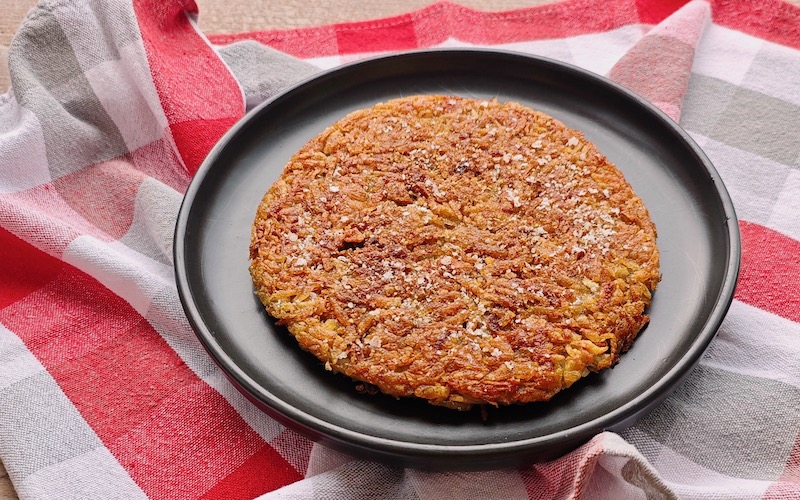
Talking about a ‘potato’ rösti in Switzerland is redundant (like ‘cheese’ fondue) as there’s only one type of true rösti and it’s made from potato. Swiss menus don’t generally offer much for vegetarians, but most have rösti with either a creamy mushroom sauce or fried egg (Spiegelei), both of which are filling and delicious. In Switzerland, rösti is usually made in a much larger portion, enough to feed 6 or more people, and the experienced rösti cook theatrically flips the half-cooked potato cake in the pan to turn it over rather than using my method of turning it onto a plate then sliding it back in. I’ve never tried the flipping, but I’m pretty sure mine would end up on the floor. Rösti made with raw potato is typical of Canton Bern, most other areas use boiled potato; either way the key to a deliciously crisp rösti is to extract as much moisture as possible, so if using boiled potatoes leave them uncovered in the fridge overnight before grating and if using raw ones, get someone to help you wring out the grated potato or do it in small batches. And ensure your pan is spotlessly clean before starting so the potato doesn’t stick. It’s hard to get Swiss wine in Australia, so I turn to Swiss-born winemaker Matthias Utzinger in Tasmania for a wine match. A glass of his riesling is a wonderful accompaniment to rösti, with or without spiegelei or mushroom sauce. It’s delicate and aromatic with a lovely citrusy zing to refresh the palate between bites of buttery rösti.

Serves 2 as a side dish

Ingredients
  • 550g Dutch cream potatoes (1lb 4oz)
  • 1 teaspoon oil (vegetable or olive)
  • 50g butter, diced (2oz)
  • Salt flakes and freshly ground white pepper, to taste
  • Freshly grated nutmeg, to taste
Method
  1. Peel potatoes and grate coarsely onto an old clean, dry tea towel.
  2. Wrap the grated potato in the tea towel and wring it to extract as much liquid as possible.
  3. Set aside for 45–60 minutes, wringing it every 15 minutes or so until very little liquid comes out; the potato will oxidise and change colour a little, that’s normal.
  4. Remove potato from the tea towel and fluff it up.
  5. Place oil and half the butter in a frying pan over medium–high heat.
  6. When melted, add potato spreading it out over the base and pushing the sides in slightly with a spatula to form a cake of even thickness.
  7. Reduce heat to medium, cover and cook for about 5 minutes, until lightly coloured around the edges.
  8. Dot half the remaining butter around the edges of the pan.
  9. Cover and cook for a further 5 minutes, it should now loosen when shaken, if it doesn’t gently loosen it with an egg lift or spatula.
  10. Cover and cook for a further 3–5 minutes, until edges are dark golden and crisp.
  11. Sprinkle generously with salt and nutmeg, add a little pepper.
  12. Cover the pan with a large plate and invert the pan to tip the potato cake onto it.
  13. Melt remaining butter in the pan then slide the potato cake back in, cooked side up.
  14. Sprinkle with salt, pepper and nutmeg and cook for 10 minutes or so, until the second side is well coloured and crisp.
  15. Serve hot.

Share page on:

Rösti (Swiss Potato Cake)

Rösti FAQ

What is the difference between rösti and hash browns?

Rösti and hash browns are both made from grated potato fried until crisp. Although hash browns likely started as a variation on roesti, today they differ in several important ways. Classic rösti is made as a single large cake, flipped halfway through cooking to crisp both sides, while hash browns are typically formed into individual patties and often deep-fried. Traditional Swiss rösti from Canton Bern is made with raw grated potato – most other cantons use pre-boiled potato – while hash browns can use either though were originally made from “hashed” (that is chopped up) leftover cooked potato (like bubble and squeak). Rösti is seasoned simply with salt, pepper and nutmeg — no onion, no egg, no filler as often appear in hash browns.


Which potatoes are best for rösti?

Potatoes that are not too floury and not too waxy, like Dutch cream potatoes, make the best roesti. Desirée is also a good option. Whichever potato variety you use, extracting as much moisture as possible before cooking is the key to a perfectly crisp result — if using boiled potatoes, leave them uncovered in the fridge overnight before grating; if using raw, wring out the grated potato thoroughly before cooking.

Can you make rösti ahead of time?

Rösti is best served straight from the pan, but you can get ahead by boiling and refrigerating the potatoes the night before — leaving them uncovered overnight actually improves the result by drying them out further. If using raw potato, grate and wring out the moisture in advance – the raw potato will discolour but that isn’t noticeable once it’s cooked and doesn’t affect the flavour.

What do you serve with rösti?

In Switzerland rösti is traditionally a breakfast dish. Today it’s served as a side dish with almost anything — particularly saucy recipes like Zürcher geschnetzeltes or mushrooms in cream sauce (pilze in sahnesosse). Roesti also makes a satisfying vegetarian main course topped with a fried egg (spiegelei) or mushrooms in cream sauce.

What Other Travellers Say

Janet (Tamworth, NSW, Aus.)
Just back from the most amazing trip to Emilia-Romagna with Roberta. Not only the home of Prosciutto di Parma, Parmigiano-Reggiano & Balsamic Vinegar, but scenery to die for and more quaint and exciting restaurants and cafés than you ever imagined. And Roberta is just the person to help you discover and enjoy them! Her knowledge of the history of the region and its wonderful cuisine know no bounds and all added to the excitement of the trip. It was faultless - well organized and lots of fun!
Deb (Belconnen, ACT, Aus.)
Wow, what a tour – I learned so much! Awesome fun traveling through Emilia-Romagna experiencing first hand some of the produce I've worked with over the last couple of years cooking with Roberta's recipe kits – the family are reaping the benefits now. If you're thinking of joining Roberta in future years get ready for an amazing experience.
Mark (Elizabeth Bay, NSW, Aus.)
My wife and I recently joined Roberta's Emilia-Romagna tour. We enjoyed all the temptations offered and learned a lot about that part of Italy, especially its food and wine culture. What was most impressive was Roberta's local knowledge of people and places. The planning and effort she put into making the whole experience seem effortless was remarkable.
Karen (Bowral, NSW, Aus.)
Our tour with Roberta through Emilia-Romagna was the highlight of the year. Good company, gorgeous palazzi and great food. What more could one ask for? Roberta's enthusiasm and knowledge made this a once in a lifetime experience through an extraordinary, diverse and very special region.
Shelley (Auckland, NZ)
Roberta’s passion for Italy shone throughout an unforgettable food and wine tour. She introduced us to family-owned artisanal producers, where we experienced everything from attic-aged balsamic to small-batch wines, Parma ham and Parmigiano-Reggiano. The local guides were equally passionate, and the excellent transport and accommodation made the trip effortless. This tour captured the region’s traditions, flavours and people, and thanks to Roberta’s deep knowledge we left with wonderful memories. A truly authentic culinary adventure — highly recommended.
Subscribe To My Newsletter & Get A Free Online Italian Cooking Class (RRP $39)