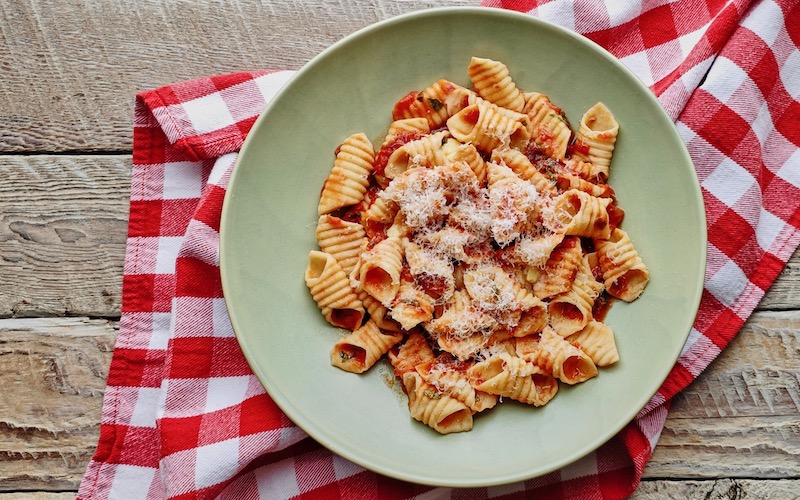
Emilia-Romagna is the home of rich egg pasta, with 1 egg used for every 100g (3½oz) of flour to create pasta sheets that are then cut into an endless variety of shapes. Garganelli are similar to penne rigati but instead of an extruded flour and water dough, they’re hand-rolled squares of fresh egg pasta (see video below). They’re rolled around a wooden rod, traditionally across a set of strings in a wooden frame (called a comb), though today a gnocchi board is more commonly used. I had garganelli with a delicious duck ragu at Hosteria Giusti in Modena in Emilia and learnt to make this simple pasta at Casa Artusi cooking school in Forlimpopoli in Romagna. The ridged hollow shape holds sauce well and you can dress garganelli with whatever you like, from a classic ragù Bolognese to a simple tomato sauce; Parma is the home of Mutti after all. Keeping it northern, I like to enrich my sauce with plenty of freshly grated Parmigiano and sometimes a knob of butter at the end. Learn more about how to make fresh pasta here – including tips on technique, equipment and ingredients – and see my page on how to cook pasta for perfect results every time.

Serves 2

Ingredients
  • 200g plain flour (7oz)
  • Pinch salt flakes
  • 2 eggs
  • ½ quantity Tomato Sauce
  • A few basil leaves, finely sliced
  • 25g cold butter, diced (optional)
  • Parmigiano-Reggiano, for serving
Method
  1. Mound the flour onto a clean, dry work surface and make a deep well in the centre, leaving a little flour covering the base. A wooden bench is ideal as it absorbs some of the moisture, reducing the need to add extra flour to stop the dough sticking.
  2. Add the salt then the eggs to the well.
  3. Use your hands to mix the egg, slowly working in the flour from the edges of the well to form a dough.
  4. Knead for 5–10 minutes until smooth and elastic; this can be done by hand or using an electric mixer with a dough hook.
  5. Shape into a ball, wrap in plastic wrap and set aside for 30 minutes or so; you can refrigerate it overnight, just return it to room temperature before rolling.
  6. On a lightly floured surface, roll the dough as thinly as possible.
  7. Cut into a neat rectangle about 30cm x 21cm 12″x 8½″). Cover the trimmings and set aside to make other pasta shapes (see FAQ below).
  8. Cut the rectangle into 3cm (1″) squares.
  9. Put a square onto a gnocchi board in a diamond shape (with a point facing towards you) and place a 1cm (⅓″) wooden rod (the handle of a wooden spoon works well) in the top centre of the triangle.
  10. Roll the pasta forward around the rod along the gnocchi board, pressing firmly to ensure it seals where the points overlap.
  11. Set aside and repeat with remaining squares.
  12. Bring a large saucepan of well-salted water to the boil, using 10g salt/litre water (⅓oz salt/2 pints water).
  13. Add pasta and cook for about 4 minutes, until tender; cooking time will depend on how dry the pasta has become, so start taste testing after 2 minutes.
  14. Meanwhile, warm Tomato Sauce in a large saucepan over a low heat and stir in basil.
  15. As soon as garganelli are cooked, scoop them out of the water into the sauce and toss to coat well.
  16. Add a tablespoon or 2 of the pasta cooking water to give a creamy consistency.
  17. Spoon into flat bowls, dot with butter (if using) and grate plenty of Parmigiano over the top.
  18. Serve immediately.

Share page on:

How To Make Garganelli Pasta

FAQ – Other Fresh Pasta Shapes

What do you do with large pieces of pasta dough off-cuts?

Use the large pieces of pasta trimmings to make maltagliata. The name of this rustic pasta literally means ‘badly cut’, referring to its irregular shape. Simply cut the trimmings into irregular strips or shapes and cook as you did the garganelli and serve with your favourite pasta sauce or add to soups like pasta e fagioli.

What do you do with smaller pieces of pasta dough trimmings?

Any small scraps of pasta dough needn’t go to waste. They can be chopped up finely to make pastina (literally ‘little pasta’) which goes into soups just like risoni, stelline and Sardinian fregola does. Pastina cook in a couple of minutes in boiling water, but can simmer in soups for longer without falling apart.


What Other Travellers Say

Janet (Tamworth, NSW, Aus.)
Just back from the most amazing trip to Emilia-Romagna with Roberta. Not only the home of Prosciutto di Parma, Parmigiano-Reggiano & Balsamic Vinegar, but scenery to die for and more quaint and exciting restaurants and cafés than you ever imagined. And Roberta is just the person to help you discover and enjoy them! Her knowledge of the history of the region and its wonderful cuisine know no bounds and all added to the excitement of the trip. It was faultless - well organized and lots of fun!
Deb (Belconnen, ACT, Aus.)
Wow, what a tour – I learned so much! Awesome fun traveling through Emilia-Romagna experiencing first hand some of the produce I've worked with over the last couple of years cooking with Roberta's recipe kits – the family are reaping the benefits now. If you're thinking of joining Roberta in future years get ready for an amazing experience.
Mark (Elizabeth Bay, NSW, Aus.)
My wife and I recently joined Roberta's Emilia-Romagna tour. We enjoyed all the temptations offered and learned a lot about that part of Italy, especially its food and wine culture. What was most impressive was Roberta's local knowledge of people and places. The planning and effort she put into making the whole experience seem effortless was remarkable.
Karen (Bowral, NSW, Aus.)
Our tour with Roberta through Emilia-Romagna was the highlight of the year. Good company, gorgeous palazzi and great food. What more could one ask for? Roberta's enthusiasm and knowledge made this a once in a lifetime experience through an extraordinary, diverse and very special region.
Shelley (Auckland, NZ)
Roberta’s passion for Italy shone throughout an unforgettable food and wine tour. She introduced us to family-owned artisanal producers, where we experienced everything from attic-aged balsamic to small-batch wines, Parma ham and Parmigiano-Reggiano. The local guides were equally passionate, and the excellent transport and accommodation made the trip effortless. This tour captured the region’s traditions, flavours and people, and thanks to Roberta’s deep knowledge we left with wonderful memories. A truly authentic culinary adventure — highly recommended.
Subscribe To My Newsletter & Get A Free Online Italian Cooking Class (RRP $39)