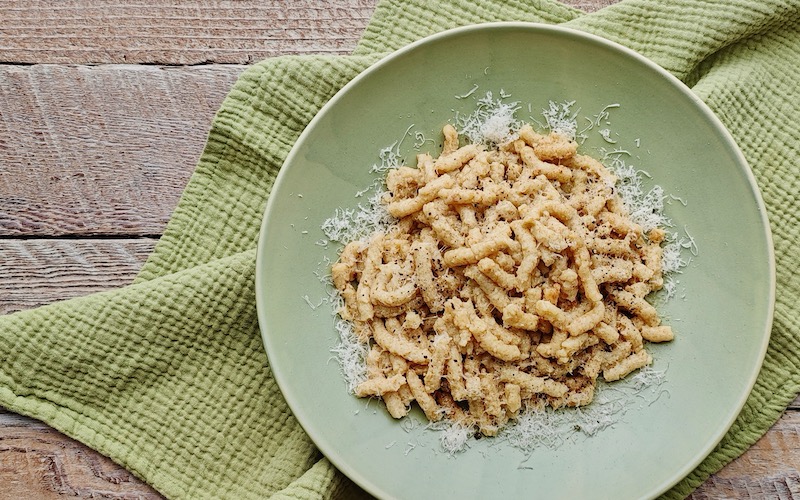
Passatelli pasta is a specialty of Romagna as well as neighbouring Marche and parts of Umbria. I was introduced to it at one of my favourite Romagnolo restaurants, Osteria La Corte in San Leo, a hill town on a rocky outcrop inland from Rimini, where I always have lunch on my Emilia-Romagna food & wine tours. Passatelli is classic cucina povera, a way to use leftover bread that also tastes great. It’s traditionally made with a perforated concave metal disc with two handles that’s pressed into the dough; but extruding it through the largest disc of a potato ricer works just as well. If your dough is too firm to easily press through the ricer into the pot of water, knead it a little to soften it and/or press it out onto a plate then tip the passatelli into the boiling water. Passatelli are most often cooked and served in a clear broth, usually made from capon (castrated rooster). My recipe is inspired by the way Daniele and Paolo serve theirs at Osteria La Corte, dressed with the local cave-aged cheese (formaggio di fossa); I use Parmigiano, but any firm cheese works well. The consistency of the passatelli can vary depending on the breadcrumbs you use, and it tastes great even if the dumplings are a little soft. Very fine, dry breadcrumbs are best, so leave the bread out overnight if need be before making them. You can watch Paolo making his passatelli pasta here. I serve my passatelli with a crisp white wine to cut through the rich buttery sauce. Mouth-filling Mauro Molino Roero Arneis works a treat with its lovely floral notes and hints of apple and lemon.

Serves 4 as a starter (or 2 as a main course with salad)

Ingredients
  • 120g very fine, fresh white breadcrumbs (4¼oz/1–1½ cups)
  • 80g freshly grated Parmigiano-Reggiano, plus 15g extra for serving (3oz/½oz)
  • 1 teaspoon freshly grated lemon zest
  • Freshly ground black pepper, to taste
  • Freshly grated nutmeg, to taste
  • 3 eggs
  • ¼ cup plain flour (35g/1¼oz)
  • 75g butter (2⅔oz/⅓ cup)
  • Squeeze lemon juice
Method
  1. Place breadcrumbs in a food processor and blitz for a minute or so to ensure they’re fine.
  2. Add cheese, lemon zest, pepper and nutmeg and blitz to combine.
  3. Add eggs and blitz to form a paste.
  4. Dust a board with half the flour, turn paste onto it and scatter remaining flour over the top.
  5. Knead well to completely incorporate the flour into the paste.
  6. Shape into a log, roll in any remaining flour on the board, wrap in plastic and refrigerate for at least 2 hours (overnight is fine).
  7. Remove from fridge 30 minutes before cooking.
  8. Bring a large saucepan of salted water to the boil, using 10g salt/litre water (⅓oz salt/2 pints water).
  9. Meanwhile, place butter in a frying pan over medium heat and cook until it’s nut brown. Remove from heat and set aside.
  10. Once butter is brown and water is boiling, squeeze the dough through a potato ricer (fitted with the largest disc) into the boiling water, using a sharp knife dipped in the water to cut off strands about 3cm (1¼ʺ) long.
  11. They’ll float almost immediately; let them boil for 2–3 minutes, until tender.
  12. When passatelli are tender, return butter to a medium heat and, as soon as it starts to sizzle, add a squeeze of lemon juice then use a slotted spoon to scoop them out of the water into the frying pan. Toss to coat them well in the butter.
  13. Transfer to a shallow bowl, layering with some of the cheese and a sprinkle of pepper as you go.
  14. Scatter remaining cheese over the top and serve immediately.

Share page on:

Passatelli Pasta with Brown Butter

Passatelli FAQ

What does passatelli mean?

Passatelli takes its name from passare (Italian for ‘to pass through’) because the dough is traditionally pressed through the holes of a perforated iron – the ferro da passatelli – though today a potato ricer makes a good alternative.

What’s the difference between passatelli in brodo and passatelli asciutti?

Passatelli in brodo are cooked and served in a clear meat broth, while asciutti (meaning ‘dry’) are served in sauce.

Passatelli in brodo is a traditional festive dish in Romagna.

Passatelli asciutti are cooked in boiling water then drained and tossed with a sauce such as brown butter and cheese.


Can you make passatelli ahead of time?

For the best texture, make the dough up to a day ahead and refrigerate it, then press and cook the passatelli just before serving.

Freshly cooked passatelli hold their shape best, so freezing isn’t recommended.

What Other Travellers Say

Janet (Tamworth, NSW, Aus.)
Just back from the most amazing trip to Emilia-Romagna with Roberta. Not only the home of Prosciutto di Parma, Parmigiano-Reggiano & Balsamic Vinegar, but scenery to die for and more quaint and exciting restaurants and cafés than you ever imagined. And Roberta is just the person to help you discover and enjoy them! Her knowledge of the history of the region and its wonderful cuisine know no bounds and all added to the excitement of the trip. It was faultless - well organized and lots of fun!
Kirstina (Cremorne, NSW, Aus.)
Straight after our Swiss tour with her, we accompanied Roberta to Emilia-Romagna. Roberta's knowledge and passion for all things food and wine made this a trip we will never forget. Especially memorable for me was visiting the Po Delta – a unique environment for its history, geography and wildlife (including flamingos!). Every meal was so delicious – often in small, unique, family-run establishments. Roberta just made the whole trip such fun.
Mark (Elizabeth Bay, NSW, Aus.)
My wife and I recently joined Roberta's Emilia-Romagna tour. We enjoyed all the temptations offered and learned a lot about that part of Italy, especially its food and wine culture. What was most impressive was Roberta's local knowledge of people and places. The planning and effort she put into making the whole experience seem effortless was remarkable.
Karen (Bowral, NSW, Aus.)
Our tour with Roberta through Emilia-Romagna was the highlight of the year. Good company, gorgeous palazzi and great food. What more could one ask for? Roberta's enthusiasm and knowledge made this a once in a lifetime experience through an extraordinary, diverse and very special region.
Shelley (Auckland, NZ)
Roberta’s passion for Italy shone throughout an unforgettable food and wine tour. She introduced us to family-owned artisanal producers, where we experienced everything from attic-aged balsamic to small-batch wines, Parma ham and Parmigiano-Reggiano. The local guides were equally passionate, and the excellent transport and accommodation made the trip effortless. This tour captured the region’s traditions, flavours and people, and thanks to Roberta’s deep knowledge we left with wonderful memories. A truly authentic culinary adventure — highly recommended.
Subscribe To My Newsletter & Get A Free Online Italian Cooking Class (RRP $39)