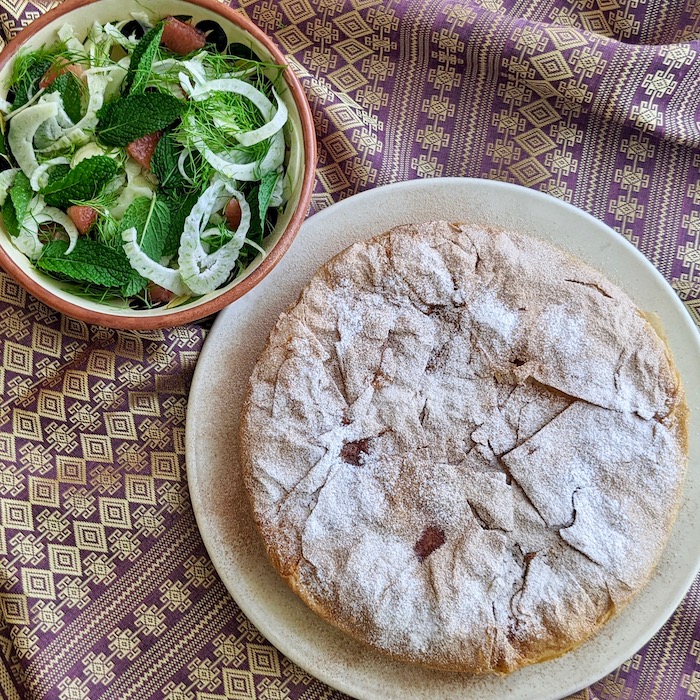
Guinea fowl makes a wonderful bisteeya – this guinea fowl recipe puts a delicious spin on the elaborately spiced Moroccan pie. Also written as bastilla, bestela, bastila, pastilla or pastila, bisteeya is traditionally made with pigeon and works well with almost any bird, including quail and chicken (see video below) – and even with seafood, as you’ll see in my salmon bisteeya recipe. It’s even a great way to use up leftover cooked poultry. The other classic ingredients in bisteeya are egg, almonds and warqa pastry, though the very similar Greek fillo pastry works well too. Traditionally the egg is scrambled into some of the poaching liquid, but the method I’ve used here (borrowed from Chef Michael Rantissi of Kepos Street Kitchen) is a safer way to ensure crisp pastry. I like a refreshing salad alongside this guinea fowl recipe – like shaved fennel, fennel fronds, mint and oranges – and in the glass something rich and aromatic such as the pinot blanc from Bob and Rita Richter at Grey Sands in Tasmania.
Serves 6
Share page on:
Guinea fowl is a game bird originating in West Africa, now farmed widely and available from some butchers and poultry suppliers.
Slightly smaller than a chicken with darker, more flavoursome meat, guinea fowl has a mild gamey quality that makes it more interesting than chicken without being too challenging.
The name comes from the Guinea coast of West Africa, where the birds were first encountered by European traders in the 15th century.
It can be substituted for other poultry in most recipes and chicken is an easy substitute for it in any guinea fowl recipe.

Bisteeya (also written as bastilla, bestela, bastila, pastilla or pastila) is a classic Moroccan pie of elaborately spiced poultry, egg and almonds enclosed in paper-thin warqa pastry, dusted with icing sugar and cinnamon.
The sweet-savoury combination is characteristic of Moroccan cuisine, particularly in Fez where bisteeya is considered a festive dish. Traditionally made with pigeon, it works beautifully with any poultry – and you can even make a seafood bisteeya.
This sweet-savoury combination in bisteeya is characteristic of Moroccan cuisine, which draws on centuries of Arab, Berber and Andalusian influences.
The dusting of icing sugar and cinnamon over the savoury meat filling is an integral part of the dish, balancing the richness of the spiced meat and egg filling and the butteriness of the pastry.
Warqa (also spelled warka or ouarka) is a paper-thin Moroccan pastry similar to Tunisian brik pastry, made by dabbing a wet dough repeatedly onto a hot pan to build up thin, almost translucent layers. It is used in bisteeya and other Moroccan pastries.
Outside North Africa, warqa and brik can be hard to find and Greek fillo (phyllo) pastry makes an excellent substitute.