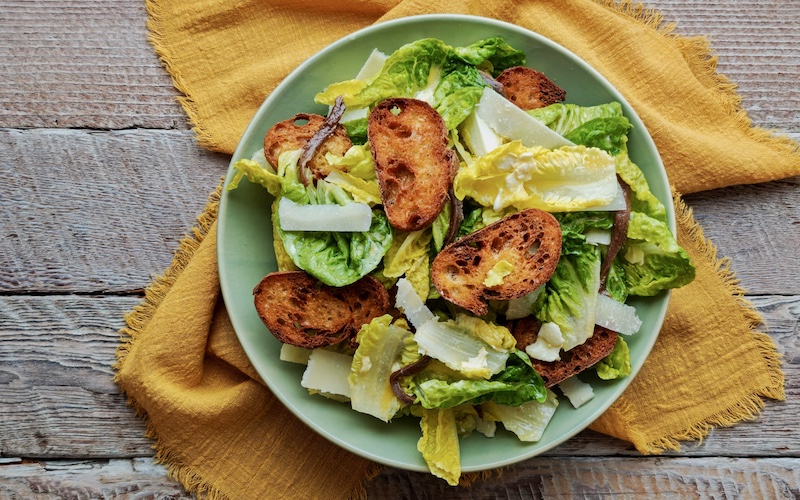
Caesar salad was created in the 1920s, during the Prohibition era, when Americans often crossed into Mexico to eat and drink. The story goes that, during the busy Fourth of July weekend, Italian restaurateur Caesar Cardini ended up low on ingredients at his eponymous Tijuana restaurant. Like any good host, he hustled together what was on hand to feed his guests – assembling it all tableside for a touch of theatre – and a 20th century classic was born. It’s hard to find a classic Caesar salad on a menu today, which is a shame as it’s one of the table’s simple pleasures and makes a great starter or light lunch. Of course it’s your salad, and you can add whatever you want – but I’ll tell you what’s in the classic recipe, then you please yourself! A classic Caesar salad is made with small romaine (cos) lettuce leaves, originally left whole to be eaten by hand, but if you want to serve it with a fork you can tear slightly larger leaves into 2 or 3 pieces. The garlic is subtle – a bruised clove rubbed around the salad bowl and/or used to flavour the oil that the croutons are fried in. The right dressing is crucial: a mustardy vinaigrette – Cardini would have used key limes, I prefer lemon, but you could use a good white wine vinegar – mixed with coddled egg (see FAQ below). Anchovies are an optional later addition – the touch of umami originally came from Worcestershire sauce – so, if you aren’t an anchovy fan, leave them out and add a dash to the dressing instead. A scattering of fried pancetta cubes is also an optional later addition, which I admit to enjoying – but I draw the line at ‘chicken Caesar salad’! Remember in a dish this simple, there’s nowhere for inferior ingredients to hide, so use the best anchovies and Parmigiano or Grana you can – I shave mine with a potato peeler. Here’s how I make my classic Caesar salad – see video below for another delicious cos lettuce salad.
Serves 4 as a starter or 2 as a light lunch
Caesar Salad Dressing
Share page on:
No – Caesar salad is named after Caesar Cardini, the Italian-born restaurateur who created it in Tijuana, Mexico. Despite its creator’s roots, it isn’t an Italian dish, but an American classic from the 1920s.
Yes – at least partly – that’s part of its charm.
Croutons can be fried a day or two in advance and stored in an airtight container at room temperature.
A few hours before assembling the salad, you can:
Refrigerate everything in airtight containers then just before serving, dress the leaves and assemble the salad.

A coddled egg is like a very lightly boiled egg, only half set.
Traditionally eggs are coddled in a special ceramic or glass ‘egg coddler’ below boiling point for 5 to 7 minutes to achieve barely set whites and still liquid yolks.
For a coddled egg dressing, you can achieve a similar result by placing an egg into rapidly boiling water for a minute or 2.
The old housewives’ trick is to prick the narrow point of the egg with a fine needle, so that the air pocket there doesn’t expand and crack the shell.
I find this can sometimes result in the white oozing out through the hole if it isn’t fine enough – and that if the egg is at room temperature and/or has been placed in a bowl of very hot tap water for a minute before being added to the boiling water, all is well.