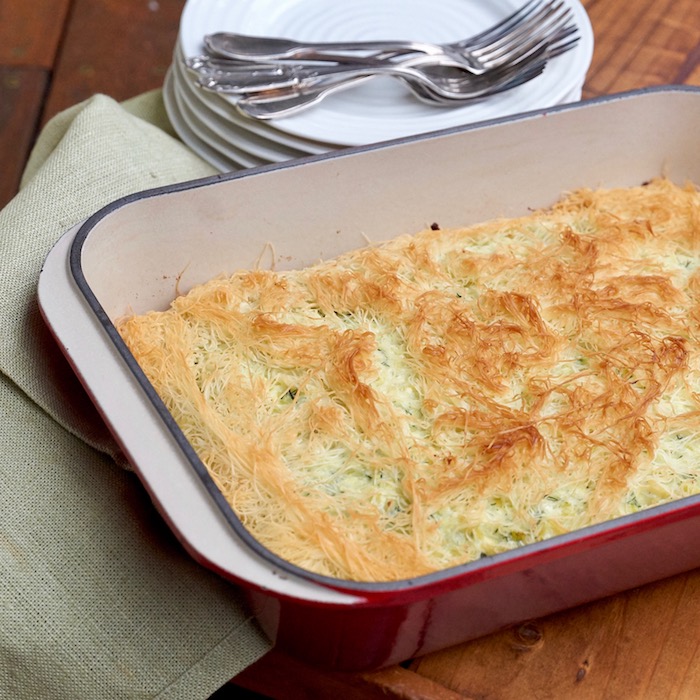
Prasopita is one of the many variations on Greek filo pies. I’ve long been a fan of spanakopita (spinach and cheese), tiropita (cheese) and hortopita (wild weeds; see video below) – then I discovered this leek and cheese version, which may just be the most delicious of all. Prasopita is popular in Greece during Lent, when devout Orthodox Christians abstain from eating meat before Easter, but I’m happy to eat it year round. Graviera is a semi-hard Greek cheese modelled on Swiss gruyere, which is a good substitute if you can’t find it. Although filo pastry is traditional, I prefer stringy kataifi for the extra crunch (see FAQ below for how to make prasopita with filo). I often serve a bowl of tzatziki on the side for some tang and I love a glass of Tim Stock’s Les Fruits Peu de Peau with prasopita. It’s a textural sauvignon blanc from one of my favourite wine areas, Basket Range in the Adelaide Hills.
Serves 6
Share page on:
Kataifi is a traditional Eastern Mediterranean pastry made from very fine strands of dough – sometimes described as shredded wheat or angel hair pastry. It’s used in both sweet and savoury Greek, Turkish and Middle Eastern dishes.
Kataifi pastry is made from a very thin batter of flour, cornflour, oil and water that’s piped in a fine spray onto a hot, rotating non-stick surface so that it cooks into fine strands.
The strands of kataifi pastry need to be pulled apart and mixed with butter or oil so they can be layered around fillings to produce an extremely crisp, crunchy result when baked or deep-fried.
Tear or cut off a piece of kataifi and place it in a large bowl. Use your fingers to tease the strands apart, then add butter or oil and work it through by hand until every strand is coated.
In Greece kataifi is best known as the pastry used in the honey-soaked sweet also called kataifi, but it works beautifully in savoury pies like prasopita that are more often made with filo pastry.

To use filo pastry instead of kataifi to make prasopita: