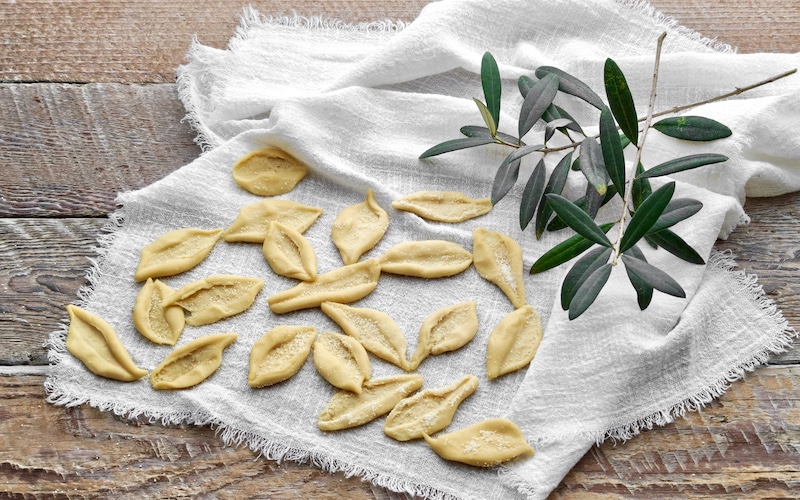
Foglie d’ulivo are a very rustic southern Italian pasta named for the olive leaves their shape resembles. They will be somewhat irregular, just like olive leaves, so don’t try to make them all perfectly the same and don’t worry if they even tear a little. Smaller pieces of dough, around 1cm thick (no more than ½″), are easiest to work with – at least until you’ve mastered how to shape foglie d’ulivo, then you can make larger leaves if you like. This olive leaf pasta has a lovely slippery texture when cooked, and the rough area in the centre holds pasta sauces really well. Shaping foglie d’ulivo may feel a little awkward at first, as you try to hold the dough in place with one hand while stretching it with the flat of the knife in the other hand, but once you’ve done it a few times you’ll be surprised how easy – and satisfying – it is. Though it’s now popular throughout southern Italy, foglie d’ulivo originated in Puglia where it’s traditionally dressed with chopped ripe tomato, burrata and – if you like – a touch of chilli. I love it tossed with plenty of olive oil, garlic and chilli (like a spaghetti aglio e olio) or a vibrant green pesto (see video below) to highlight its olive leaf shape. Learn more about how to make fresh pasta here – including tips on technique, equipment and ingredients – and see my page on how to cook pasta for perfect results every time.
To make enough foglie d’ulivo to serve 4 as a starter, you’ll need:
Coarse semolina, for dusting (called semola in Italian and often just ‘semolina’ in English)
Dust a large tray with semolina and put it on one side of your work bench.
Cut the dough into 4 pieces. Work with 1 piece at a time, leaving the rest covered with plastic.
Roll one piece of dough into a log about 30cm long (12″) and 1–1.5cm thick (about ½″).
Cut it into pieces about 1–1.5cm thick (about ½″).
Roll each piece of dough on the board so the ends are slightly tapered – this is easiest using 3 fingers applying a little more pressure on the outer fingers.
Using your dominant hand, gently press the blunt end and side of a butter knife into the centre of a tapered piece of dough then, using three fingers of the other hand, hold the dough at one end and the side closest to you and drag the knife away from you to flatten out the dough into an olive leaf shape.
Place foglie d’ulivo onto the semolina-dusted tray. Repeat with remaining tapered pieces of dough.
Roll another section of dough into a log and continue shaping foglie d’ulivo until all the dough is used.
Foglie d’ulivo can sit, covered with a dry tea towel on the semolina-dusted tray, in a cool place for a few hours before cooking.
Here’s how to cook foglie d’ulivo:
Bring a large saucepan of well-salted water to the boil, using 10g salt/litre water (⅓oz salt/2 pints water).
Shake excess semolina off the pasta, add pasta to the water and stir well.
Return to the boil and cook for 4–5 minutes, until tender. Cooking time will depend on how long the pasta has sat before cooking, and on how tender you prefer it.
Scoop foglie d’ulivo directly from the water into your favourite sauce, toss and serve.
Just back from the most amazing trip to Emilia-Romagna with Roberta. Not only the home of Prosciutto di Parma, Parmigiano-Reggiano & Balsamic Vinegar, but scenery to die for and more quaint and exciting restaurants and cafés than you ever imagined. And Roberta is just the person to help you discover and enjoy them! Her knowledge of the history of the region and its wonderful cuisine know no bounds and all added to the excitement of the trip. It was faultless - well organized and lots of fun!
Deb (Belconnen, ACT, Aus.)
Wow, what a tour – I learned so much! Awesome fun traveling through Emilia-Romagna experiencing first hand some of the produce I've worked with over the last couple of years cooking with Roberta's recipe kits – the family are reaping the benefits now. If you're thinking of joining Roberta in future years get ready for an amazing experience.
Mark (Elizabeth Bay, NSW, Aus.)
My wife and I recently joined Roberta's Emilia-Romagna tour. We enjoyed all the temptations offered and learned a lot about that part of Italy, especially its food and wine culture. What was most impressive was Roberta's local knowledge of people and places. The planning and effort she put into making the whole experience seem effortless was remarkable.
Karen (Bowral, NSW, Aus.)
Our tour with Roberta through Emilia-Romagna was the highlight of the year. Good company, gorgeous palazzi and great food. What more could one ask for? Roberta's enthusiasm and knowledge made this a once in a lifetime experience through an extraordinary, diverse and very special region.
Shelley (Auckland, NZ)
Roberta’s passion for Italy shone throughout an unforgettable food and wine tour. She introduced us to family-owned artisanal producers, where we experienced everything from attic-aged balsamic to small-batch wines, Parma ham and Parmigiano-Reggiano. The local guides were equally passionate, and the excellent transport and accommodation made the trip effortless. This tour captured the region’s traditions, flavours and people, and thanks to Roberta’s deep knowledge we left with wonderful memories. A truly authentic culinary adventure — highly recommended.
Subscribe To My Newsletter & Get A Free Online Italian Cooking Class (RRP $39)