Wherever I travel I want to get inside the food, wine and culture, to discover what makes the place unique. The Eternal City is no different – my aim in Rome is to be off the beaten path while walking through the heart of one of the world’s most visited cities. This Rome food guide explains how to do it.
My Southern Italian Food & Wine Tour starts and finishes in Rome, and I always give myself a few extra days there to eat, drink and explore. Like most big cities, Rome’s historic centre is a mix of locals and tourists, glamorous shops, restaurants, cafés and convenience stores. Unlike many cities, instead of skyscrapers Rome is dotted with totally out-of-scale ancient buildings and sunken ruins almost everywhere you look. The best time to explore the historic centre is early in the morning when it’s quiet, or of an evening after the day-trippers have left. The rest of the time I take my own day trips into the surrounding hills, or hide out in Trastevere, the bohemian district across the River Tiber – a coffee granita at an outdoor table there is the perfect way to soak up Rome’s food scene (see video below).
Where to Stay in Rome Le Clarisse Pantheon
Rooms in this historic building, on a quiet street just around the corner from the Pantheon, are comfortable and clean with modern bathrooms. My favourites look out over the central courtyard and breakfast ‘sunroom’ on the terrace surrounded by spring flowers, greenery and the balconies of locals’ apartments. Breakfast is excellent, staff are friendly and it’s walking distance to everywhere a food lover wants to go in Rome.
Where to Eat in Rome Osteria La Gensola
I look forward to eating at this simple, family-run osteria on cobbled Piazza della Gensola on every visit to Rome. I sit at a quiet corner table to contemplate each delicious leaf of the best carciofi alla Giudìa (deep-fried artichokes) in Rome. Next are tiny tuna meatballs with tomato and smoked provola, or one of Rome’s classic pasta dishes, like rigatoni with sugo coda alla vaccinara (oxtail sauce). Superb cannoli to finish too.
Where to Drink in Rome Latteria Trastevere
This is one of my favourite Roman wine bars. In buzzy north Trastevere, just a few minutes from Piazza di Santa Maria and its namesake basilica, Latteria is named for the dairy that once occupied the space. It has a great selection of natural wines from Lazio and beyond plus more mainstream options, good craft beers and a short, well-priced menu of snacks. Staff are happy to make suggestions or pour tastings to help wine lovers select.
Where to Shop in Rome Campo de’ Fiori
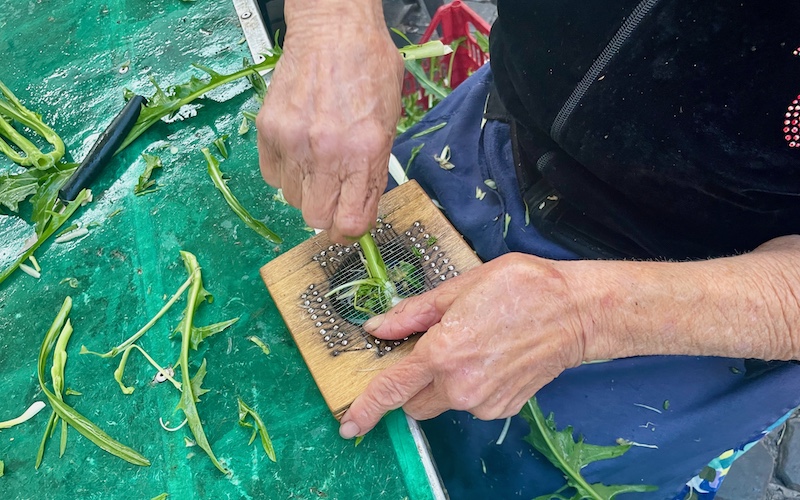
Campo de’ Fiori, near Piazza Navona, is likely Rome’s oldest food market. Souvenirs and other touristy bits are increasingly encroaching on fresh produce, but it still has plenty of charm. Especially early when stalls are setting up and Nonnas are shredding huge bunches of puntarelle through simple wooden graters into buckets of water to curl. An early morning visit to this colourful market is an essential introduction to Roman food.
Where to Walk in Rome From Piazza di Spagna
An early morning walk helps balance the indulgence of Rome’s delicious food scene. My favourite route is up the Spanish Steps and past the Villa Borghese Gardens to Terrazza del Pincio for views across the rooftops to the Vatican, then down to Piazza del Popolo with its ancient Egyptian obelisk and intact city walls. From Le Clarisse it’s about a 1½-hour loop via Campo de’ Fiori and Piazza Navona to see Bernini’s Fountain of the Four Rivers.
What to Buy in Rome Sermoneta Gloves
Forget the tacky fridge magnets made in China, my favourite souvenirs in Rome are a pair of leather gloves from this colourful shop on Piazza di Spagna. It was started by Giorgio Sermoneta in the early ‘60s when gloves were generally only black or brown. This small narrow shop sells leather gloves in many styles arranged in a mesmerising display of over 60 different colours. It’s worth a visit even if you don’t think you need a pair of gloves.
What to See in Rome Trajan’s Forum
There’s a museum attached to this ancient public space built by Emperor Marcus Ulpius Traianus (Trajan). But you get the best view by circumnavigating the well-excavated ruins from Via dei Fori Imperiali. The huge semi-circular multi-storey market building, which now houses the museum, once held over 150 offices and shops trading in spices, oil and wine. And like ancient ruins throughout Rome, it’s all in plain sight amid more modern buildings.
Where to Go in the Roman Hills Cantine Riccardi Lorella Reale
Just over an hour from Rome, on a hillside beneath the town of Olevano Romano, is the home and winery of Piero Riccardi and Lorella Reale. A tasting with these journalists-turned-winemakers is a highlight of my Roman food tour. Their wines are made from grapes indigenous to Lazio – like cesanese, malvasia puntinata and bellone – and aged in traditional chestnut barrels; and lunch includes foraged wild greens from the vineyards.
Getting a taxi in Rome isn’t always easy. Whether it’s for airport transfers or day trips into the countryside, I highly recommend Marco Galati from NCC Easy Ride.
Updated 19 Oct 2026
Rome is called the Eternal City because of an ancient belief that the city would last forever.
The poet Tibullus first called it ‘urbs aeterna’ (the Eternal City) in the 1st century BC, and Ovid, Virgil and Livy soon took up the phrase.
The theme evolved into ‘Roma aeterna’, which shaped how Romans saw their city and empire for some four centuries.
Trastevere means ‘across the Tiber’. The name comes from the Latin ‘trans Tiberim’.
Emperor Augustus, who divided Rome into 14 regions, made this area the 14th, and it is home to two of Rome’s most ancient churches, Santa Maria in Trastevere and Santa Cecilia – as well as to many wonderful traditional restaurants and bars.
Today its maze of narrow cobbled lanes is my favourite place to eat like a local in Rome and escape the mass tourism of the busy historic centre on the other side of the Tiber River.

The hooded statue in Campo de’ Fiori is the philosopher and monk Giordano Bruno, burned for heresy on that spot where his statue stands.
Bruno was burned alive on 17 February 1600 and his statue – by sculptor Ettore Ferrari – was unveiled in the centre of the square on 9 June 1889. Its inscription is dedicated to Bruno and all free thinkers.
The square’s name means ‘field of flowers’, after the open meadow that stood here before the square was laid out in the mid-15th century.
Carciofi alla giudia (‘Jewish-style artichokes’) are whole artichokes deep-fried until the leaves open like a crisp golden flower.
The dish comes from the cuisine of Rome’s Jewish community and was traditionally prepared for Passover, when spring artichokes are at their peak.
Among Rome’s many ancient buildings, the Pantheon survives almost completely intact because it became a church in 609 AD.
Continuous religious use meant continuous maintenance, while other ancient buildings were quarried for stone.
It was completed under Emperor Hadrian around 125 AD, and its 43.3m (142′) dome is still the largest unreinforced concrete dome in the world. The Romans mixed lighter materials like tufa and pumice into the concrete so the dome weighs less as it rises.