For food lovers the world over, a pilgrimage to Paris is a rite of passage – but all those Michelin stars can add a couple of extra zeros to the bill. Thankfully Paris is also the birthplace of bistros, neighbourhood restaurants serving traditional French food at great prices.
Don’t let the word ‘bistro’ fool you into expecting something plain though. Many Paris bistros are close to a hundred years old, and while tables are tightly packed and the room can get noisy – that’s part of the theatre. Some of the best Paris bistros have formal waiters in long aprons, wine poured from magnums, and a warmth that the grandest Michelin-starred dining rooms can’t always match. Paris bistros usually offer great value 2 or 3-course ‘menus du jour’ (set menus) or ‘formule’ (with limited options for each course). These are how the locals often eat and are as much a part of the history of this most foodie of cities as are the refined temples of gastronomy. Order the plat du jour off a chalkboard, mop up the sauce with excellent baguette, and you’ve had the full Belle Époque experience for the price of a Michelin-starred starter. If you do want to dine in some of Paris’ fancier restaurants without going too crazy, many offer 2 or 3-course weekday lunch specials that are significantly cheaper than their evening menus.
La Rôtisserie Tour d’Argent (5th arr.)
A meal at this casual sibling to Michelin-starred Tour d’Argent is, unsurprisingly, all about the duck! Whole Canard Challandais in two services: breast roasted to rare perfection then slow-cooked legs – flash-fried to crisp deliciousness – with a creamy mustard sauce. Start with a little œuf mayonnaise (2021 world champions), finish with a huge, fluffy Îles flottantes glistening with caramel, order a bottle of Burgundy, and sigh “Ah Paris”!
Au Pied du Cochon (1st arr.)
Once open 24/7 to feed workers at nearby Les Halles Market, this Art Nouveau bistro – with a touch of Belle Époque Parisian bordello – now closes just 3 hours/day. Piggy bits are the star – including trotters, snouts and tails – and there’s a great shellfish counter with freshly shucked cockles, clams and oysters. It’s Parisians’ favourite spot for a late night bowl of onion soup too. Desserts are delicious, including crêpes Suzette flamed tableside.
Le Bon Georges (9th arr.)
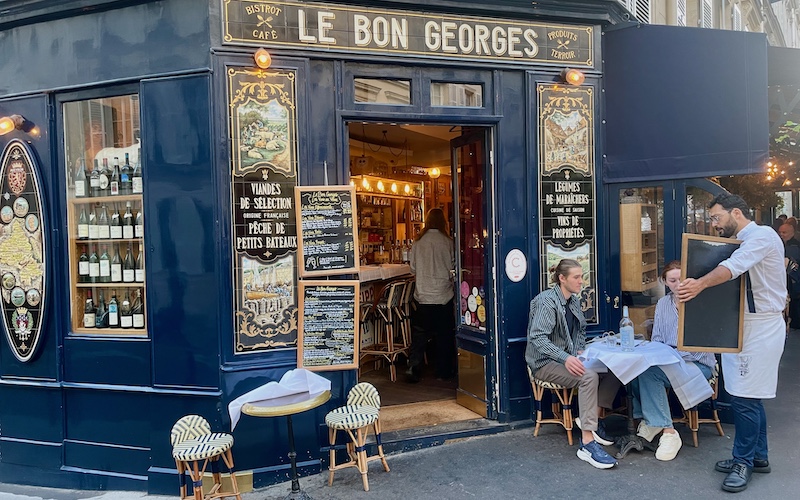
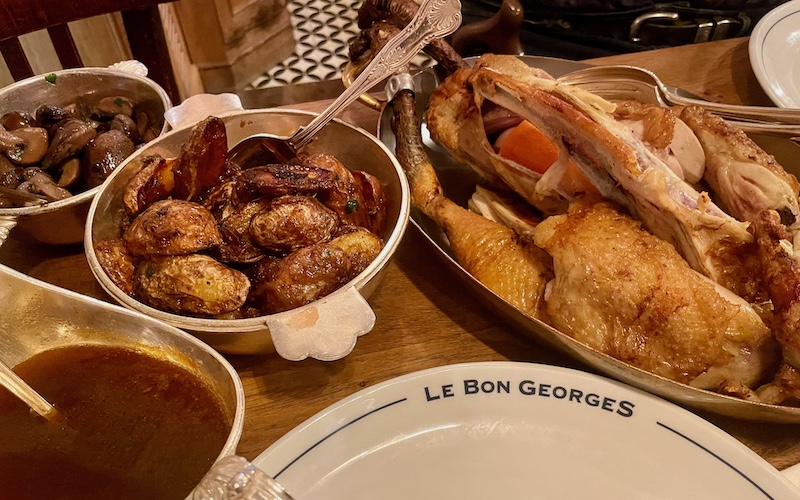
Bustling Le Bon Georges, near Montmartre, feels like a quintessential Paris bistro, with its mirrors, bentwood chairs and chalkboard menus. The food, however, is next level with the likes of whole Bresse chicken, cuts of meat chalked up by weight and crossed off the board as each sells out, and a killer cheese trolley. Nothing is stamped off a production line here. Service is professional with a touch of fun, and the wine cellar is legendary.
Aux Bons Crus Les Routiers (11th arr.)
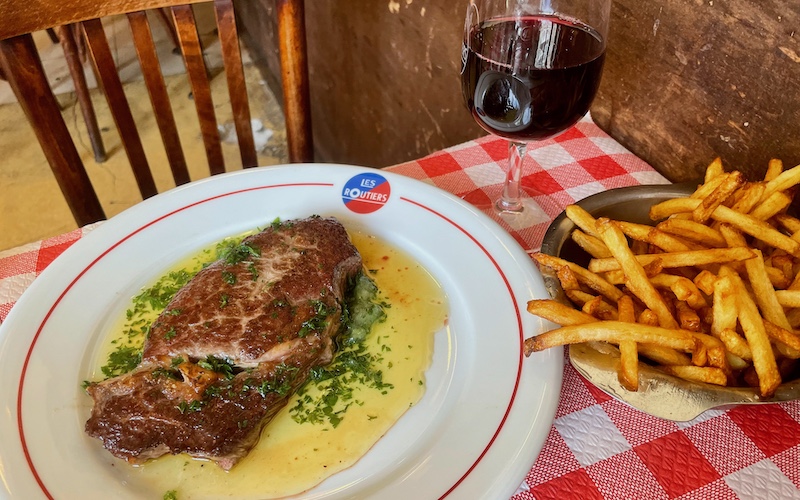
Off the tourist trail, this no-frills bistro has paper-topped checked tablecloths, utilitarian servingware and generous serves of bistro classics. Great frisée salad, tête de veau with excellent ravigote sauce, simple tasty steak frites, and an incredibly light chocolate mousse large enough to serve two or more. The ‘Les Routiers’ sign certifies it as a trucker-approved eatery. Sister bistro Les Marches near the Eiffel Tower is also Les Routiers.
Robert et Louise (3rd arr.)
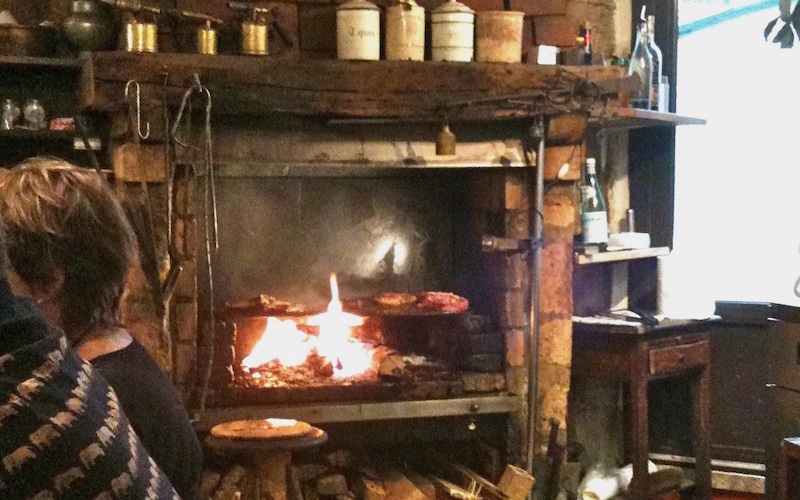
At this casual bistro in the bohemian Marais district, meat is cut off a large chunk in the open kitchen and cooked on a metal plate over the fireplace. ‘Fresh sausages’ arrive as just that: two thin sausages hot off the grill, the only garnish a smudge of grease; salt and mustard are on the table. Rustic terrine, buttery escargot, and andouillette are similarly unadorned. Dishes like delicious mushroom omelettes keep non-carnivores happy too.
Benoit (4th arr.)
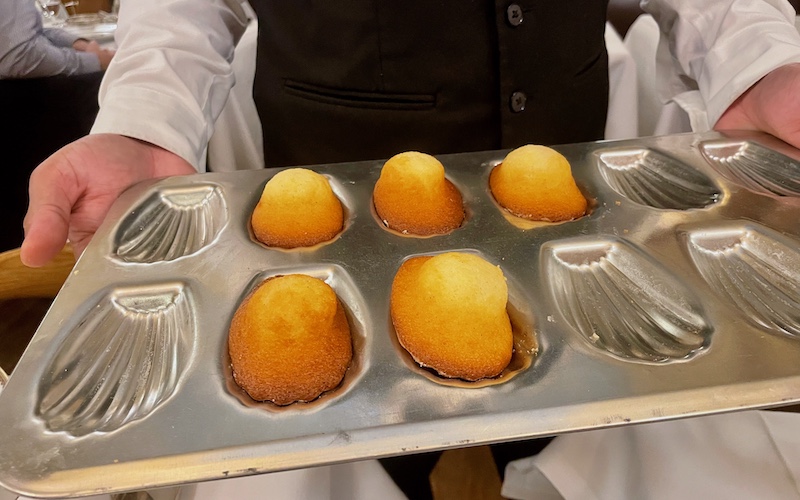
Pricier than other Paris bistros but so worth the indulgence, Benoit is the only bistro in Paris with a Michelin star. Alain Ducasse bought it in 2005, preserved the Belle Époque charm and refined the food while staying true to its bistro roots. Expect life-changing escargot, cassoulet served tableside, and offal classics like excellent ris de veau. Pêche Melba is assembled at the table too, and madeleines are served hot from the oven tray.
Bistro Allard (6th arr.)
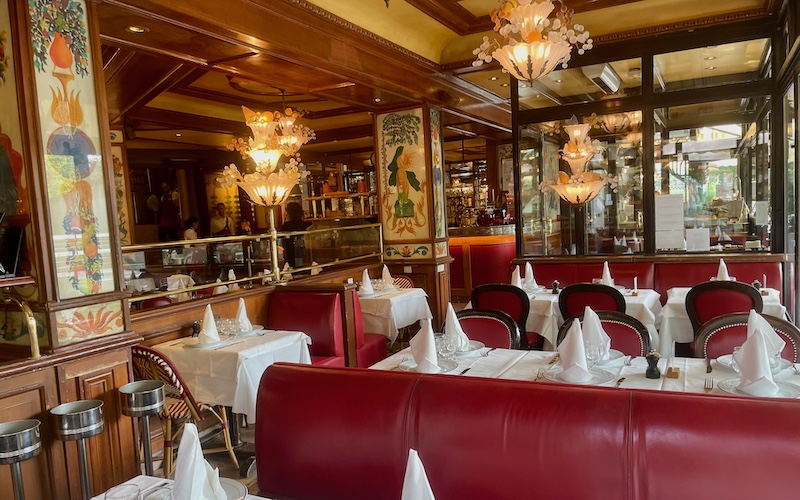
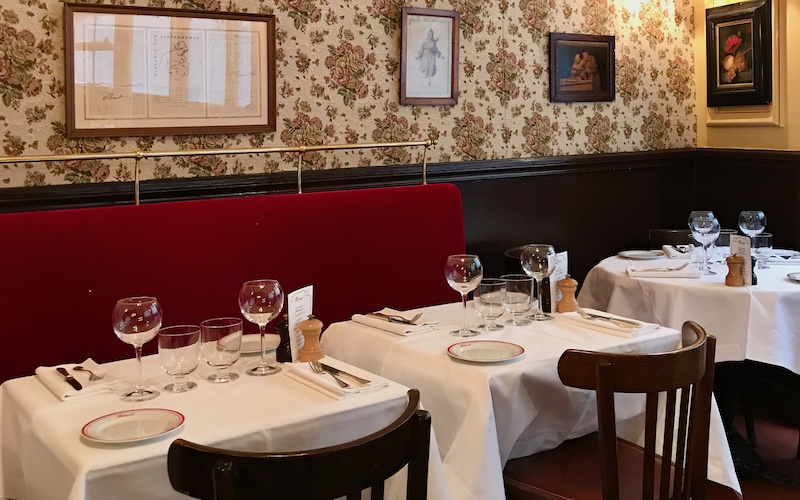
Opened in 1932, Allard is another old-school Paris bistro rescued by Alain Ducasse. It’s as old-school-French as they come – with plush red banquettes, butter cut from a 5kg dome, and digestifs poured from double magnums. All the classics are here: gougères, terrines, confit, perfectly dressed salad, turned vegetables, superb bread, rum savarin with Chantilly cream and an impressive dessert trolley.
Aux Lyonnais (2nd arr.)
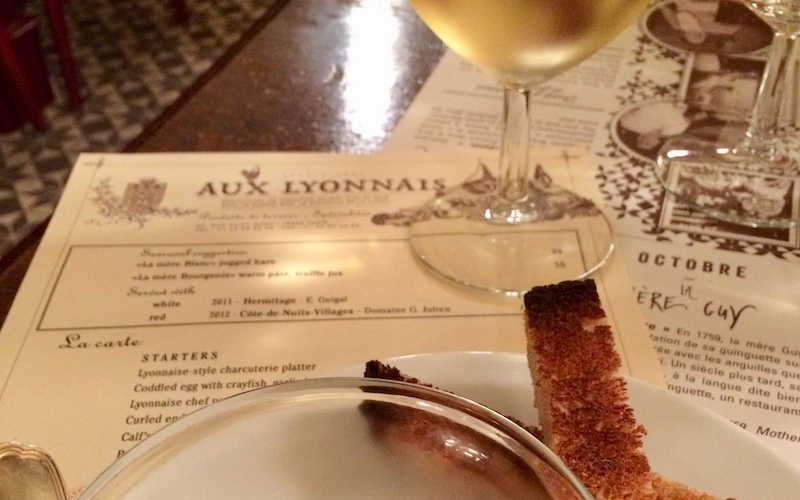
The first Paris bistro I fell in love with – this ornate dining room still seduces with its floral tiles, huge mirrors and charming service. From the generous bowl of herbed cheese and little sack of dark bread on arrival to excellent desserts, this classic bistro blends the traditions of France’s two great food cities: Paris and Lyon. I love the charcuterie plate with pickles jar and wooden tongs, and the famous seafood quenelles with Nantua sauce too.
Updated 24 Aug 2026
Tour d’Argent is widely acknowledged as the oldest restaurant in Paris.
In 1582, a cook named Rourteau opened an inn on the banks of the Seine at what’s now the Quai de la Tournelle. He named it Hostellerie de la Tour d’Argent (Inn of the Silver Tower) for the glittering silver-toned stone of the nearby Château de la Tournelle. Tour d’Argent has stood on the same stretch of riverbank for over 440 years, though it did move from the ground floor up to the sixth in 1936, gaining the panoramic view over Notre-Dame it’s now known for.
No – though it did hold three stars for an impressive 63 years. When Michelin extended its three-star rating to Paris in 1933, Tour d’Argent was one of only three Paris restaurants to receive it immediately. It held three stars continuously until 1996, when it dropped to two and then, in 2006, the one star it holds today.
Tour d’Argent is famous for its numbered pressed duck – over 1.1 million served since the tradition began in 1890, each one recorded with a number stamped onto a postcard the diner takes home. It also holds a legendary cellar of nearly 300,000 bottles. In 1940, as the Nazis were marching on Paris, owner Claude Terrail secretly slipped back from Bron air base to brick up a cellar door, hiding the finest vintages behind it for five years until the war ended. Today diners are sometimes invited into the cellar to see the dusty bottles and the plaque commemorating the night Terrail risked his life to save them.
Yes – both Michelin-starred Tour d’Argent and its casual Rôtisserie opposite serve the same breed of Challandais duck, sourced from the same family farm – Maison Burgaud in Challans, Vendée – a relationship that goes back to 1890. The preparation, however, is different. La Rôtisserie spit-roasts the whole duck and presents it in two services: first the rare breast, then the slow-cooked legs. At Tour d’Argent, the duck is presented tableside and carved with theatre: the breast is sliced paper-thin, the legs set aside to be grilled, and the carcass pressed in a silver press in view of diners to extract its juices – which are then blended with Madeira, Cognac and the duck’s liver to make the famous sauce.

Despite its Belle Époque and Art Nouveau décor, Au Pied de Cochon only opened in 1947. The iconic bistro originally opened its doors to feed the workers at the neighbouring Les Halles food market.
Au Pied de Cochon was famously open 24/7 to cater to the round-the-clock schedules of workers and butchers at the historic Les Halles market. It traded continuously for over 70 years until COVID-19 lockdowns forced its first closure on 16 March 2020. Today, the restaurant is open 21 hours a day, closing only between 5am and 8am.
Yes, but only one: Benoit, opened in 1912 then bought and revived by Alain Ducasse in 2005, is the only true bistro in Paris to hold a Michelin star.
‘La carte’ is the full à la carte menu, priced per dish. ‘Le menu’ (or ‘menu du jour’) is a fixed-price set menu, usually 2–3 courses. A ‘formule’ is similar but doesn’t necessarily change daily and generally offers a limited selection in each course, and a ‘plat du jour’ is just the single daily special main course.
Yes. The building dates to 1890, when it began life as a coal and wine depot, before becoming a proper bistro in 1914 under owner Daniel Violet. Alain Ducasse bought it in 2002 with his friend Thierry de la Brosse, drawn to its old-world charm and to Lyonnais cuisine – close to his heart from his early training near Lyon under the late Alain Chapel – and ran it for nearly 25 years. In 2025, he handed the restaurant over to Félix and Margot Dumant, members of a well-known Parisian bistro family that also owns Les Marches, Aux Bons Crus and other popular Paris bistros. Ducasse says he chose the Dumants for their proven ability to keep Paris’s bistro traditions alive – and the kitchen stays in safe hands too, with Lyon-trained chef Victoria Boller remaining at the helm.
Yes – Allard is another bistro rescued by Ducasse. By the time he bought it in 2013, the once Michelin-starred bistro (it held two stars in the 1960s, a record for a bistro) had been slowly fading for decades under a series of owners, having lost its final star back in 1974. Ducasse bought it explicitly to save it from decline, keeping the original 1932 recipes and decor intact while bringing in new energy. His other Paris bistro acquisition – Aux Lyonnais – wasn’t about rescue, it was already a thriving landmark when he bought it in 2002.
Yes – bistros do take reservations and – given the popularity of the best bistros in Paris – it’s worth making a booking, especially at peak times. Of course, if you’re passing, you can always try for a table; Paris bistros are happy to welcome walk-ins if they have space.