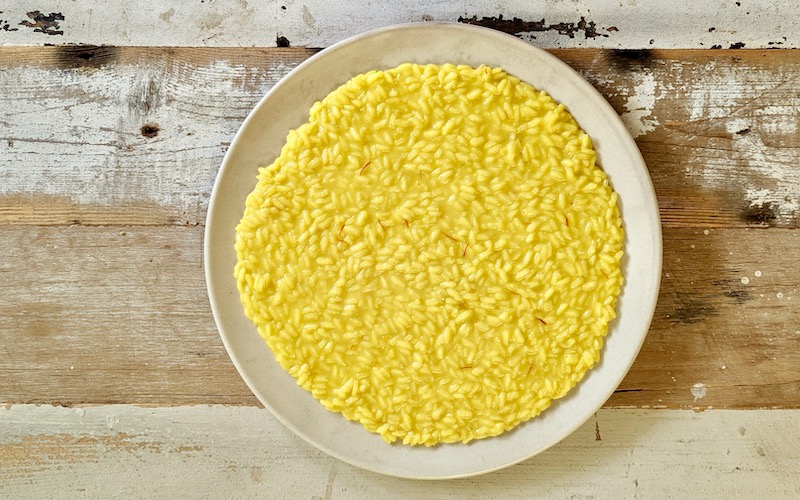
Risotto Milanese originated in Milan, where it’s the traditional accompaniment to ossobuco. Lombardy is the home of risotto, and my friend Alessandro Pavoni is the king of risotto making. He was born in Brescia in Lombardy and you haven’t tasted risotto until you’ve tasted his! This recipe is inspired by the way he taught me to make risotto (see video below). Risotto Milanese is one of the simplest and most delicious risottos – rich, aromatic and golden – it’s the perfect recipe to learn the basics of risotto making. Once you’ve mastered risotto Milanese you can create an endless variety of risottos – there’s a whole chapter dedicated to them in A Lombardian Cookbook which Alessandro and I co-wrote. Traditionally, if making risotto Milanese without the ossobuco, some bone marrow (available from good butchers) is stirred through it at the end with the butter and cheese; you can leave this out for a vegetarian version that still tastes delicious. In Italy, leftover risotto is never reheated – it would be overcooked and gluggy. It’s often made into rice balls, called arancini in the south and suppli in the north. In Lombardy it’s more often pan-fried into a crisp rice cake called risotto al salto. Most chefs prefer carnaroli rice to the more widely available arborio, for risotto, as it absorbs more liquid (therefore flavour) without splitting, and gives the creamiest result. Acquerello is the best carnaroli rice I know; it’s available in Australia through Lario Fine Foods. When it comes to a wine match, I love a glass of Sabi Wabi Hunnybee semillon from the Hunter Valley; it’s textural and creamy, just like this risotto Milanese.
Place stock in a saucepan and bring to a simmer, reduce heat to lowest setting and cover.
Add saffron to the wine and set aside.
Melt half the butter in a high-sided frying pan or large saucepan over a medium heat.
Add shallot and a good pinch of salt and cook for about 5 minutes, stirring occasionally, until tender but not coloured.
Add rice and cook for 2–3 minutes, stirring constantly, until very hot but not coloured; it should start to smell toasty.
Add a good pinch of salt, then saffron and wine and stir for a couple of minutes, until wine has been absorbed.
Add enough stock to cover the rice well. Scrape down the sides of the pan, but do not stir.
Shake the pan to combine the ingredients, reduce heat and leave rice to cook, without stirring, for 10 minutes, shaking the pan occasionally and adding more stock as necessary to keep the rice just covered. Adjust the heat, if necessary, so that the liquid is gently bubbling.
After 10 minutes, stir in another ladle of stock then stir continuously for about 7 minutes, until rice is al dente, adding more stock as each ladleful is absorbed.
If you run out of stock, add a little boiling water.
Remove from heat, cover and set aside for 1 minute.
Add Grana and remaining cold butter (keep it in the fridge until using) and, using a wooden spoon and shaking the pan, beat to create a creamy consistency, adding a little more stock if necessary to keep it fluid.
Taste and add salt if needed.
Spoon onto flat plates and tap them gently on a tea towel-covered work bench to flatten out the risotto.
Serve risotto Milanese immediately and eat from the outside of the plate towards the centre.
I’ve been on three of Roberta’s food and wine tours and each has been an amazing well-organised experience. From remarkable Venice and the surrounding Veneto region to historic Rome and Pompeii, the spectacular Amalfi Coast, and the charming villages of Switzerland – each tour offers something special. Then there’s the food in fabulous places where you can truly eat like a local – inspired travel through great food, wine and company. I’m already looking forward to the next one!
Mark (Elizabeth Bay, NSW, Aus)
My wife and I joined Roberta's Emilia-Romagna tour. We enjoyed all the temptations offered and learned a lot about that part of Italy, especially its food and wine culture. What was most impressive was Roberta's local knowledge of people and places. The planning and effort she put into making the whole experience seem effortless was remarkable.
Shelley (Auckland, NZ)
Roberta’s passion for Italy shone throughout an unforgettable food and wine tour. She introduced us to family-owned artisanal producers, where we experienced everything from attic-aged balsamic to small-batch wines, Parma ham and Parmigiano-Reggiano. The local guides were equally passionate, and the excellent transport and accommodation made the trip effortless. This tour captured the region’s traditions, flavours and people, and thanks to Roberta’s deep knowledge we left with wonderful memories. A truly authentic culinary adventure.
Diane (Cremorne Point, NSW, Aus)
Relaxed, organised and well-paced – I enjoyed a wonderful small group tour starting in Rome, then travelling down the Amalfi Coast to stay at a family estate where we were treated like old friends. It included some hidden gems too, notably on our way to Matera, a fascinating town built into the side of a mountain. We finished with Naples and Pompeii – with plenty of wine and more new tastes. Roberta is a specialist and very personable as she hosts and explains every detail of the food and wine experience.
Fiona (Blackheath, NSW, Aus)
I thoroughly enjoyed the trip to the Veneto and Venice. Roberta creates wonderful bespoke small group tours with her incredible knowledge of food and wine and adds great accommodation and points of interest. It’s like travelling with your ‘besties’ – including one who’s done all the hard work researching and discovering the best and most interesting places to go, especially to eat and drink. Come with an appetite! Also factored in is time for you to do your own exploring and discover your own gems.
Di (Manly, NSW, Aus)
We had always travelled independently, so a small group tour felt like a risk, but by day 2 we knew it was the right choice. Roberta knows people and places far from the tourist trail: winery lunches, a family lemon grove high on the Amalfi Coast, a third-generation cheesemaker, an amazing cave hotel in Matera. We'll definitely travel with Roberta again.
Subscribe To My Newsletter & Get A Free Online Italian Cooking Class (RRP $39)