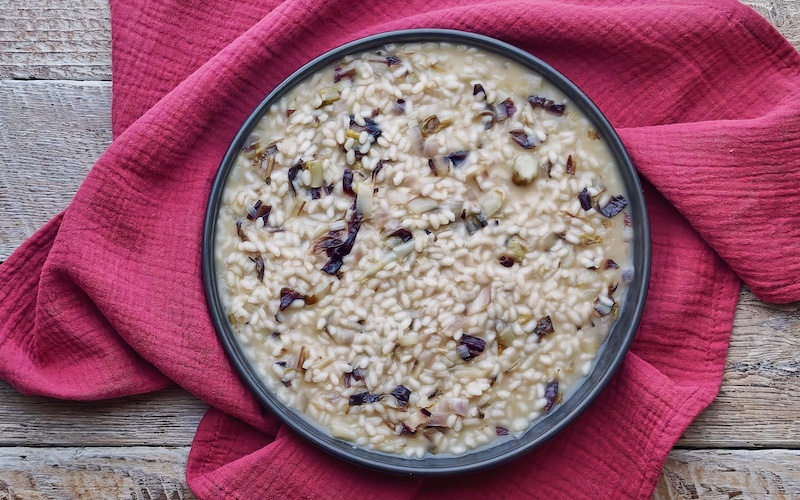
Risotto alla Trevigiana – also called risotto alla Trevisana or risotto con radicchio – is a classic Venetian risotto from Treviso, traditionally made with radicchio tardivo. The province of Treviso is famous for its radicchio, especially tardivo, which grows in tight elongated bunches with thick white ribs and only a little red leaf. Producing radicchio tardivo is a complicated two-step process (see FAQ below), so it can be hard to find outside Italy — but it’s worth seeking out from specialty greengrocers and farmers’ markets in winter, for its authenticity and mild bitterness. I have chef Col Barker from Megalong Lot 101 to thank for mine, so you may be able to pick some up at the Saturday markets at his Tea Rooms. If you can’t find it, a regular round Chioggia radicchio works well — include as much of the white rib as possible; the risotto will be pinker (see photo in the print-friendly version) and still taste delicious. I like the extra sweetness red onion adds to this radicchio risotto (especially when made with the more bitter varieties), though brown onion is traditional and either works well. Treviso being the home of Prosecco, that’s the wine often used in a risotto alla Trevigiana — and the rest of the bottle makes a delicious accompaniment. A crisp pinot grigio works beautifully too, like the one from New Era on the Limestone Coast of South Australia — its white floral notes and crisp granny smith apple and grapefruit lift the risotto and cut through its creaminess. Vialone nano rice is traditional for Venetian risottos, but carnaroli works if that’s what you have.

Serves 4 as a starter

Ingredients
  • 60g cold butter, diced (2oz)
  • Extra virgin olive oil, for drizzling
  • 1 red onion, finely chopped
  • Salt flakes and freshly ground white pepper, to taste
  • 1.2 litres Chicken Stock or Vegetable Stock, more or less (about 2½ pints)
  • 300g vialone nano rice (10½oz)
  • 80ml Prosecco or dry white wine (⅓ cup)
  • 200g radicchio, finely sliced (7oz)
  • 40g freshly grated Grana Padano (1½oz)
Method
  1. Place half the butter in a large high-sided frying pan with a drizzle of oil over low–medium heat until melted.
  2. Add onion and a good pinch of salt, cover and cook for 10–15 minutes, stirring occasionally, until onion is tender, not coloured.
  3. Meanwhile, bring stock to the boil. Cover and set aside.
  4. Add rice to the onion and increase heat to medium–high, stir for 2–3 minutes, until rice is hot to the touch but not coloured; it should start to smell toasty.
  5. Add Prosecco and shake the pan gently to mix it through the rice.
  6. As soon as it evaporates add enough stock to cover the rice well. Shake the pan to combine the ingredients and scrape down the sides if necessary.
  7. Reduce the heat and leave the rice to cook, without stirring, for 10 minutes, shaking the pan occasionally and adding more stock as necessary to keep the rice just covered. Adjust the heat, if necessary, so the liquid is gently bubbling.
  8. After 10 minutes, stir in radicchio and another ladle of stock.
  9. Increase heat slightly so it’s just bubbling and stir continuously, adding more stock as each ladleful is absorbed for about 7 minutes, until rice is almost al dente.
  10. Add another ladle of stock, remove from heat, beat in cheese and remaining butter.
  11. Taste and add salt and pepper.
  12. Cover and set aside for 2 minutes.
  13. Serve risotto alla Trevigiana into shallow bowls or lipped plates – it should lie flat on the plate.

Share page on:

How To Make Risotto

Radicchio Risotto FAQ

Is the radicchio risotto from Treviso called risotto alla Trevigiana or risotto alla Trevisana?

Treviso’s radicchio risotto can go by either name. Trevigiana refers to the province of Treviso, historically the Marca Trevigiana, the medieval march (fortified borderland) around Treviso. Trevisana (or Trevisano in the masculine) refers to something specifically from city of Treviso.

What is radicchio Trevigiano?

Radicchio Trevigiano – also called radicchio Rosso di Treviso – is the radicchio variety native to the Treviso area. Used on its own, the term ‘Trevisana’ typically means the tardivo radicchio from Treviso: a variety with tight elongated heads, thick white ribs and only a small amount of red leaf. It has a more delicate bitterness than other radicchio varieties and is the traditional choice for risotto alla Trevigiana.

How do you grow radicchio tardivo?

Producing radicchio tardivo is a two-step process. First the elongated Rosso di Treviso is grown as a normal plant outdoors. Then, after the leafy radicchio is harvested, the long tap root is replanted in the dark where it grows a second crop of crunchy white ribs with just a touch of bitter red leaves. This process – called ‘forcing’ or ‘blanching’ – is used on other vegetables, such as rhubarb. White asparagus is also ‘blanched’, though it’s generally just deprived of sunlight by mounding earth or mulch around the stems.


Is radicchio tardivo less bitter than other radicchios?

Yes, tardivo is less bitter than other radicchios. It still has some of the typical radicchio bitterness, but the forcing (or blanching) process of growing it in the dark changes its flavour profile significantly. The lingering bitterness of other radicchios is replaced with a more complex bitter-sweet flavour in tardivo.

What is risotto con radicchio?

Risotto con radicchio is the Italian name for any risotto made with radicchio. While risotto alla Trevigiana is the most celebrated version and considered the benchmark, risotto con radicchio can be made with any variety of radicchio.

What makes a Treviso risotto different from other radicchio risottos (risotti)?

A traditional Treviso risotto – risotto alla Trevigiana – uses radicchio tardivo di Treviso, which has a more delicate bitterness and is much crunchier due to its thick white ribs. Vialone nano rice and Prosecco – both regional products – are also traditional in a Treviso risotto, giving it a distinctly Venetian (and Trevisano) character that sets it apart from other risotti con radicchio.

Is radicchio a type of lettuce?

No. While radicchio and lettuce are both leafy head-forming vegetables often used in salads, radicchio is part of the chicory family which is known for its bitterness due to a compound called intybin.

What Other Travellers Say

Fiona (Blackheath, NSW, Aus.)
I thoroughly enjoyed Roberta’s trip to the Veneto and Venice. She creates wonderful bespoke small group tours with her incredible knowledge of food and wine and adds great accommodation and points of interest. It’s like travelling with your ‘besties’ – including one who’s done all the hard work researching and discovering the best and most interesting places to go, especially to eat and drink. Come with an appetite! Also factored in is time for you to do your own exploring and discover your own gems.
Belinda (Balmain, NSW, Aus.)
I’ve been on three of Roberta’s food and wine tours so far and each one has been an amazing well-organised experience. From historic Rome and Pompeii to the spectacular Amalfi Coast, remarkable Venice and the charming villages of Switzerland, each tour offers something special. Then there’s the food in fabulous places where you can truly eat like a local. I highly recommend Roberta’s tours to anyone who wants to discover inspired travel through great food, wine and company. I’m already looking forward to the next one!
Beverly (Woden, ACT, Aus.)
Had a fabulous time on Roberta’s back to back tours of Veneto and Southern Italy – good to revisit places I knew well like Venice, and discover new ones like Padua. Fantastic and varied food experiences, great cooking classes, met interesting wine makers, restaurateurs and other food artisans and drank some beautiful wines. Highly recommend both tours – and doing them together. I’ll definitely be doing another tour with Roberta.
Subscribe To My Newsletter & Get A Free Online Italian Cooking Class (RRP $39)