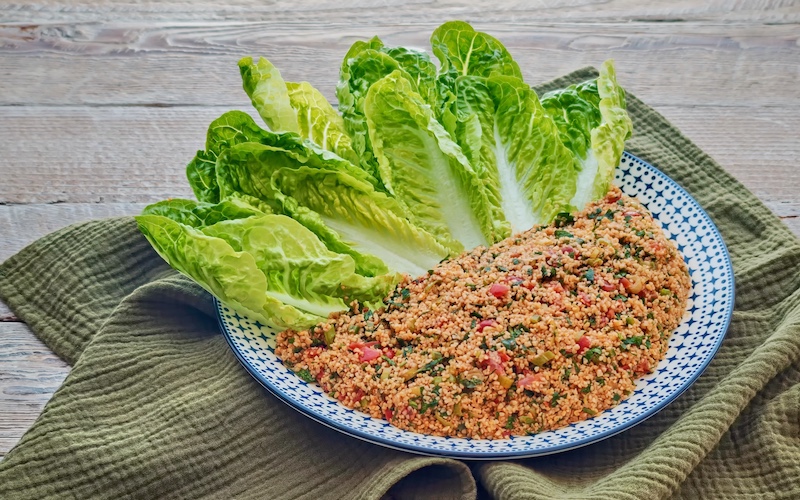
I’m a fan of traditional recipes but every now and then I prefer to do things my way. And I’ve always made tabouli with far more cracked wheat than any Lebanese cook ever would. Then I realised I wasn’t making tabouli – I was making the kisir I enjoyed so much in Türkiye. Kisir (kısır in Turkish, pronounced with the short “i” as ku-sur) originated in southeastern Türkiye. Often referred to as Turkish tabbouli, it’s now widely popular and seen on mezze menus across the country. The essential elements are the same as for tabbouli – burghul (cracked wheat), tomato, parsley, mint, lemon juice, olive oil – though in different ratios as, unlike tabbouli, the burghul is the star in kisir with the vegetables as support acts. Kısır is a distinctive rich red colour due to the tomato paste and biber salçası (red pepper paste) used to flavour it. I like spicy (acı) biber salçası in my kisir, but use the milder (tatlı) version if you prefer. Chef Somer Sivrioğlu – my go-to on all things Turkish – tells me kisir has many regional variations. He adds some pickled cucumber and the pickling juice to his – as his mother did – and I’ve seen recipes that include fresh cucumber, cooked onion and red pepper (capsicum), cumin or dried mint. Some cooks use either pomegranate molasses or lemon juice, but I like both. The ratio and amount of vegetables is down to personal taste too – I add quite a bit, but many versions I’ve had have far less. Kisir is often served with cos lettuce leaves to scoop it up, and sometimes moulded into little vegetable patties and served on the leaves. It keeps in the fridge for a week, so it’s worth making a big batch. Serve this ‘Turkish tabouli’ with any grilled meat, in wraps or on its own as a healthy snack. If you’re after a more traditional Lebanese-style tabouli recipe, see the video below.
Serves 4 as a side dish or 6 as a mezze
Share page on:
Bulgur, also called burghul, is cracked durum wheat that has been par-boiled then dried. It’s available from Middle Eastern grocers and some delis and supermarkets.
Both kisir and tabouli (tabbouleh) are made with bulgur (burghul), tomato, parsley, mint, lemon juice and olive oil — but in very different ratios. In tabouli, the herbs are the star with just a little bulgur; in kisir, the bulgur dominates and the vegetables play a supporting role. Kisir also has a distinctive rich red colour from tomato paste and biber salçası (Turkish red pepper paste), which tabouli doesn’t use.

Biber salçası is a Turkish red pepper paste made from dried red peppers. It’s widely used in Turkish cooking to add depth of colour and flavour. It’s available from Turkish and Middle Eastern grocery stores and comes in two versions: acı (hot/spicy) and tatlı (mild/sweet).
Pul biber – also known as Aleppo pepper or Turkish chilli flakes – is a mildly spicy, fruity dried chilli used throughout Turkish and Middle Eastern cooking. It has a distinctive dark red colour and oily texture. It’s available from Middle Eastern grocers and some specialty food stores, and is worth seeking out as it has a more complex flavour than regular chilli flakes.
Aleppo pepper is oily because when it’s prepared the chillies are sun-dried, coarsely crushed then rubbed with a little vegetable or olive oil as well as salt to help preserve the vibrant colour. Because of the oil, pul biber is best stored in the fridge to maintain freshness.