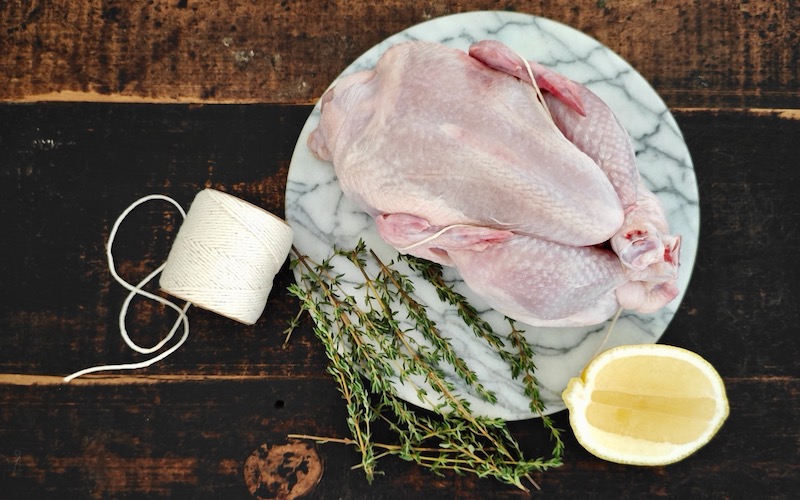
It’s easy to learn how to truss a chicken, or any poultry. Trussing just means tying the bird securely with twine so its wings and legs stay close to the body.

This makes the bird more compact so it cooks evenly and the wings and drumstick tips don’t burn.

Trussing also gives the cooked chicken a neater, more attractive appearance which is important for dishes such as chicken in half mourning.

Use a strong, unbleached cotton twine, called kitchen twine, butcher’s twine or cooking twine; it’s important to use pure cotton twine as synthetic twines may melt or burn.

You’ll need:

  • kitchen twine (butcher’s twine)
  • scissors

Here’s how to truss a chicken (or how to truss any poultry). Scroll down for a step-by-step video:

  1. For a full-sized chicken, cut about 130cm (51″) of kitchen twine.
  2. Place the bird on its back with the neck end closest to you.
  3. Place the twine underneath the bird’s back then bring the ends towards you between the body and wings (‘under the arms’) then around the outside of the wings and away from you to cross it under the tip of the breast, pulling tightly to secure the wings close to the body.
  4. Bring the twine around the outside of the tips of the drumsticks then cross it under them, pulling them together.
  5. Holding the twine tightly, flip the bird over onto its breast.
  6. Twist the twine around the tail and knot it.
  7. Cut off the excess twine.

Share page on:

How To Truss A Chicken

What Other Cooks Say

Melisa (Beacon Hill, NSW)
We made the pot-sticker dumplings and bang bang chicken from the Chinese class the other night. Once again both exceeded our expectations. My husband keeps saying it’s better than going out to restaurants as the recipes and quality are amazing.
Glennis (Caringbah South, NSW)
The whole Be Inspired experience has helped me love cooking again. I was sick of cooking the same old things - meal time is a lot brighter thanks to you Roberta.
Pam (Cammeray, NSW)
Pam (Cammeray, NSW)
Your recipes are something I always feel confident offering guests and also reasonable in the time to prepare. We often try your recommended wines and suppliers and enjoy your travel tales too!
Darcy, Austin TX (USA)
I find your weekly check-in to my kitchen an inspiration with chatty, warm, inspiring dishes to experience. Recently I was looking for a recipe for Persian spice blend advieh and yours was the first to catch my attention, even before I knew it was written by you. What a fun surprise to see your happy, calming face with a new friend sharing the benefits of Persian cooking.
Katrina (Arncliffe, NSW)
I am absolutely loving Be Inspired! There are ingredients I have never worked with before so having the confidence to try something new is so much fun! The recipes are just amazing and the notes on what can be prep’d beforehand are a great help too. Thank you so much.
Deb (Belconnen, ACT)
Awesome fun traveling through Emilia-Romagna experiencing first hand some of the produce I've worked with over the last couple of years cooking with Roberta's classes – the family are reaping the benefits now.
Judith (Woronora, NSW)
Food, wine and travel! Three of my favourite things! Be Inspired with Roberta has been a wonderful experience and given me more confidence in the kitchen. I have learnt so much, cooked things I never would have attempted without Roberta’s excellent videos, and used ingredients I have never tried before.
Sandra (Garran, ACT)
I'm a competent cook whose learned so much from Roberta's online cooking classes. The recipes are yummy and Roberta’s video guidance offers so many little tips to improve flavour and organise the flow of preparation. I enjoy her warmth, sense of humour, and ability to giggle at herself when she occasionally messes up.

FAQ

Do I need to truss a chicken before baking or roasting?

Trussing poultry isn’t essential, but it makes a real difference. A trussed chicken cooks more evenly because the legs and wings stay close to the body, preventing the thinner parts from overcooking before the breast is done. It also gives the finished bird a neater, more attractive appearance.


What twine (string) do I use to truss a chicken? What do I truss a chicken with?

Use strong, unbleached pure cotton twine — sold as kitchen twine, butcher’s twine or cooking twine. It’s important to use pure cotton as synthetic twines can melt or burn in the oven.

How much twine (string) do I need to truss a chicken?

For a full-sized chicken, cut about 130cm (51 inches) of kitchen twine. For smaller birds like poussin (spatchcock) or quail, you’ll need less.

Can I truss other poultry the same way as trussing a chicken?

Yes — the same trussing technique works for any poultry including duck, guinea fowl, spatchcock (poussin) and quail – even turkeys. Simply adjust the length of twine to suit the size of the bird.

Does trussing poultry affect cooking time?

Trussed poultry takes slightly longer to cook than an untrussed one because the legs and thighs are tucked close to the body rather than splayed out. To check, pierce the thickest part of the thigh with a skewer, the juices should run clear.

Subscribe To My Newsletter & Get A Free Online Italian Cooking Class (RRP $39)