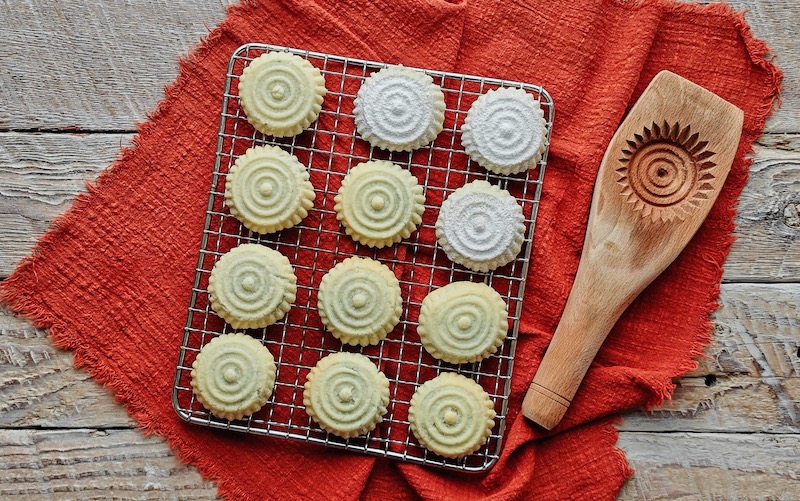
I love these Ramadan date cookies, also called qrass bil-tamr. They’re similar to shortbread with a date filling and are an essential part of Ramadan feasts in Lebanon. They’re also enjoyed by Middle Eastern Christians as part of Easter celebrations as well as by Jewish communities during their significant holidays including Purim. The dough can be filled with walnuts or dates and I love how easy they are to make. All that changes traditionally, apart from the filling, is the tabe (wooden mould) used to shape them so that guests know which flavour they’re selecting. Date ma’amoul is traditionally round and flat (see picture above), while walnut ma’amoul is round and domed (see video below). They’re fun to make with a traditional ma’amoul mould, available from Middle Eastern grocers and online from Harkola in Australia. If you don’t have a tabe, just roll them in the palms of your hand and decorate the top with the tines of a fork or tip of a paring knife if you like – they’ll still taste great. Ma’amoul keep in an airtight container in a cool place for at least a week. Use just orange blossom or just rosewater if you prefer.
Makes 16
Ma’amoul Dough
Share page on:
Ma’amoul are Middle Eastern shortbread-style cookies filled with dates, walnuts, or pistachios. They’re traditionally associated with the end of Ramadan, when they’re served to celebrate Eid al-Fitr. After a month of fasting, ma’amoul are offered to visiting guests as a sweet treat, usually alongside Arabic coffee. Ma’amoul are also enjoyed by Christians at Easter and during Purim by some Jewish communities.

Ma’amoul are most commonly filled with sweet date paste or finely chopped walnuts mixed with sugar and spices. In some regions, pistachios are also used. Date-filled ma’amoul are especially popular during Ramadan, while walnut and pistachio fillings are often served for special occasions and gifts.
No you don’t need a ma’amoul mould, called a tabe, to make ma’amoul. A traditional wooden tabe is fun to use, but not essential. Different shaped moulds are used to indicate the different fillings in ma’amoul. If you don’t have one, you can simply roll the dough in your palms and decorate the top with a fork or the tip of a paring knife. The flavour and texture will still be excellent.
The main difference is the filling and the traditional shape. Date ma’amoul are usually round and flat, while walnut ma’amoul are round and slightly domed. These shapes are created using different moulds (tabe) so guests can easily recognise which flavour they’re choosing. Apart from the filling and shape, the dough is the same.
Homemade ma’amoul will keep for at least one week when stored in an airtight container in a cool place. In dry, cool conditions, they may last even longer. For best flavour and texture, keep them away from heat and humidity.
No, you don’t need both. While many recipes use a combination of orange blossom water and rosewater, you can use just one if you prefer. Using only orange blossom water gives a lighter citrus-floral aroma, while rosewater creates a more pronounced floral aroma. Both options are traditional and authentic.