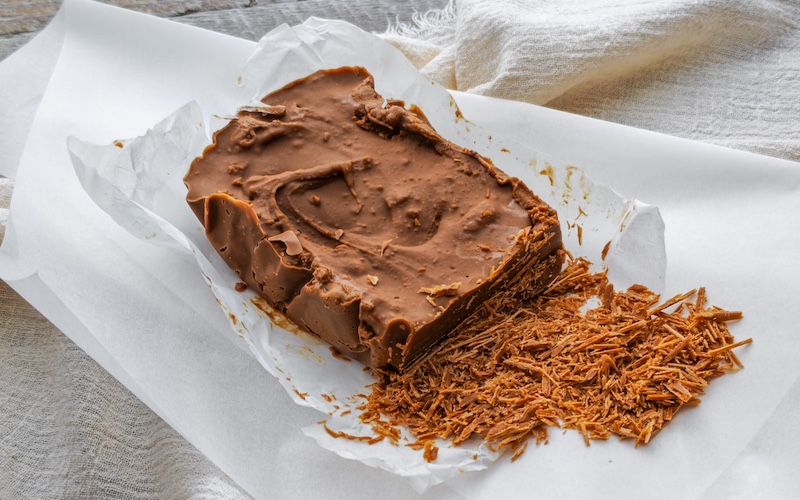
I find white chocolate a bit boring – but caramelised white chocolate, also called blonde chocolate, is a different story with its rich butterscotch notes. It’s surprisingly easy to make at home too. It can be anywhere from pale golden to a deep caramel colour – the deeper the colour the toastier and less cloying the flavour, so I make mine quite dark. Caramelised white chocolate can be used in any recipe calling for chocolate: as a coating or filling, in baking, in chocolate mousse or shaved over lemon tiramisu – even for hot chocolate (see video below). The most important thing when making caramelised white chocolate is to turn it regularly while it’s cooking, so it colours evenly. Two silicone spatulas are best for this, a larger one to turn the chocolate over and spread it back into a neat blob in the middle of the tray, and a smaller one to scrape the chocolate off the larger spatula. Remember that molten chocolate can be very hot, so don’t be tempted to touch it with your fingers. A solid silicone mat is ideal for caramelising white chocolate on, but baking paper works fine too – just oil the tray lightly so the baking paper sticks to it and ensure the paper is longer than the tray so you can easily hold the end while stirring. Caramelising white chocolate takes a bit of faith as it will look clumpy, chalky, or grainy – as if it’s seized – at some point. This is normal, so just trust the process and keep stirring every 10 minutes. You can only caramelise high-quality couverture chocolate (see FAQ below for details) – I use Valrhona Ivoire (with 35% cocoa butter).
Makes about 240g (8½oz)
Share page on:
In any chocolate, the percentage of cocoa solids (also called cocoa mass) is the combined pale cocoa butter (or fat) and dark non-fat cocoa solids (the brown powder). Since white chocolate has 0% brown powder, 100% of its cocoa solids come from cocoa butter.
Couverture chocolate is a high-grade chocolate containing a higher percentage of cocoa butter (typically at least 31%, often more) than standard eating chocolate. ‘Couverture’ comes from the French word meaning ‘to cover’ (couvrir) as its high cocoa butter content makes it more fluid when melted – perfect for covering items dipped into it or for coating moulds.
In compound white ‘chocolate’, the cocoa butter is replaced with cheap vegetable fats such as coconut or palm oil. As it has 0% cocoa solids, it isn’t chocolate at all and can’t be labelled as such – instead it’s usually sold as something like ‘white baking chips’ or ‘white candy melts’.

Technically, white chocolate doesn’t caramelise – it’s a misnomer. White chocolate changes colour when heated due to a Maillard reaction – the same reaction that gives the surface of seared meat its appetising brown colour and rich flavour. Caramelisation is what happens when sugar is exposed to heat. Maillard is a more complex reaction involving the heating of combined sugar and protein – in the case of white chocolate that’s the milk proteins it contains.