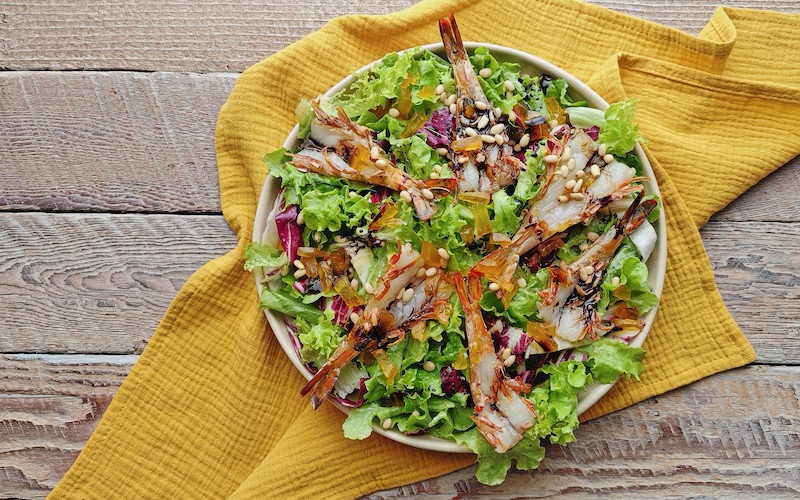
This is the pescatarian version of a simple, delicious chicken salad I had in Modena. It’s the mustard fruit, pine nuts and balsamic vinegar that make it special. Of course you could use a 12 year old or 25 year old Aceto Balsamico Tradizionale di Modena (DOP) if you have one handy; in that case there’s no need to reduce it, just drip some onto the salad. However, this recipe is also a good opportunity to use the younger (and less expensive) Balsamic Vinegar of Modena (IGP), as even a relatively humble vinegar tastes syrupy and delicious when reduced for a few minutes. Depending on the age of the vinegar you may not need to reduce it for long, or at all. So taste it first, then decide; it should be quite thick and taste sweet with a pleasantly sour undertone. Mustard fruits (mostarda in Italian) are a sweet-spicy northern Italian preserve, scroll down to the FAQ below to learn more about them. Aromatic Atma White, a blend of xinomavro and malagouzia, from Greek winemaker Thymiopoulos, is great match with the juicy prawns, sweet balsamic and spicy mustard fruit. See video below for more details on the best way to grill prawns. Prawns oxidise quickly once they’re caught or harvested so are best stored either frozen or refrigerated in a tub of cold water (details on storing prawns here).

Serves 2

Ingredients
  • 6 medium-sized green prawns (U12/15)
  • About ¼ cup Balsamic Vinegar of Modena IGP (60ml)
  • Salt flakes, to taste
  • 1 green oak leaf lettuce, rinsed and dried
  • 3 leaves radicchio, coarsely shredded (optional)
  • Extra virgin olive oil, for drizzling
  • 2 tablespoons chopped mostarda di frutta (about 40g/1½oz)
  • 1 tablespoon pine nuts, toasted
  • Crusty bread, for serving
Method
  1. Cut off and discard the prawn heads, place prawns on a chopping board on their backs and split down the underside almost all the way through without cutting through the shell. Remove the digestive tracts.
  2. Turn them over and press firmly along the shell to flatten them out. Set aside for about 30 minutes to come to room temperature.
  3. Meanwhile place vinegar in a small saucepan, bring to the boil, reduce heat to medium–high and boil for about 5 minutes, until reduced and slightly syrupy. If using a young vinegar it may need to be reduced by two-thirds, if it’s an older vinegar it may be less.
  4. Preheat a char-grill pan or heavy-based frying pan over medium–high heat.
    Arrange prawns in the pan, shell side down, in a single layer. Sprinkle with salt and cook for 3–5 minutes, depending on size, until flesh is just opaque.
  5. Meanwhile, tear oak leaf lettuce leaves into bite-sized pieces and place in a large mixing bowl with radicchio (if using).
  6. Add a good drizzle of oil and sprinkle of salt and toss to coat the leaves well.
  7. Arrange lettuce on a platter.
  8. Arrange prawns on top.
  9. Scatter with mostarda di frutta and pine nuts, drizzle with reduced balsamic vinegar then oil and a sprinkle of salt.
  10. Serve with crusty bread.

Share page on:

How To Grill Prawns

Mustard Fruits (Mostarda) FAQ

What is mustard fruit (mostarda)?

Mustard fruit is a preserve from northern Italy, especially Lombardy and Emilia-Romagna, made by poaching candied fruit in a syrup flavoured with spicy mustard oil.

What does mostarda (mustard fruits) taste like?

Italian mustard fruit is a little sweet (from the syrup) and has a good spicy kick from the mustard – a heat that’s sinus-clearing, like horseradish or wasabi, rather than the tongue burning heat of chilli or pepper.

What do you use mustard fruits (mostarda) for?

Mustard fruits are spicy from the mustard oil and a little goes a long way. In a dish mostarda is best chopped up into small pieces and mixed thoroughly with other ingredients. The syrup of mustard fruit can also be used to add flavour to salad dressings, marinades and sauces.

What does mostarda (mustard fruits) go with?

Mostarda is most typically served with boiled or roasted meats and is also often seen alongside cheese and salumi. The sweet/spicy flavour of mustard fruits has many applications and is particularly good with crustaceans, like an easy prawn salad with mustard fruits and balsamic vinegar.

What is the traditional way to eat mostarda (Italian mustard fruits)?

Italian mustard fruit (mostarda di frutta) is the traditional accompaniment to bollito misto (mixed boiled meats) however it’s also a great accompaniment to cheese and salumi and fabulous in this tasty prawn salad inspired by insalata di cappone, a chicken salad from Modena.

Is mustard fruit (mostarda) sweet or savoury?

Mostarda is both sweet and savoury all at once, a remnant of Medieval food traditions where sweet and savoury were often combined.

What fruits are used to make mostarda (mustard fruit)?

Stone fruits (cherry, peach, apricot, plum) and pomme fruits (apple, pear, quince) are most common in mustard fruits. Fig and citrus (clementine, citron, orange) also appear as does pumpkin.

Where does mustard fruit (mostarda di frutta) come from?

Mustard fruits are most common in Lombardy, especially the provinces of Cremona and Mantua. The Mantovana version is spicier and a single fruit, usually pear, apple or quince, while the Cremonese mostarda is often a colourful mixture of small whole fruits or large pieces of pears, cherries, apricots, figs, melon and more. In Emilia-Romagna, a pureed mostarda (like a spicy fruit paste) is traditional to Bologna and Modena, while in the provinces of Piacenza and Ferrara, close to the Lombardian border, whole pieces or slices of fruit are sometimes preserved in a mustard-flavoured syrup.


What Other Travellers Say

Janet (Tamworth, NSW, Aus.)
Just back from the most amazing trip to Emilia-Romagna with Roberta. Not only the home of Prosciutto di Parma, Parmigiano-Reggiano & Balsamic Vinegar, but scenery to die for and more quaint and exciting restaurants and cafés than you ever imagined. And Roberta is just the person to help you discover and enjoy them! Her knowledge of the history of the region and its wonderful cuisine know no bounds and all added to the excitement of the trip. It was faultless - well organized and lots of fun!
Deb (Belconnen, ACT, Aus.)
Wow, what a tour – I learned so much! Awesome fun traveling through Emilia-Romagna experiencing first hand some of the produce I've worked with over the last couple of years cooking with Roberta's recipe kits – the family are reaping the benefits now. If you're thinking of joining Roberta in future years get ready for an amazing experience.
Mark (Elizabeth Bay, NSW, Aus.)
My wife and I recently joined Roberta's Emilia-Romagna tour. We enjoyed all the temptations offered and learned a lot about that part of Italy, especially its food and wine culture. What was most impressive was Roberta's local knowledge of people and places. The planning and effort she put into making the whole experience seem effortless was remarkable.
Karen (Bowral, NSW, Aus.)
Our tour with Roberta through Emilia-Romagna was the highlight of the year. Good company, gorgeous palazzi and great food. What more could one ask for? Roberta's enthusiasm and knowledge made this a once in a lifetime experience through an extraordinary, diverse and very special region.
Shelley (Auckland, NZ)
Roberta’s passion for Italy shone throughout an unforgettable food and wine tour. She introduced us to family-owned artisanal producers, where we experienced everything from attic-aged balsamic to small-batch wines, Parma ham and Parmigiano-Reggiano. The local guides were equally passionate, and the excellent transport and accommodation made the trip effortless. This tour captured the region’s traditions, flavours and people, and thanks to Roberta’s deep knowledge we left with wonderful memories. A truly authentic culinary adventure — highly recommended.
Subscribe To My Newsletter & Get A Free Online Italian Cooking Class (RRP $39)