Milan – Italy’s second largest city – is such a convenient spot to fly in and out of, with that breathtaking view of the Alps from Malpensa Airport.
But while Milan’s an easy city to love if you’re into fashion, it takes a little more to uncover Milan’s best food and drink. So I’ve done the hard work for you with this Milan food lovers’ guide: where to eat, drink, stay and shop in Italy’s most fashion-conscious city, from Milan’s best restaurant to the perfect bars for aperitivo and a great place to stay close to the city centre. Value is relative, so while this might not quite be a guide to ‘cheap eats’ in Milan, follow my tips and you won’t spend a fortune to enjoy Milan’s best food, drinks, culture and art! First, keep ‘your Milan’ small, walking distance from Piazza Duomo and Italy’s largest church, the striking Gothic Santa Maria Nascente. Secondly, to enjoy a city as expensive as Milan on the cheap, and still eat and drink well, take advantage of aperitivo. This most Milanese of traditions is the perfect way to sit, drink, snack and soak up the atmosphere of beautiful locations without spending a lot of money. At bars serving apericena – where aperitivo merges into cena (dinner) – it can even replace your evening meal.
Where to Stay in Milan Hotel Gran Duca di York
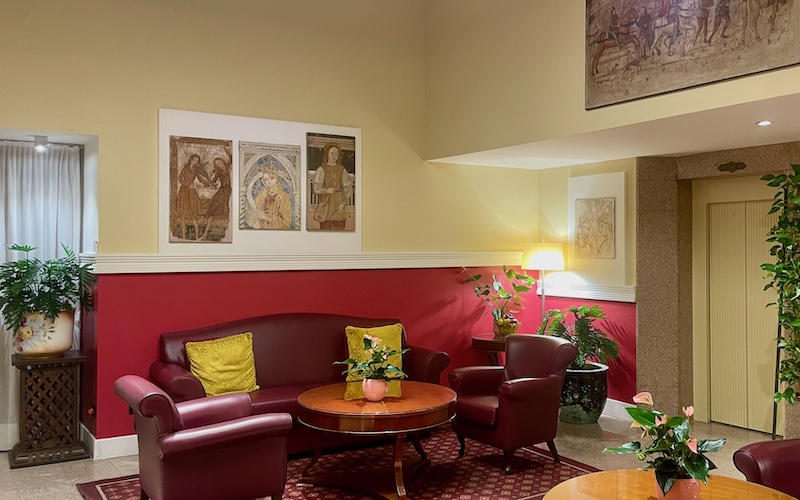
Start with well-positioned accommodation, walking distance to everywhere. This comfortable hotel, just 600m from Piazza Duomo, has a lovely homey feel with light-filled rooms, friendly staff, and little touches like a free non-alcoholic mini-bar, large block of choccy on the pillow and a free welcome drink in the cosy bar. It’s one of my favourite palazzo hotels in Italy. Nab the street facing room with a small leafy balcony if you can.
Where to Eat in Milan Ristorante Ratanà
A 30-minute stroll from the centro storico, set in beautiful parkland, is this historic house serving some of the most delicious, inspired food I’ve ever eaten. Sit in the garden or perch at the bar – and take advantage of the €24 business lunch with main course, glass of wine, water, and coffee, or deep dive into the great-value 5-course menu. Best house-made grissini ever and superb risotto Milanese. More details & photos here.
Classic Aperitivo in Milan Camparino in Galleria
Gaspare Campari started serving his bitter aperitif in the beautiful neoclassical Galleria Vittorio Emanuele II in 1867 – and the tradition of aperitivi (pre-dinner drinks with nibbles) took off. Other places may offer a more elaborate array of snacks, but they don’t sit within this grandeur. So do some serious Dior, Prada, Fendi, & Co. window shopping then hit Camparino for a little affordable luxury.
Aperitivo & Art in Milan Pinacoteca di Brera & Caffè Fernanda
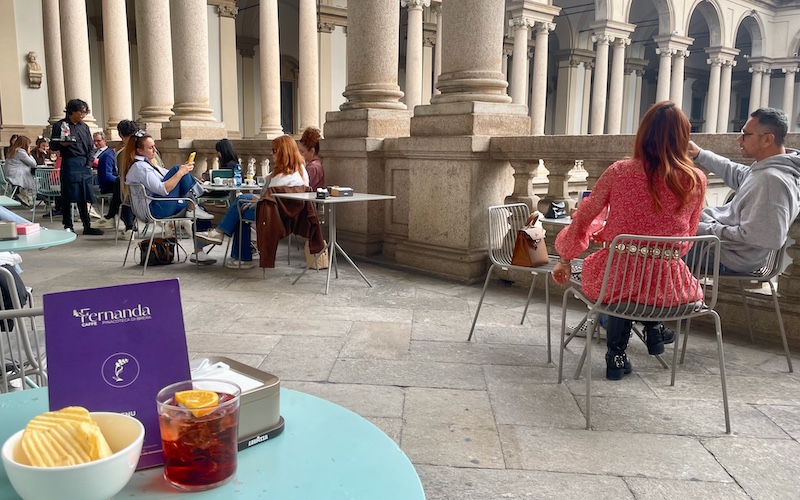
You could spend half a day exploring one of the world’s foremost collections of Italian paintings in Milan’s main art gallery, the Pinacoteca di Brera in the Baroque Palazzo Brera (free entry first Sunday of the month). It’s also home to another of the best places in Milan for aperitivo, or coffee, and people watching: Caffè Fernanda in the loggia of the upper floor overlooking the courtyard – I could spend half a day here.
Aperitivo & History in Milan Colonne di San Lorenzo & Porta Ticinese
The remains of the Porta Ticinese, part of Milan’s medieval city walls, sit beside the Colonne di San Lorenzo, a towering row of sixteen 7m (23′) high marble columns believed to be part of a 2nd-century Roman pagan temple. Spotlit at night, it’s a lively place to enjoy a casual drink and snack at one of the open air bars, or grab a panino and sit in Piazza di San Lorenzo.
Designer Vintage Shopping in Milan Via Brera
If you fancy a little affordable fashion shopping in Milan, skip the big name shops of the Quadrilatero d’Oro and stroll the narrow streets around bohemian Via Brera (on your way to Ratanà or Caffè Fernanda perhaps). Amid the art galleries and shops selling feather quills for calligraphy is Cavalli e Nastri, full of pre-loved, high-end fashion from Valentino handbags and Missoni dresses to second-hand Louboutins.
Free Alternative to the Last Supper in Milan Santa Maria presso San Satiro
If you don’t book tickets quickly enough for da Vinci’s Last Supper, you can end up paying a lot for a guided tour. Or you can get your Milan culture fix by popping in to see Bramante’s trompe l’oeil behind the altar of this small church set back from the road between the chain shops on Via Torino (without crowds, appointment or charge). Clever use of fresco and stucco creates the illusion of a deep apse (choir) in a space of less than one metre.
See Milan’s Duomo for Free Duomo di Milano
To enjoy Piazza Duomo and il Duomo di Milano for free, go at sunrise and wander around the outside of the Duomo – looking up at the endless variety of architectural details and sculptures hidden in its many nooks and crannies. The stonework is amazing. Then treat yourself to an early morning stroll through Galleria Vittorio Emanuele II before the shops open and crowds descend.
Updated 24 Feb 2026
Yes. In Milan – and across Italy – many bars charge more for the same drink served at a table than standing at the bar, so locals drink ‘al banco’ (at the counter).
It’s a Milanese habit with history: the city’s first bar di passo (‘passing bar’) opened in the Galleria Vittorio Emanuele II in 1915, when Gaspare Campari’s son, Davide, opened Camparino – serving Campari and soda to Milanese pausing for a quick refreshment between shops and offices.
A quick coffee or aperitivo standing at the counter is still the most Milanese way to drink – and an insider tip for spending less too.
Aperitivo is the Italian pre-dinner ritual that Milan made famous: an early-evening drink such as a spritz, Campari soda or Negroni, served with complimentary snacks to whet the appetite.
Apericena is a compound of aperitivo and cena (the Italian word for dinner). Similar to feasting on tapas in Spain or mezze in the Middle East, it’s where the snacks accompanying aperitivo are sufficient to be a light dinner.
Especially if you’ve had a substantial lunch, apericena is a great cheap dinner alternative – and both aperitivo and apericena are great ways to enjoy Milan’s most beautiful bars without spending a fortune.
Risotto alla milanese is Milan’s signature dish – creamy carnaroli rice cooked in beef stock with butter, onion, Parmigiano-Reggiano and saffron, which gives it its golden colour. It’s traditionally enriched with a slice of bone marrow on top or served alongside ossobuco where the marrow mingles with it.
Legend says risotto alla milanese was created in 1574, when glassmakers working on the Duomo’s stained-glass windows used saffron to colour their glass – and one apprentice slipped it into the rice at his master’s daughter’s wedding feast.
An apse is the vaulted space at the end of a church, behind the altar – also called the choir, as it’s where the clergy traditionally sang.
When Donato Bramante rebuilt the church of Santa Maria presso San Satiro in the late 15th century, a street behind it left him just 97cm (3′2″) for the apse. So he created one of the earliest trompe l’oeil illusions: painted and moulded perspective that makes the shallow space look about 9.7m (32′) deep. Walk towards the altar and the illusion gradually reveals itself.
It took almost 600 years to build Milan’s cathedral, Santa Maria Nascente.
Work began in 1386 using pink-veined white marble from Candoglia, near Lago Maggiore, and the same quarry still supplies stone for its upkeep.
The golden Madonnina statue was raised to the top of the main spire in 1774, and Napoleon pushed the façade towards completion ahead of his coronation as King of Italy there in 1805 – it was finished in 1813.
The last of the Duomo’s bronze doors was only installed in 1965, completing a cathedral with more than 3,400 statues and 135 spires.