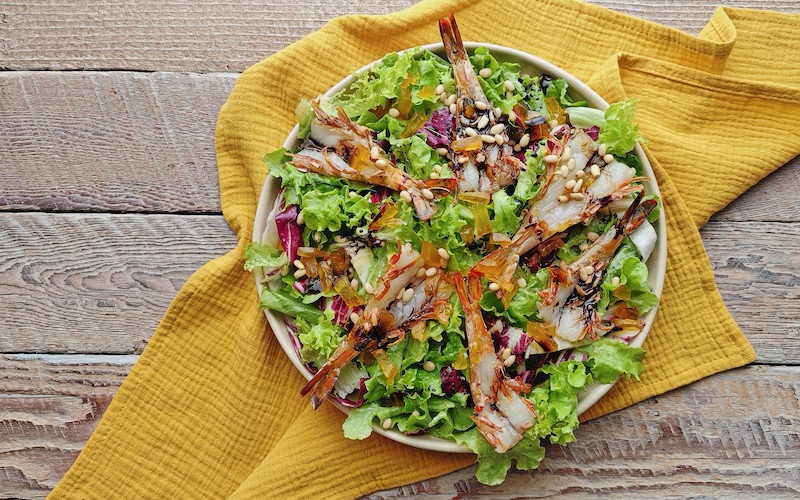
This is the pescatarian version of a simple, delicious chicken salad I had in Modena. It’s the mustard fruit, pine nuts and balsamic vinegar that make it special. Of course you could use a 12 year old or 25 year old Aceto Balsamico Tradizionale di Modena (DOP) if you have one handy; in that case there’s no need to reduce it, just drip some onto the salad. However, this recipe is also a good opportunity to use the younger (and less expensive) Balsamic Vinegar of Modena (IGP), as even a relatively humble vinegar tastes syrupy and delicious when reduced for a few minutes. Depending on the age of the vinegar you may not need to reduce it for long, or at all. So taste it first, then decide; it should be quite thick and taste sweet with a pleasantly sour undertone. Mustard fruits (mostarda in Italian) are a sweet-spicy northern Italian preserve, scroll down to the FAQ below to learn more about them. Aromatic Atma White, a blend of xinomavro and malagouzia, from Greek winemaker Thymiopoulos, is great match with the juicy prawns, sweet balsamic and spicy mustard fruit. See video below for more details on the best way to grill prawns. Prawns oxidise quickly once they’re caught or harvested so are best stored either frozen or refrigerated in a tub of cold water (details on storing prawns here).
Serves 2
Share page on:
Mustard fruit is a preserve from northern Italy, especially Lombardy and Emilia-Romagna, made by poaching candied fruit in a syrup flavoured with spicy mustard oil.
Italian mustard fruit is a little sweet (from the syrup) and has a good spicy kick from the mustard, a heat that’s sinus-clearing like horseradish or wasabi than the tongue burning heat of chilli or pepper.
Mustard fruits are spicy from the mustard oil and a little goes a long way. In a dish mostarda is best chopped up into small pieces and mixed thoroughly with other ingredients. The syrup of mustard fruit can also be used to add flavour to salad dressings, marinades and sauces.
Mostarda is most typically served with boiled or roasted meats and is also often seen alongside cheese and salumi. The sweet/spicy flavour of mustard fruits has many applications and is particularly good with crustaceans, like an easy prawn salad with mustard fruits and balsamic vinegar.
Italian mustard fruit (mostarda di frutta) is the traditional accompaniment to bollito misto (mixed boiled meats) however it’s also a great accompaniment to cheese and salumi and fabulous in this tasty prawn salad inspired by insalata di cappone, a chicken salad from Modena.
Mostarda is both sweet and savoury all at once, a remnant of Medieval food traditions where sweet and savoury were often combined.
Stone fruits (cherry, peach, apricot, plum) and pomme fruits (apple, pear, quince) are most common in mustard fruits. Fig and citrus (clementine, citron, orange) also appear as does pumpkin.
Mustard fruits are most common in Lombardy, especially the provinces of Cremona and Mantua. The Mantovana version is spicier and a single fruit, usually pear, apple or quince, while the Cremonese mostarda is often a colourful mixture of small whole fruits or large pieces of pears, cherries, apricots, figs, melon and more. In Emilia-Romagna, a pureed mostarda (like a spicy fruit paste) is traditional to Bologna and Modena, while in the provinces of Piacenza and Ferrara, close to the Lombardian border, whole pieces or slices of fruit are sometimes preserved in a mustard-flavoured syrup.